


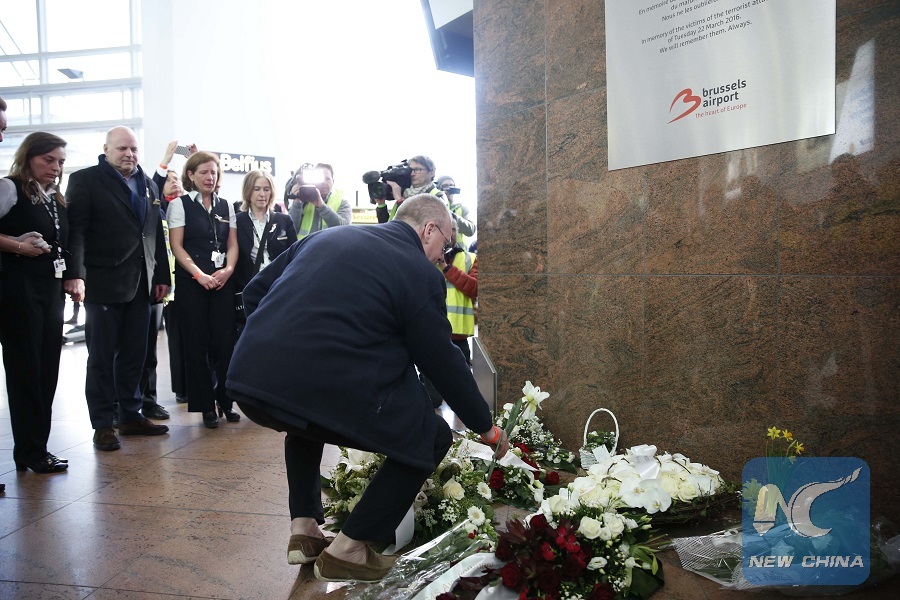
A man places a flower under a memorial plaque inside the departure terminal during a commemorative event on the first anniversary of the Brussels terrorist attacks at Brussels Airport in Brussels, Belgium, March 22, 2017. (Xinhua/Ye Pingfan)
BRUSSELS, March 22 (Xinhua) -- One year after the two deadly terror attacks killed 32 people and injured 320 others, fear and withdrawal still gripped the Belgian capital.
Brussels hosted several commemoration ceremonies on Wednesday, for the first anniversary of the terror attacks. The bombings had tremendously impacted Belgium's political and social agenda, placing security as the top priority.
On March 22 of 2016, two separate terror attacks hit Brussels airport and the city's metro system.
DISCONTENT
The last terror victim who was hospitalized after the bombings finally went home on Feb. 15, 2017. A total of 224 people had to be brought to hospital after the attacks at the airport and Maelbeek metro station.
Some of the victims are still under medical treatment in health centers. Some victims are asking to the Belgian government to consider giving them a national recognition of their status as terror victims. Others are demanding a refund for their health expenses and a compensation on a long-term period.
"Families of the victims did not receive any help from the government," complained Anna, whose mother Janina Grazyna Panasewcz died at the age of 61 in Maelbeek metro station.
Panasewicz left Poland in 1998 and move to Belgium in order to provide her children with good education.
Eddy, whose wife died at the airport one year ago, set up an association, V-Europe, for gathering the victims of the bombing attacks.
About 100 wounded and relatives of the victims are members of this association. They offered assistance on insurances procedure and contacting Belgian authorities and administrations.
SECURITY
Belgium's political and social agenda was tremendously impacted since the bombing attacks. Security has become a top priority for the government, and migration came back to the front of the political debate as well.
Belgium adopted a series of measures to improve its security since the attacks. Anyone convicted of terrorist offence can have their nationality withdrawn. Police raids are allowed 24 hours per day for terrorism files.
Border controls have been re-established and over 1,000 military still patrol in the streets of major Belgian cities.
The Belgian parliament had created a database (Passenger Name Record) that contains the itinerary for a passenger in the airlines and travel industries.
In the past two years, the Belgian government had allocated 630 million euros (680 million U.S. dollars) in fighting terrorism.
Belgium is safer than one year ago, said Interior minister Jan Jambon. "Many legal and material resources have been mobilized in the fight against terrorism," he said.
"But our opponent is not stayed still in the meantime. If ISIS remains, we cannot say that this cancer has been eradicated," he warned.
Jambon also admitted that Brussels' Molenbeek district -- regarded as the European capital city of extremism -- "is not entirely under control".
SELF-WITHDRAWAL
For ordinary people, seeing military on the streets or being searched at the entrance of a concert or a shopping mall has become integrated in daily life in Belgian cities.
According to a recent survey, one out of two Belgians thinks that people have to get used to living with a terror threat because no solution has yet been found to eradicate this threat completely.
For Michael Dantine, doctor in criminology at Liege University who spoke to the local newspaper Le Soir, the bombings revealed the many negative aspects already existing in Belgium's society.
In the past, such events would have led to a movement of unity and fraternity, but it doesn't apply to today's situation.
"Instead of becoming the cement of a fragmented society, these events are like water sneaking into a crack rock, enlarging the loopholes," Dantine told the newspaper.
"It is our responsibility, each and every one of us, to make our society more humane and fairer. Let us learn to listen to each other, to respect each other and to correct our weaknesses," Belgian King Philippe said in a speech at a commemorative ceremony.
"And above all, let us dare tenderness. On this day of gathering and remembrance, our country owes you this commitment," the King said.
