S. Africa bans live chicken sale amid bird flue outbreak
                 Source: Xinhua | 2017-06-30 15:52:50 | Editor: huaxia

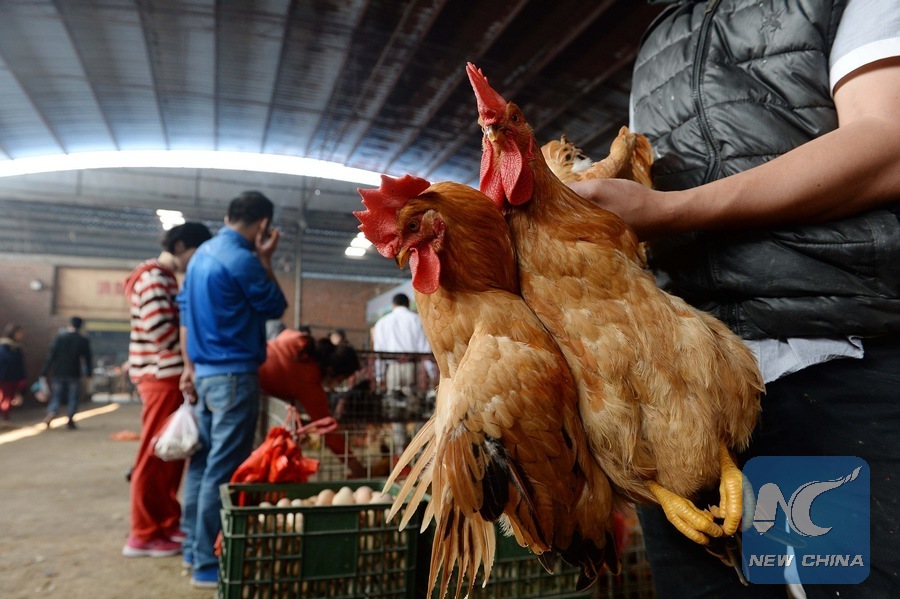
A merchant picks live chickens for consumers at a market in Shanghai, east China, May 1, 2014. Shanghai resumed the live poultry trade starting from Thursday. (Xinhua/Lai Xinlin)

CAPE TOWN, June 30 (Xinhua) -- South African authorities said they have banned the sale of live chickens due to an outbreak of H5N8 bird flu, the first of its kind in the country.

The measure is imposed to contain the further spread of the pandemic and is in the interest of the country and the poultry producers at large, Minister of Agriculture, Forestry and Fisheries Senzeni Zokwana said.

The ban, announced on Thursday, will be in place for as long as it takes to declare the country free from the disease, the minister said.

The outbreak has triggered a nationwide concern after a number of livelihoods had been affected. South Africa had never reported an outbreak of bird flu before.

Highly pathogenic avian influenza H5N8 was first reported on a farm in Mpumalanga Province in northern South Africa last week.

So far two farms, both in Mpumalanga, have been affected.

The affected farms have been placed under quarantine and approximately 260,000 birds were culled, according to the minister.

There have been several calls to permit vaccination against the disease.

But Zokwana said he has been advised by his team of experts that this will not be in the best interest of both the country and the producers.

"Vaccination of birds will create an endemic situation, affect surveillance efforts and affect our export certification because all our trade partners only want products from a country that is free of avian influenza where vaccination is not practised," he explained.

The minister reaffirmed that the type of virus does not affect people, as has been confirmed by the World Health Organization and the World Organization for Animal Health.

"The meat that is on the shelves is safe to eat as it has gone through a process of meat inspection and certified fit for human consumption," he assured.

To date, no human cases of infection with avian influenza H5N8 have been reported, however people handling wild birds, sick or dying poultry have been advised to wear protective clothing and wash their hands with disinfectants.

Back to Top Close
Xinhuanet

S. Africa bans live chicken sale amid bird flue outbreak

Source: Xinhua 2017-06-30 15:52:50

A merchant picks live chickens for consumers at a market in Shanghai, east China, May 1, 2014. Shanghai resumed the live poultry trade starting from Thursday. (Xinhua/Lai Xinlin)

CAPE TOWN, June 30 (Xinhua) -- South African authorities said they have banned the sale of live chickens due to an outbreak of H5N8 bird flu, the first of its kind in the country.

The measure is imposed to contain the further spread of the pandemic and is in the interest of the country and the poultry producers at large, Minister of Agriculture, Forestry and Fisheries Senzeni Zokwana said.

The ban, announced on Thursday, will be in place for as long as it takes to declare the country free from the disease, the minister said.

The outbreak has triggered a nationwide concern after a number of livelihoods had been affected. South Africa had never reported an outbreak of bird flu before.

Highly pathogenic avian influenza H5N8 was first reported on a farm in Mpumalanga Province in northern South Africa last week.

So far two farms, both in Mpumalanga, have been affected.

The affected farms have been placed under quarantine and approximately 260,000 birds were culled, according to the minister.

There have been several calls to permit vaccination against the disease.

But Zokwana said he has been advised by his team of experts that this will not be in the best interest of both the country and the producers.

"Vaccination of birds will create an endemic situation, affect surveillance efforts and affect our export certification because all our trade partners only want products from a country that is free of avian influenza where vaccination is not practised," he explained.

The minister reaffirmed that the type of virus does not affect people, as has been confirmed by the World Health Organization and the World Organization for Animal Health.

"The meat that is on the shelves is safe to eat as it has gone through a process of meat inspection and certified fit for human consumption," he assured.

To date, no human cases of infection with avian influenza H5N8 have been reported, however people handling wild birds, sick or dying poultry have been advised to wear protective clothing and wash their hands with disinfectants.

010020070750000000000000011100001364071321