


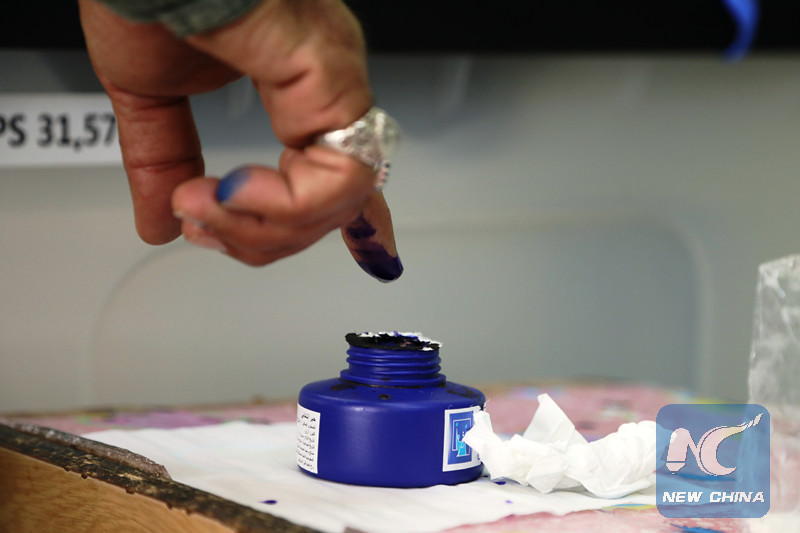
On May 10, Iraqi security personnel cast their votes across the country ahead of parliamentary election amid tight security. (Xinhua/Khalil Dawood)
BAGHDAD, May 10 (Xinhua) -- Millions of Iraqis will head to polling centers across Iraq on May 12 for the first time since the defeat of Islamic State (IS) group, giving Iraqis a new hope for more inclusive government that would counter wide spread corruption.
The coalitions formed to compete in the elections are showing fragmentation in sectarian and ethnic lines in response to voters who blame the Shiite-led government for failing to repair the crumbling infrastructure, reduce unemployment and end violence.
Najib al-Jubouri, a political expert and lecturer at Baghdad University, sees that the political landscape for the majority Shiite community shows five separate Shiite coalitions are competing for Saturday's elections:
Current Prime Minister Haider al-Abadi and his predecessor Nuri al-Maliki heads separate lists within the ruling Islamic Dawa Party due to internal disputes between the two wings of Abadi and Maliki, Jubouri told Xinhua.
Abadi is seeking a wider voter base as his list is campaigning in each of Iraq's 18 provinces, including in the Sunni heartland of Nineveh and Anbar provinces, in addition to the three Kurdish provinces.
In theory, Abadi is in a strong position to win a second term, as he is credited with victory over the IS group, in addition to pushing the Kurdish Peshmerga forces from the disputed area, including the oil-rich province of Kirkuk.
He is also credited with balancing Iraq's relations with Iran and the United States, while he made great successes in his relations with Iraq's neighbors in the Gulf, especially with Saudi Arabia.
"However, Abadi has failed so far to convince Iraqis about his economic reform plan and his fight against corruption," Jubouri said.
Meanwhile, former prime minister Nuri al-Maliki, leader of State of Law Coalition, is still seen by his considerable base of supporters as a strong leader who defended the Shiite interests, despite that many blame him for losing swathes of territories to IS group, including Mosul.
Still, Maliki is rejected by many local, regional and internationally parties, especially after Iraq lost about one-third of its land to IS and more than four million people were displaced during his eight-year rule.
The third Shiite coalition is the al-Fath Coalition (Conquest) headed by Hadi al-Ameri, who is the head of Badr Organization, which maintains its longtime ties with strong support from the neighboring Shiite country.
Ameri's Fath Coalition is expected to reap high percentage of votes in the Shiite provinces and is expected to make a breakthrough in the Sunni provinces because he has military presence and gained support from some tribal leaders in some Sunni provinces for helping defeat IS group in December 2017. But he is also blamed for including extremist Iranian-backed Shiite militias within the Hashd Shaabi brigades.
There is also al-Sa'iroon Coalition, which includes loyalists to Shiite cleric Moqtada al-Sadr, in addition to the Iraqi Communist Party and other parties of civil rights.
"Many Iraqis believe that this coalition will gain significant number of seats due to its cross-sectarian formation, as the group includes religious Sadrists, communists, liberal and others activists who are known of their struggle for countering corruption and improving governance," Jubouri said.
A fifth Shiite coalition is the al-Hikma al-Watany Movement, (National Movement of Wisdom) headed by Shiite cleric Ammar al-Hakim. Hikma Coalition cannot win the race with the other four major coalitions, but it can be instrumental in the post elections stage when the winning coalitions will regroup to form the largest alliance that would form the next government.
Meanwhile, the Sunni Arab polls runners are at their lowest point, as almost 2.2 million remain displaced, while millions others jobless and living in half-ruined cities.
Analysts believes that the devastative Sunni conditions would prevent large part of them from participating in the polls.
The Sunni traditional coalitions are also suffering fragmentation as some leading figures joined powerful Shiite coalitions like the sacked defense minister Khalid al-Obeidi, who joined Abadi's al-Nasr Coalition in Nineveh province, Jubouri said.
They entered the polls in several coalitions, including the two major coalitions of al-Qarar, led by the former parliament Speaker Osama al-Nujaifi, and al-Wataniyah, or National Coalition led by the Shiite secular Ayad Allawi, a veteran politician and former prime minister.
The Kurds in northern Iraq are also facing tough hurdles after the controversial referendum, held on Sept. 25 last year, as they are facing division in their parties.
Losing a few parliamentary seats is inevitable for the Kurds after they lost control over the disputed areas outside the Kurdish region, including Kirkuk province, Jubouri said.
The two major Kurdish parties, Kurdistan Democratic Party and the Patriotic Union of Kurdistan, are intending to run in the competition in two separate lists for the first time after the consequences of the referendum, while the oppositions parties like Gorran and other two smaller parties are joining in one coalition to compete for the parliament seats.
Ibrhim al-Ameri, a political analyst and teacher of politics at Baghdad University, told Xinhua that fragmentation of Iraqi political landscape would mean that there is potential for cross-sectarian coalitions.
"Such (cross-sectarian) coalitions could present genuine political and economic reforms to counter corruption and improves governance that would bring more stable security situation," Ibrahim al-Ameri said.
However, Ameri sees that fragmentation and repositioning in the political landscape could also open up opportunities for sectarian and ethnic hard-liners, who will be empowered by the political polarization.
"The rise of hardliners could complicate and delay the formation of next government, deteriorate security situation and let Iran to intervene further in Iraq's politics," Ameri concluded.
After the defeat of IS group, it is essential for the government to give confidence to the citizens that it is acting in the interest of the society, Ameri argued.
Since the overthrow of Saddam Hussein in 2003, successive governments have been unable to persuade the Iraqi people that national interests are being safeguarded by those in power, he added.
"The failure in forging trust in state authority would not help preserving the unity of the country, there is a need for less-sectarian, more inclusive and accountable government," Ameri said.
Ameri believes that the post elections stage would be more important than before the polls, as regrouping into larger alliances to form the largest alliance that would designate the next prime minister who will form the Iraqi government for the next four years.
