







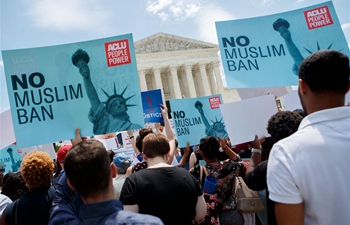






WASHINGTON, June 26 (Xinhua) -- U.S. President Donald Trump has hailed a Supreme Court ruling that upholds his controversial executive order banning nationals from seven countries - five of them Muslim-majority - from entering the United States.
The U.S. Supreme Court on Tuesday ruled Trump's travel ban on several Muslim-majority countries is lawful.
In a quick response, Trump called the ruling "a tremendous victory" and "moment of profound vindication" in a White House statement.
In a 5-4 opinion, the court found that Trump's executive order on the immigration restriction fell "squarely within the scope of Presidential authority under the INA (the Immigration and Nationality Act)."
"The order is expressly premised on legitimate purposes: preventing entry of nationals who cannot be adequately vetted and inducing other nations to improve their practices," Chief Justice John Roberts wrote in the majority opinion.
"The text says nothing about religion." Roberts wrote, rejecting claims that the ban was motivated by religious hostility.
"Supreme Court upholds Trump travel ban. Wow!" the president tweeted.
The case has been central to the White House immigration policy, presenting a key test of Trump's campaign promise to restrict immigration and secure U.S. borders.
Trump has signed three versions of executive orders on immigration restrictions targeting several Muslim-majority countries. The initial order, signed soon after he took office in January last year, led to days of nationwide protests and chaos at airports across the country.
The third version of Trump's travel ban barred nearly all travelers from five mainly Muslim countries, namely Iran, Libya, Somalia, Syria and Yemen. It also adds a ban on travelers from the Democratic People's Republic of Korea (DPRK) and government officials from Venezuela. The lower courts had ruled that all three versions either violate federal law or are unconstitutional.
However, hundreds of demonstrators gathered Tuesday evening outside the federal courthouse in downtown Minneapolis to oppose the U.S. Supreme Court decision, with signs reading "No Muslim ban ever" and "Demand an end to anti-Muslim bigotry."
In addition, Colleen Hanabusa, member of the U.S. House of representative from Hawaii, called the ruling "unfortunate," adding, "We cannot allow this president to discriminate against any group or apply divisive tactics and racism to the formation of public policy."
"We must never forget what can happen when hate and racism inspire government action," She added.
Hawaii's attorney general Russell Suzuki said he is "profoundly disappointed" in the ruling and continues to believe Trump's travel ban is unconstitutional.
"We must remain vigilant and continue to challenge the president's unprecedented, unjust actions, and protect Hawaii residents from his discriminatory policies."
Democratic National Committee Chair Tom Perez also expressed concern about it in a press release and said the decision was wrong and dangerous. "This ban does more than just violate our values, it also makes us less safe," Perez said.
