Feature: Pakistanis start planting trees "today" to save "tomorrow"
                 Source: Xinhua | 2018-09-07 10:08:54 | Editor: huaxia

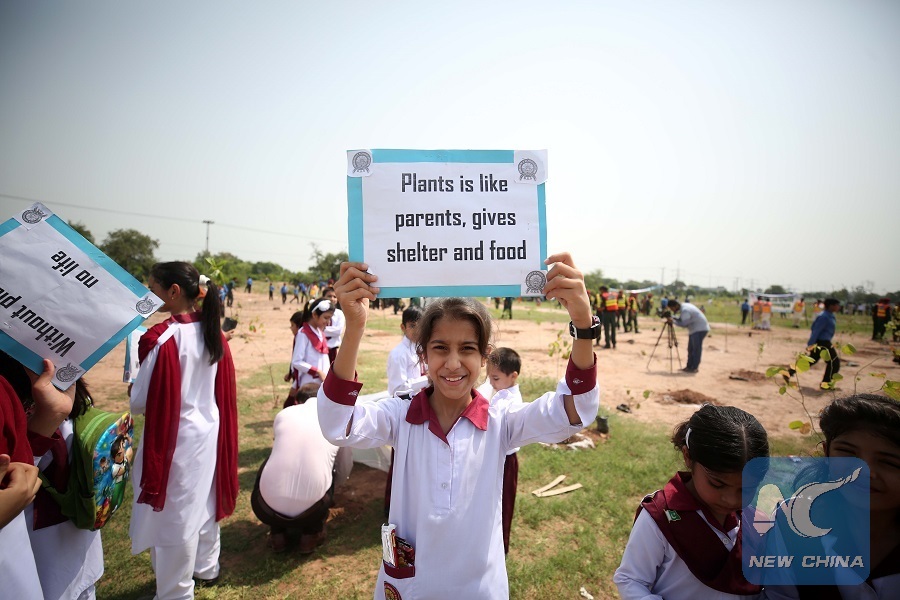
A student holds a placard during a plantation campaign "Plant for Pakistan" in Rawalpindi, Pakistan on Sept. 2, 2018. (Xinhua/Ahmad Kamal)

by Misbah Saba Malik

ISLAMABAD, Sept. 6 (Xinhua) -- Absar Kazmi, an electrical engineer in Islamabad, brought his three kids to plant trees at a section of the famous Parade Ground in the city, invited by the government for planting saplings under the "Plant for Pakistan" campaign aiming at protecting the country from pollution and climate change.

Kazmi said he brought his kids to plant trees to let them know the importance of saving the earth from the adverse effects of climatic changes. "I want them to know that we plant a tree today it will save their tomorrow," Kazmi told Xinhua.

Pakistani Prime Minister Imran Khan has kicked off the drive "Ten Billion Trees Tsunami" recently by planting a sapling in the country's northwest Khyber Pakhtunkhwa province himself.

The campaign is of an effort to combat climate change by planting trees across the country during five-year tenure of the current government.

The prime minister's advisor on climate change Malik Amin Aslam told local media that trees were planted and distributed freely across the country with an objective to motivate general public to make Pakistan greener.

Irfan Nizai, environment director of the Environment Directorate Islamabad, said that for an ideal atmospheric condition it is important that 20 percent area of a country should be under forest, but in Pakistan it is less than 2 percent.

"The government is now focusing on this issue to control the extreme weather conditions which are posing a threat to our agro-economy and also making living conditions harder for people," Niazi told Xinhua.

He said that in the first step about 1.5 million trees will be planted in various areas of the country and in next step they will provide saplings to schools where each kid will plant one sapling.

"It will make the kid guardian of the tree and he will water it and take care of it, giving him a sense of responsibility and motivating him to plant more trees," he said.

Students plant a tree during a plantation campaign "Plant for Pakistan" in Rawalpindi, Pakistan on Sept. 2, 2018. (Xinhua/Ahmad Kamal)

Khalid Malik, director of the Pakistan Meteorological Department, told Xinhua that Pakistan is the seventh most vulnerable country to climate change in the world and one of the major reasons is deforestation.

"A country's vulnerability to climate change is not only determined by changes in weather pattern but also the efforts which government and residents are making to control the affects of changing weather," he said.

He said that deforestation in the country has taken a serious toll on climate and no one cared to plant new trees which resulted in harsh weather conditions.

Uzair Qamar, a professor of water resource management and engineering in University of Agriculture Faisalabad, said that planting trees at individual as well as state level would help mitigate against climate change to a great extent.

Qamar told Xinhua that recently extreme weathers are being witnessed in Pakistan for the lack of trees. When more trees are planted they will convert excess carbon dioxide in the atmosphere into healthy ecosystems, resulting in moderate weather condition.

"It is a natural phenomenon that spring is followed by winter and autumn follows summer to give people some time to adapt themselves with the new weather, however, in Pakistan spring and autumn are almost going to extinct due to climatic changes mainly due to deforestation."

He said that the results of plantation will become visible at least half a century later, so planting a tree today can save the future generation from the hostilities of the climate like drought and flooding.
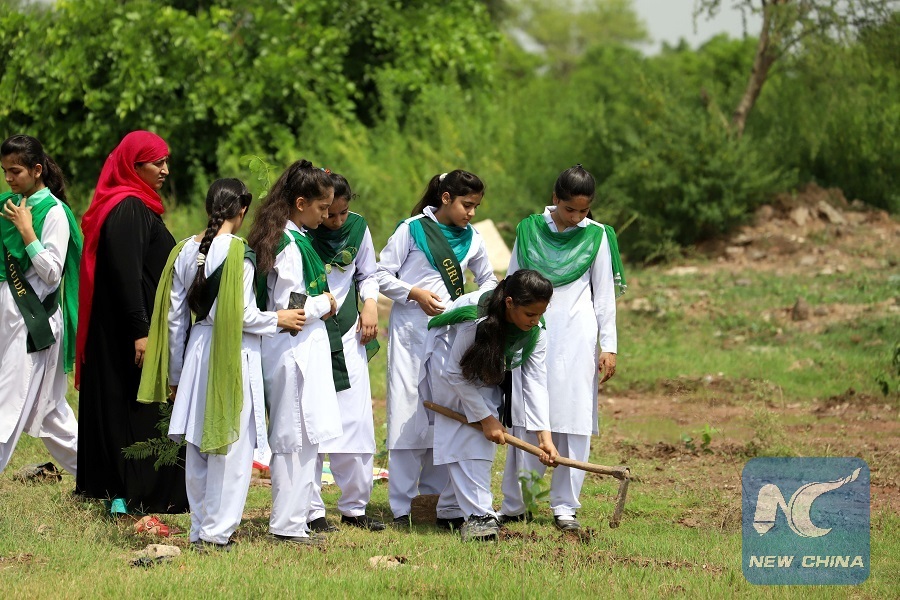
A student digs ground to plant a tree during a plantation campaign "Plant for Pakistan" in Rawalpindi, Pakistan on Sept. 2, 2018. (Xinhua/Ahmad Kamal)

People participating in the tree-plantation drive in Islamabad said that the government should raise awareness about the importance of tree plantation in kids and include topics related to climate change in their curriculum.

Asif Khan, a businessman in Islamabad, was planting sapling with his five-year-old daughter in the Parade Ground. In a conversation with Xinhua, Khan said that he came to know about the drive from social media and told his daughter to join him.

"She doesn't know how important tree plantation is for her future. If teachers tell her and her class fellows about climate change in schools, they will participate more actively in the drive," he said.

Back to Top Close
Xinhuanet

Feature: Pakistanis start planting trees "today" to save "tomorrow"

Source: Xinhua 2018-09-07 10:08:54

A student holds a placard during a plantation campaign "Plant for Pakistan" in Rawalpindi, Pakistan on Sept. 2, 2018. (Xinhua/Ahmad Kamal)

by Misbah Saba Malik

ISLAMABAD, Sept. 6 (Xinhua) -- Absar Kazmi, an electrical engineer in Islamabad, brought his three kids to plant trees at a section of the famous Parade Ground in the city, invited by the government for planting saplings under the "Plant for Pakistan" campaign aiming at protecting the country from pollution and climate change.

Kazmi said he brought his kids to plant trees to let them know the importance of saving the earth from the adverse effects of climatic changes. "I want them to know that we plant a tree today it will save their tomorrow," Kazmi told Xinhua.

Pakistani Prime Minister Imran Khan has kicked off the drive "Ten Billion Trees Tsunami" recently by planting a sapling in the country's northwest Khyber Pakhtunkhwa province himself.

The campaign is of an effort to combat climate change by planting trees across the country during five-year tenure of the current government.

The prime minister's advisor on climate change Malik Amin Aslam told local media that trees were planted and distributed freely across the country with an objective to motivate general public to make Pakistan greener.

Irfan Nizai, environment director of the Environment Directorate Islamabad, said that for an ideal atmospheric condition it is important that 20 percent area of a country should be under forest, but in Pakistan it is less than 2 percent.

"The government is now focusing on this issue to control the extreme weather conditions which are posing a threat to our agro-economy and also making living conditions harder for people," Niazi told Xinhua.

He said that in the first step about 1.5 million trees will be planted in various areas of the country and in next step they will provide saplings to schools where each kid will plant one sapling.

"It will make the kid guardian of the tree and he will water it and take care of it, giving him a sense of responsibility and motivating him to plant more trees," he said.

Students plant a tree during a plantation campaign "Plant for Pakistan" in Rawalpindi, Pakistan on Sept. 2, 2018. (Xinhua/Ahmad Kamal)

Khalid Malik, director of the Pakistan Meteorological Department, told Xinhua that Pakistan is the seventh most vulnerable country to climate change in the world and one of the major reasons is deforestation.

"A country's vulnerability to climate change is not only determined by changes in weather pattern but also the efforts which government and residents are making to control the affects of changing weather," he said.

He said that deforestation in the country has taken a serious toll on climate and no one cared to plant new trees which resulted in harsh weather conditions.

Uzair Qamar, a professor of water resource management and engineering in University of Agriculture Faisalabad, said that planting trees at individual as well as state level would help mitigate against climate change to a great extent.

Qamar told Xinhua that recently extreme weathers are being witnessed in Pakistan for the lack of trees. When more trees are planted they will convert excess carbon dioxide in the atmosphere into healthy ecosystems, resulting in moderate weather condition.

"It is a natural phenomenon that spring is followed by winter and autumn follows summer to give people some time to adapt themselves with the new weather, however, in Pakistan spring and autumn are almost going to extinct due to climatic changes mainly due to deforestation."

He said that the results of plantation will become visible at least half a century later, so planting a tree today can save the future generation from the hostilities of the climate like drought and flooding.

A student digs ground to plant a tree during a plantation campaign "Plant for Pakistan" in Rawalpindi, Pakistan on Sept. 2, 2018. (Xinhua/Ahmad Kamal)

People participating in the tree-plantation drive in Islamabad said that the government should raise awareness about the importance of tree plantation in kids and include topics related to climate change in their curriculum.

Asif Khan, a businessman in Islamabad, was planting sapling with his five-year-old daughter in the Parade Ground. In a conversation with Xinhua, Khan said that he came to know about the drive from social media and told his daughter to join him.

"She doesn't know how important tree plantation is for her future. If teachers tell her and her class fellows about climate change in schools, they will participate more actively in the drive," he said.

010020070750000000000000011100001374514741