


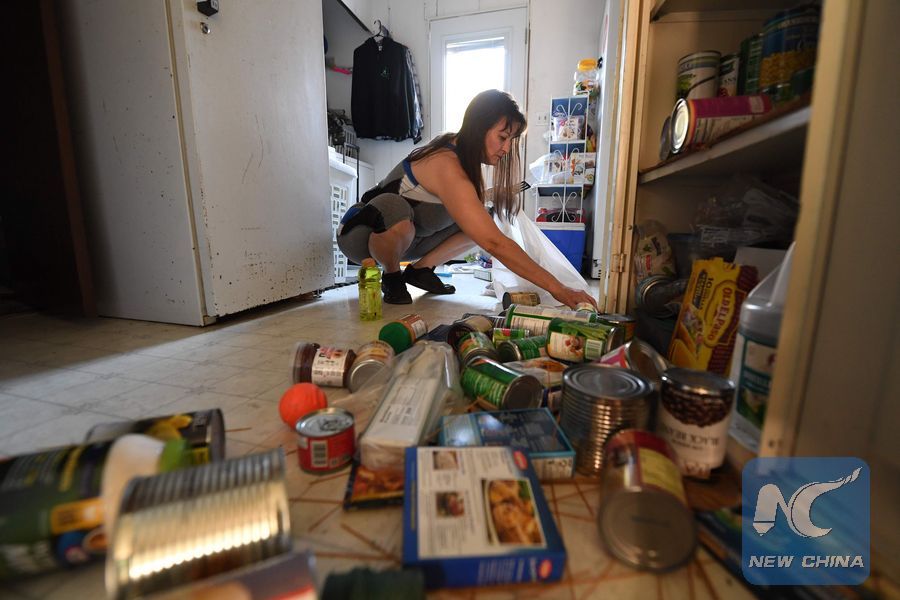
Tammy Sears cleans up her kitchen after a magnitude 7.1 earthquake dumped food items on the floor at her mobile home in Ridgecrest, California, on July 6, 2019. (Photo by Robyn Beck / AFP)
by Julia Pierrepont III
RIDGECREST, the United States, July 7 (Xinhua) -- While most California residents were enjoying the rumble and explosion of benign firework displays in the night sky on July 4th, residents in the rural Mojave Desert community of Ridgecrest 150 miles from Los Angeles faced rumblings and explosions of a far more menacing variety: a 6.4-magnitude earthquake - the largest to hit the area in almost 20 years - followed the next day by a 7.1-magnitude quake, ten times bigger than the first.
The massive earthquakes sent terrified residents fleeing from their homes in fear for their lives as debris, shattered glass and household goods rained down upon them.
Chaotic mounds of ruined furniture, broken bottles and shards of window glass, and mangled ceiling tiles lay in mute testimony to the ordeal they had endured.
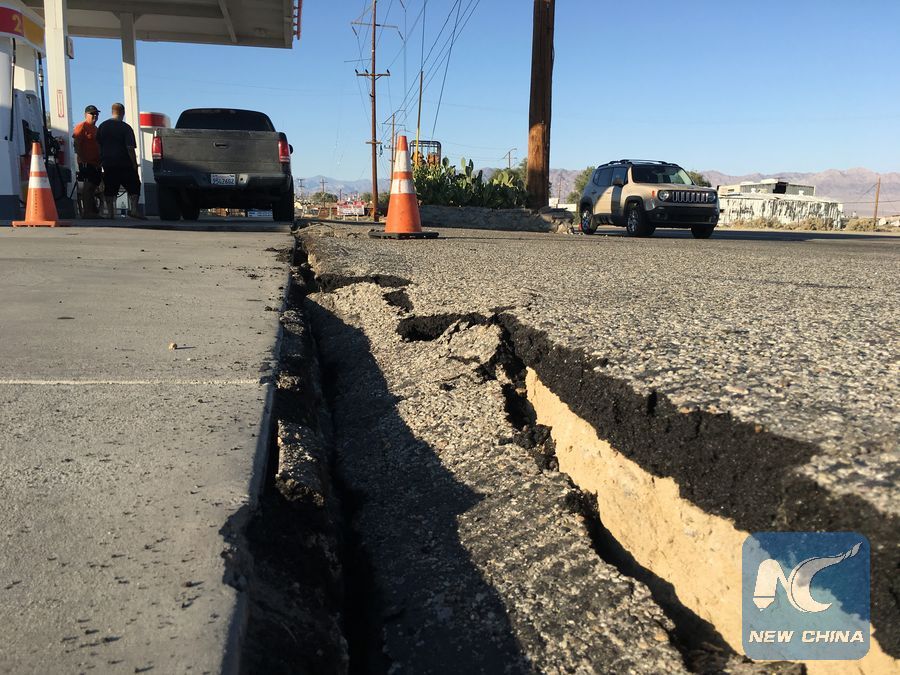
Photo taken with a mobile phone shows a road damaged by earthquakes in Trona of California, the United States, July 6, 2019. (Xinhua/Tan Yixiao)
One poignant news video on Channel 7 News showed a little boy struggling to carry a toddler girl to safety as families fled in terror from a local Ridgecrest laundromat rocking violently during the 7.1-magnitude quake.
Gas leaks, power outages and water shortages hit soon after, prompting Governor of California Gavin Newsom to visit in person and declare the area an official disaster area.
Residents were heartened by his visit, but they will need more than words to deal with the aftermath in an area where many families fall below the national poverty level and unemployment is in the double digits.
In this hard-scrabble corner of rural California, low income families struggle every day to eke out a living in an out-of-the-way, desert community where jobs can be scarcer than water.
"It's unbelievable how your life can change so drastically from one second to the next," said local resident Ceasar Martinez Valdez, sadly shaking his head.
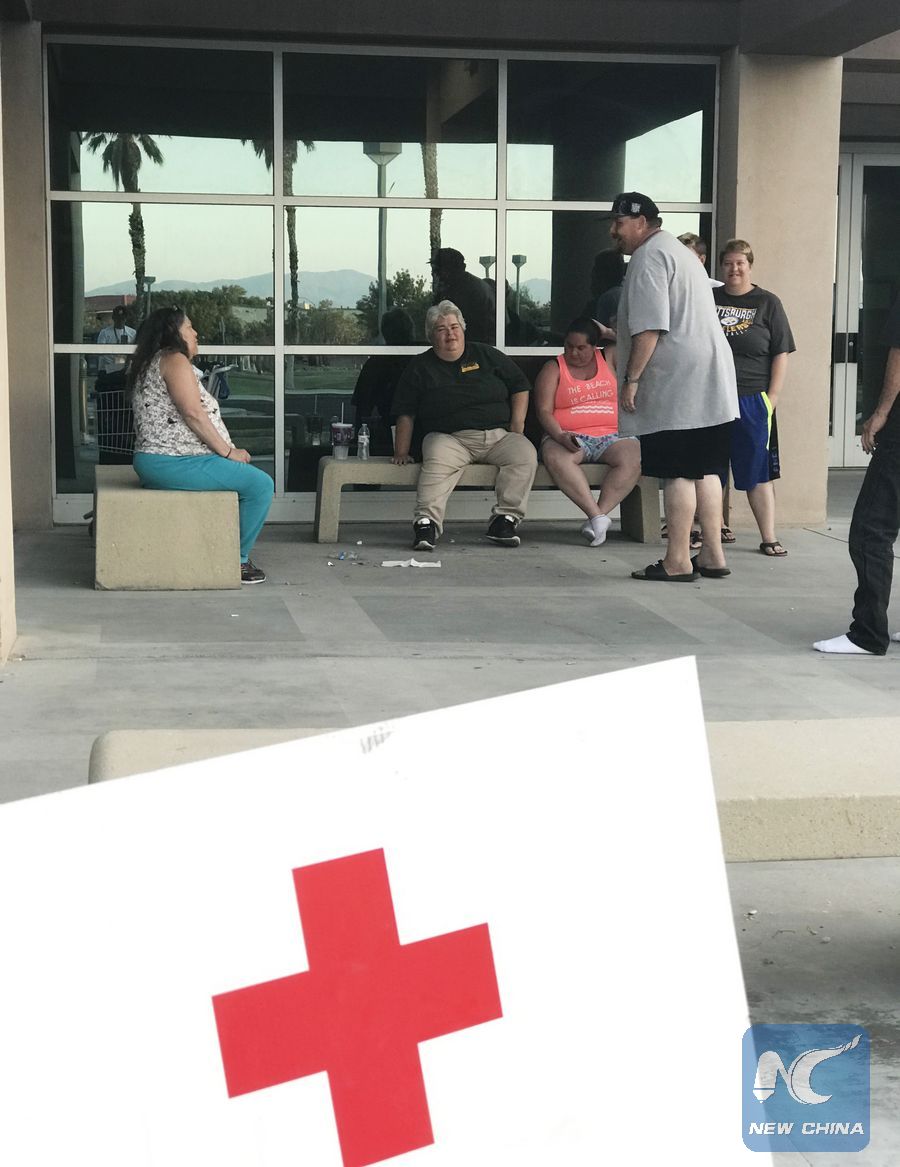
Photo taken with a mobile phone shows people resting at a medical facility in Ridgecrest of California, the United States, July 6, 2019. (Xinhua/Zeng Hui)
After his home sustained heavy damage, Valdez and his entire family decided to camp out in blankets and tents in the field behind the Red Cross Emergency Center in Ridgecrest where he plans to stay for another couple of days to make sure his family is safe to return home.
"We are afraid to sleep inside. What if the roof collapses next time? I can't take that chance with my family."
He's not alone. Enduring over 3,000 aftershocks and fearing that another even bigger earthquake was just around the corner prevented many other distraught local residents from returning to their homes, afraid their once-safe dwelling might become deathtraps that could collapse on top of them without warning.
Terry Carter, father of five who lives in a mobile home with his family in nearby Trona, was in the shower when the quake hit and sustained injuries when it knocked him to the ground. He works in the nearby ammonia plant and wanted to get his family safely out of the area in case the plant blew up.
"That could have taken out the whole area," he explained to Xinhua. "So I knew we had to get out of there, fast!"
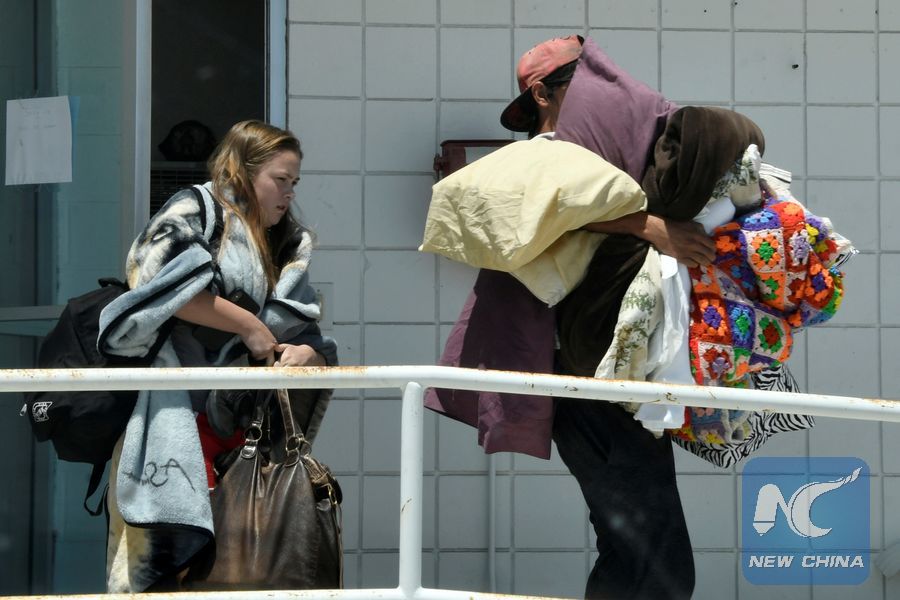
Evacuees leave a fire station with their belongings after an earthquake near Trona, U.S. California, July 6, 2019. (REUTERS/Gene Blevins)
He is still traumatized by the experience. "It was terrifying! I was all banged up from falling and had to crawl out to look for my kids while stuff was falling all over me," he told Xinhua. "I found my baby boy, grabbed him and ran! Luckily, the rest of family was already safe outside."
He added, "That was our first earthquake and we're all really scared. We don't want to go back to Trona, but everything we own is there. My wife wants to leave California for good, but what do we do with our house?"
Many others also spent sleepless nights on pins and needles anxiously waiting for the next big quake, while others fell into an exhausted slumber in cars, vans, or on mattresses they hauled outside into the relative safety of their front yards.
Up to 100 residents slept at the Red Cross Center, hastily assembled to provide disaster relief and emergency housing. Other volunteer organizations were on hand to help.
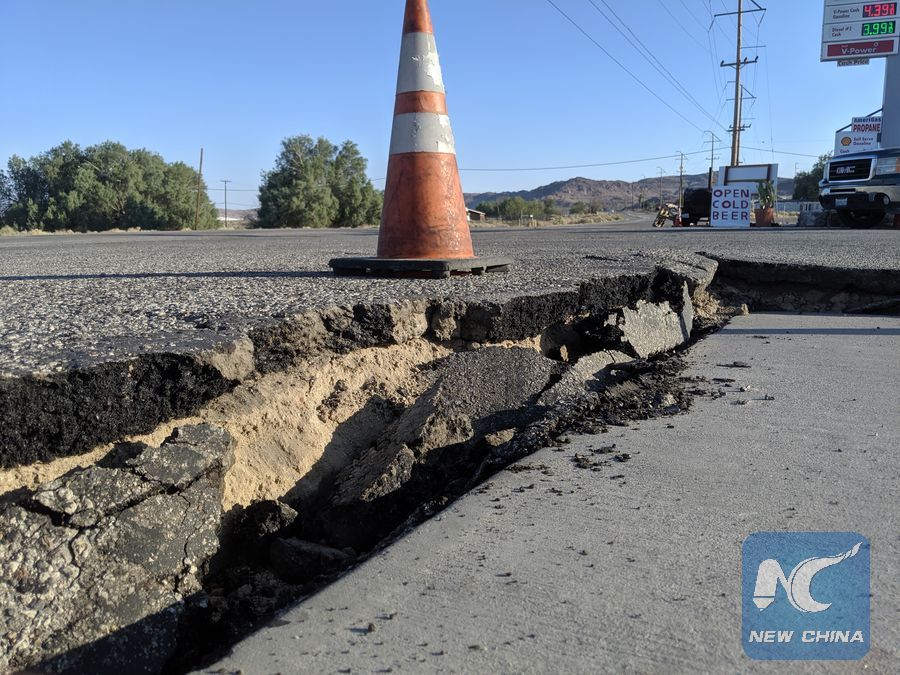
Photo taken with a mobile phone shows a road damaged by earthquakes in Trona of California, the United States, July 6, 2019.(Xinhua/Tan Yixiao)
Jeremiah Cox of the First Baptist Church was giving out free water to the locals who had lost their water supply. He explained that their church had received a lot of donations from local and out-of-town businesses, like computer and trucking companies.
"We're just trying to help any way we can," said Cox. "Everyone is."
Pastor Jeff Jackson from Bakersfield originally came to assist the deaf residents in Ridgecrest, but ended up giving solace to any that needed it. He brought food for people to eat as well as food for their displaced pets.
"The Good Lord helps us all and we all have to help each other, one day at a time," he told Xinhua.
Many residents staying in the shelter or camping out behind it looked haggard after a restless night riddled with anxiety.
Susan Bowman, an elderly resident of Ridgecrest, who had everything in her home destroyed, spoke to Xinhua about her traumatic experience, "It wasn't like a gentle wind, it was a huge force. A 7.1," she told Xinhua. "It turned everything in my house into mashed potatoes!"
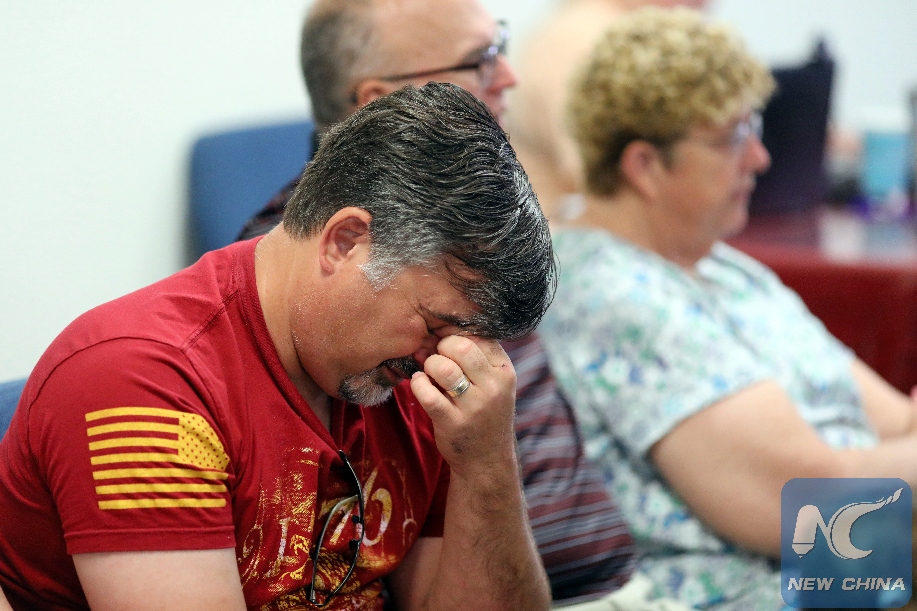
Chris Gill prays with other people who lived through a powerful magnitude 7.1 earthquake, triggered by a 6.4 the previous day, at Grace Connection Foursquare church in Ridgecrest, California, U.S., July 7, 2019. (REUTERS/David McNew)
Many of the poorer homes in Ridgecrest and Trona had already seen better days, and now, after repeated pummeling from earthquakes and aftershocks, they face being red-tagged by government agencies as too unstable to live in. That could render many residents tragically homeless.
Kathy Vander Houwen, 76, watched in despair as a county public health and safety official yellow-tagged her house after the quakes pushed it off its original foundation.
Not as bad a red tagging, yellow tagging means there is hope it can be repaired enough for her to return to live in it. Now staying with an old family friend, she is justifiably anxious about the fate of her home and when she could return to it.
"I'm too old to start over again," she said with a sense of resignation.
Officials warned that a heat wave over the next few days could push temperatures to 100 degrees Fahrenheit and higher, putting residents at serious risk of over-exposure, sunstroke and dehydration. They urged everyone to stock good supplies of food, water and fuel on hand or to visit the Red Cross Center for assistance.
