


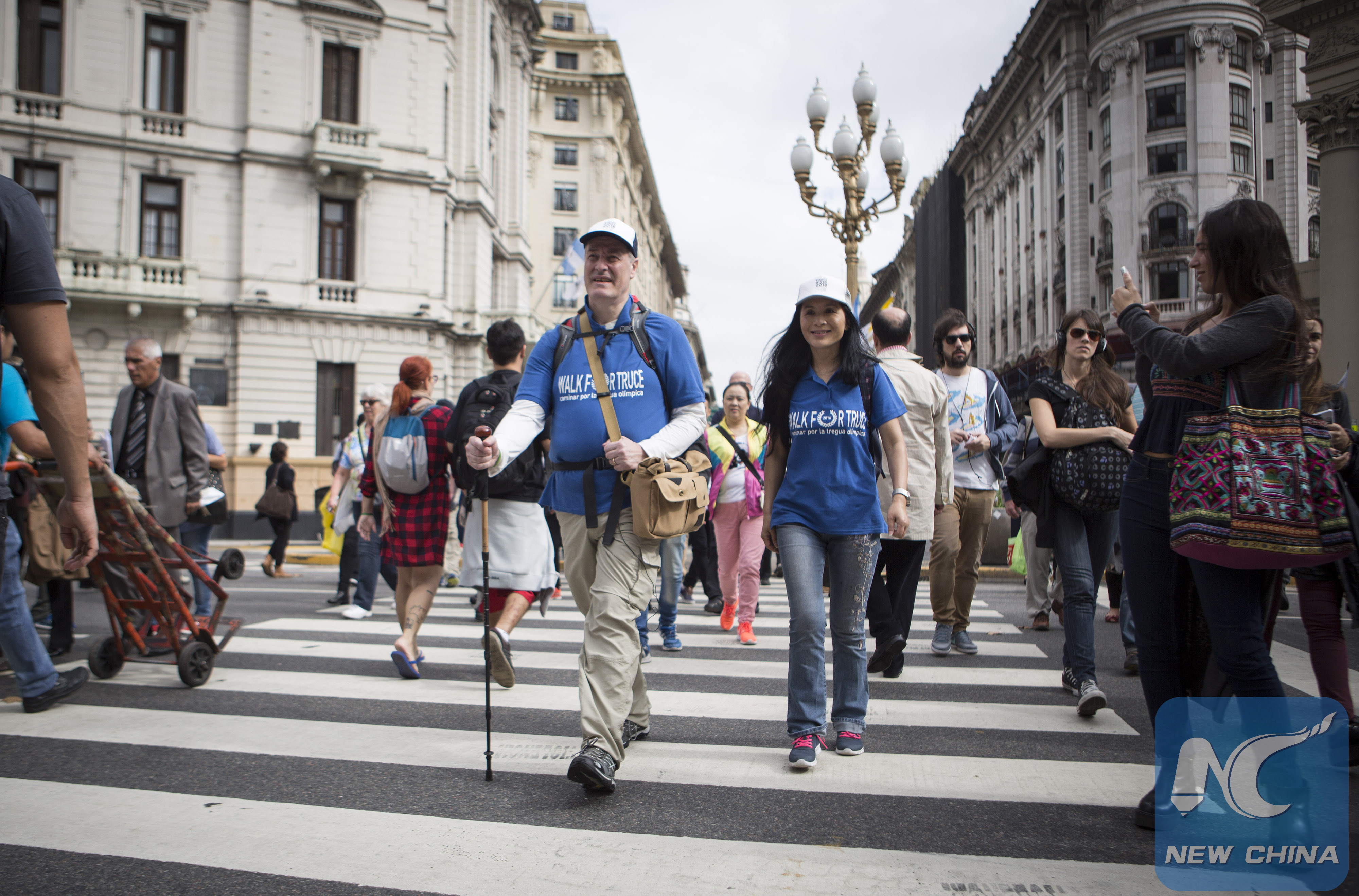
Lord Bates and his wife Xuelin started Walk for Truce in Buenos Aires in 2016. (Xinhua photo)
By Ru Ge
A series of TEDx speeches were recently held in Beijing on Sept. 30, 2017, themed "China's Road and Prospects." Among the slate of world-renowned politicians presenting speeches was Lord Michael Bates, a Minister of State at the Department for International Development in the UK government. He also serves as a Conservative peer in the House of Lords and is a philanthropist who has carried out five major walks to raise money for meaningful causes around the world. Lord Bates shared a poignant experience that he had several years ago in China, and his speech left a particularly strong impression on me.
On July 27, 2015, a special day which marked the third anniversary of the 2012 London Olympic Games, Lord Bates embarked upon a 71-day, more than 1,700 kilometers walk from Beijing to Hangzhou. During this, he raised about 900,000 yuan (150,000 US dollars) and donated most of the money to a charity called Hope House in Pizhou, a county of Xuzhou City in Southeast China's Jiangxi Province.
"I had the most impressive experience in a Hope House in Pizhou among all the 71 days I walked in China," said Lord Bates. "It was a place for children with disabilities. Some of the children have no limbs and have to use wheelchairs and usually places like that are very difficult. As a parent and grandparent myself, I feel real sadness when I see these problems. But in this school, the person who set it up taught his children, often with great disabilities, to play ping-pong. Because of that, 12 students of that school won medals at the Paralympic Games in London 2012."

Book-signing after the speech. (Photo by Ma Yuanhao)
Lord Bates said it was an experience that filled him with hope and excitement. Although students in that school suffered a lot, and their situation might have seemed hopeless to some, they remained defiantly optimistic and strong in the face of great challenges. Lord Bates loved what he saw and in order to continue supporting these children, he donated most of the money he raised from the walk to the Hope House.
Lord Bates' interests are not only restricted to the field of charity work, he also wants to do anything he can to make the world a better and more peaceful place. When he arrived in Nanjing on his walk, he visited the museum and the Garden of Peace dedicated to the victims of the Nanjing Massacre.
"When I came out on the Garden of Peace from the dark underground of the museum, I felt this contrast between terrible, awful things that human beings can do to each other and the wonderful optimism of peace and hope for better future. The Garden of Peace in my opinion, isn't a garden wanting for revenge, but a garden wanting for peace," said Lord Bates.
In addition to this, Lord Bates also mentioned his respect for John H. D. Rabe, a German who saved 250,000 lives during the Nanjing Massacre by providing shelter to vulnerable civilians.
When I listened to his speech and later interviewed him, admiration welled up inside me. I found myself profoundly moved by his dedication to working toward people's happiness and well-being, even though those he helps live thousands of kilometers away from him. He is a person who takes helping the world as his own duty and not only serves people from his own country but also cares about improving the livelihoods and helping developing countries in far-flung places around the world. Lord Bates' work should set a shining example for anyone who wishes to improve the world we live in, both now and in the future.
His book Walk for Peace, based on a 71-day journey from Beijing to Hangzhou in 2015, was published in China in 2016, partially in English and partially in Chinese. The walk was to commemorate the 70th anniversary of the end of the Second World War and to highlight the first China-UK Year of Cultural Exchange.
In the book he writes about the kindness of the local people, his observations in different cities on the way, the beauty of the countryside and his thoughts on the cultural differences between China and his home country.
In stories like the ones shared by Lord Bates, we can see a new picture of China illuminated, one that shows a country aware of its past, mindful of its present challenges, and that welcomes the involvement of anyone from any country who wishes to improve the lives of its people.
Also presenting at the conference were former Slovenian president Danilo Türk, former Egyptian prime minister Essam Sharaf, and former Kyrgyz prime minister Djoomart Otorbaev.
