
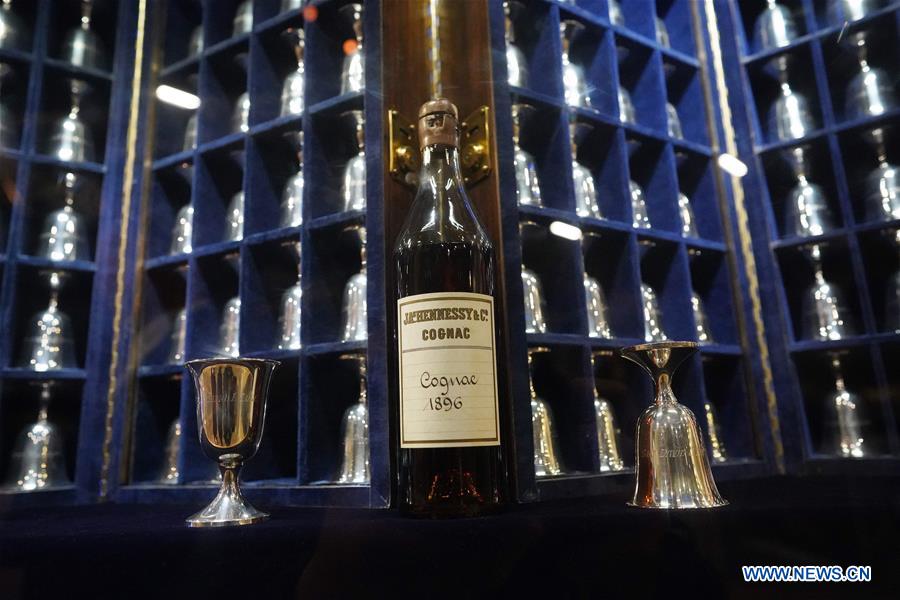
Photo taken on April 19, 2019 shows the sole upright goblet (L), engraved with the name Richard E. Cole, at the National Museum of the U.S. Air Force in Dayton, Ohio, the United States. Seventy-nine silver goblets have been symbolically turned upside down, leaving only one, engraved with the name Richard E. Cole, standing upright. All shine behind show windows in the largest military museum in the world as a silent homage commemorating 80 heroic Doolittle Raiders who launched America's first airstrike on Tokyo during WWII. (Xinhua/Liu Jie)
by Xinhua writers Xu Jianmei, Liu Liwei, Chang Yuan, Hu Yousong and Zhang Yongqing
DAYTON/SAN ANTONIO, United States, April 27 (Xinhua) -- Seventy-nine silver goblets have been symbolically turned upside down, leaving only one, engraved with the name Richard E. Cole, standing upright. All shine behind show windows in the largest military museum in the world as a silent homage commemorating 80 heroic Doolittle Raiders who launched America's first airstrike on Tokyo during WWII.
THE GOBLETS
Probably sometime this summer, the sole upright goblet will be turned over at a ceremony at the National Museum of the U.S. Air Force in Dayton, Ohio, since Lieutenant Colonel Dick Cole, the last surviving Doolittle Tokyo Raider, died at the age of 103 on April 9 in San Antonio, Texas, museum staff Rob Bardua told Xinhua.
Four months after the Japanese unprovoked attack on Pearl Harbor, a group of 80 U.S. airmen named after their mission commander Jimmy Doolittle volunteered to retaliate. Most of them were later rescued by voluntary Chinese civilians and troops. By doing so, they all risked their lives with a spirit of self-sacrifice.
"The tradition of those goblets comes from a western military tradition of remembering lost comrades," Dr. Douglas Lantry, the museum's curator and historian, told Xinhua in a recent interview.
Shortly after the war, said Lantry, the Doolittle Raiders began reunions during which they remembered their lost comrades with a toast. In 1959, they were presented with these silver goblets by the city of Tucson, Arizona. What makes the goblets unique is that each of them, 4-inch (10.16-cm) high and 3-inch (7.62-cm) in diameter, is engraved with the raider's name twice, one on the right side and the other on the bottom. So people can read the deceased raider's name after his goblet is turned over.
"When a (Doolittle) Raider passed away, his comrades would drink a toast to him and then turn the goblet upside down. Now there are no more Raiders left," said Lantry.
"The goblets and the tradition of the toast, especially this one, represent everything that we want American airmen to live their lives by. It represents courage and commitment and also a spirit of innovation. Those raiders were doing something that had never been done before. And so our young people are inspired," he said. "Now that all the raiders are gone, the goblets keep the story alive because there are valuable lessons inside".
Moreover, part of such lessons can be drawn from Doolittle Raiders' experiences in China, the U.S. ally during WWII, the museum historian noted.
"Lots of people know the story of the raid and the raiders, but fewer people know the story of how they survived after the raid and the price that the Chinese people paid for helping those guys," said Lantry.
"There was a close connection between the Doolittle Raiders and the Chinese," Secretary of the U.S. Air Force Heather Wilson told Xinhua, calling it an "untold story" that most Doolittle Raiders were rescued by the Chinese and then brought to safety. "It's an important story and it's a story that more people should know."
30 SECONDS
Though nicknamed the master of the calculated risk, Doolittle "proposed the unimaginable to strike Tokyo from an aircraft carrier with a land-based bomber," Wilson recalled at a memorial service for Cole at Joint Base San Antonio-Randolph, Texas, on April 18, the day marking the 77th anniversary of the legendary raid.
The mission was "unthinkable on an impossible timeline," let alone the raiders had to take off 10 hours earlier and flew much further away than they had planned after being spotted by a Japanese boat in the Pacific, she told more than 1,000 servicemen at Hangar 41 as Cole learned to fly in class 41.
"Every man knew it was likely going to be a one way trip. They didn't have enough fuel with the forecast headwind to make it to the Chinese mainland after the strike. Doolittle gave every man the option not to go. And not a single airman opted out," she said in a trembling voice.
Cole, 26, was co-piloting in the lead plane of 16 B-25 Mitchell medium bombers. Each with a crew of five men, without fighter escort, the bombers took off from the U.S. Navy's aircraft carrier USS Hornet. They arrived over Japan in daylight and bombed oil storage facilities, tankers, warehouses, military targets and industrial plants in Tokyo and several other major Japanese cities.
"Flying very fast and very low, they only had about 30 seconds over their targets and drop bombs," Lantry said, adding that the navigation had to be very accurate to get to the right place.
"Sometimes a moment of courage, a moment of heroism, can define a whole life," said Lantry of the raiders' historic 30 seconds. "This one moment made the group famous because it was so important to so many other people."
With newspaper headlines proclaiming "US Bombs Tokyo" after months of doom and gloom due to Japan's rapid advance in Asia and West Pacific, the Doolittle Raid immediately boosted American morale, said Wilson.
"(Though) the physical damage to the Japanese mainland was not substantial, it punctured Japan's sense of invincibility. It caused its leaders to pull the Japanese fleet back to protect the homeland and provoked their strategic miscalculations that turned the tide of the war in the Pacific," she said.
"When America was at its lowest point, it needed a hero. It found 80 of them, who volunteered, innovated, and flew straight into the heart of the enemy," she said.
CHINESE RESCUE
"What's the most significant event in your life?" Cole was once asked in an interview.
"My parachute opened," Cole answered with a quick wit.
After the raid, one bomber steered towards the Soviet Union and the other 15 headed towards China. Thanks to a miraculous 37-mph brisk tailwind instead of the forecast 25-mph headwind, they finally reached China's coastline, said Col. Robert Gardner at the memorial service. However, the airmen were forced to parachute into a heavy storm in complete darkness as fuel ran dangerously low.
It was Cole's first combat mission and also the first time he used a parachute, said Lantry, adding that Cole was supposed to jump out of the plane, count to 10 and then pull the cord for the parachute. Instead, Cole jumped out, counted one and pulled the cord immediately because he wasn't sure how close to the ground he was. He pulled the cord so hard that he gave himself "a big black eye" before landing on a pine tree and stayed atop until daylight.
"That was the scariest time," Cole recalled during an interview in 2013 when he was 98. "There you are in an airplane over a land you are not familiar with, under a big weather front, very active with lots of rain, with thunderstorms and lots of lightning and you are going to jump out."
Three raiders died trying to reach China. Five were interned in Soviet Union for about one year. Among the eight captured and tortured by the Japanese forces, three were executed and one died in captivity. All the remaining 64 raiders including Doolittle and Cole were rescued by the Chinese and smuggled out to safety.
"When they had to jump out of their airplanes, they were completely helpless," said Lantry. "It was dark and the weather was bad and they didn't know where they were and who would find them. Some of them got hung up in trees and others just landed on the ground and maybe found a shed or a farm or something and just were hiding."
"But without exception, whoever found them was kind to them. And they offered assistance and help and medical care and food and shelter," said the museum historian, "It was remarkable... all the strangers they met understood that they were on the same side and they did everything they could to help them."
"They (Doolittle Raiders) could not have survived without the kindness of the people who found them," he told Xinhua. "I'm convinced that without help they would have been completely lost."
The price China paid for aiding the U.S. ally was very high, said the museum historian. "There was a great deal of retaliation after the raid. Very serious retaliation...The Chinese people suffered greatly."
Recently some researches from the U.S. side have estimated that up to 250,000 Chinese people lost their lives because they helped Doolittle Raiders, according to Lantry. He said that the Japanese troops devastated more than 20,000 square miles (52,000 square km)of farmland including livestock and crops and attacked several cities where the raiders were hidden in eastern China.
Goblets & Friendship
On April 9, the day that last Doolittle Raider Cole passed away, Chinese Consul General in New York Huang Ping happened to be visiting the National Museum of U.S. Air Force. He asked the museum to convey his deep condolences to the veteran's family, and spoke highly of the American pilots who fought side by side with the Chinese people during WWII.
"The exhibits in this museum record a fond memory shared by China and the United States, when the two countries joined hands in fighting the menace of fascism and safeguarding world peace,"said Huang. "The friendly feelings between our two peoples are sincere and deep-rooted, as proven by history."
"American airmen have always been very grateful for the cooperation of the Chinese population because it was very dangerous for them to help those Americans," said Lantry. "All of those Raiders expressed lifelong gratitude. And they did that when they got together at their reunions every year... They took that friendship very seriously because their lives depend on," Lantry told Xinhua.
The Sino-U.S. cooperation continued before and after the raid, he noted, citing flying supplies over the Himalayan "Hump" and building bomber bases by hand. After the raid, Cole continued to fly the "Hump" and other missions in the China-Burma-India Theater until 1944.
"The (Chinese) acts of kindness and cooperation to help those flyers get back into the battle, or back to their home, has been an inspiration of friendship and cooperation over the years," said Landry. "It's important to focus on what you share. That's the lesson of the Doolittle Raiders I think."
The museum historian's thoughts resonated with fond remarks made by Doolittle and two late U.S. Republican presidents Ronald Reagan and George H. W. Bush in the 1980s and 1990s.
In March 1992, surviving Doolittle Raiders and five of their Chinese rescuers were reunited in Red Wing, a city in Minnesota, for the first time in 50 years after the raid and rescue.
"On this special occasion, we also salute those good people in China, who, following the raid and without regard for their own well-being, provided shelter and protection for wounded Americans." said then-president George H. W. Bush in a letter to the reunion.
Gen. Doolittle, 95 at that time, did not attend the reunion but also wrote a letter to their Chinese rescuers.
"On behalf of the entire Doolittle Raider organization, and especially those Doolittle Raiders and their families present here tonight, I extend deep hearted appreciation to our Chinese friends, who at great risk to themselves and to their families, rescued and cared for our men."
"A hearty thumbs up to you all," said Doolittle who passed away in September 1993 at the age of 96.
Ronald Reagan, in his April 1984 speech at Fudan University in Shanghai during his China visit, also spoke highly of Doolittle Raiders and the Chinese rescue.
"When the armies of Fascism swept Asia, we fought with you to stop them... Remember when our general Jimmy Doolittle and his squadron came halfway round the world to help. Some of those pilots landed in China. You remember those brave young boys. You hid them and cared for them and bound up their wounds. You saved many of their lives."
In his enthusiastic speech, Reagan said the friendship between the American and Chinese people was the basis of the friendship between the two governments.
"History is a river that may take us as it will. But we have the power to navigate, to choose direction and make our passage together. The wind is up, the current is swift, and opportunity for a long and fruitful journey awaits us," said Reagan.
"With peaceful cooperation as our guide," he said, "the possibilities for future progress are great."
