
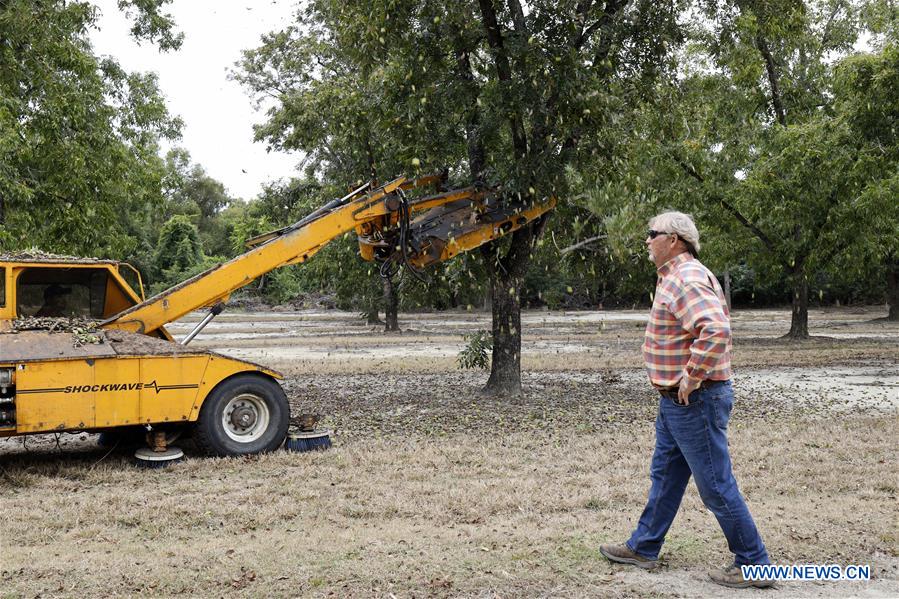
Randy Hudson, chief executive officer of Hudson Pecan Company and former president of U.S. Pecan Growers Council, is pictured as pecans are shaken off the tree in one of his orchards near Ocilla, Georgia, the United States, Oct. 24, 2019. U.S. annual pecan production this year would be short of that in the previous season due to residual impacts of hurricanes, according to pecan growers, experts and industry associations. (Xinhua/Li Muzi)
TIFTON, the United States, Oct. 27 (Xinhua) -- U.S. annual pecan production this year would be short of that in the previous season due to residual impacts of hurricanes, according to pecan growers, experts and industry associations.
The output of pecan in the state of Georgia, which was the largest producer of the tree nut for quite a few years, was roughly halved in 2018 resulting from impacts of Hurricane Michael, according to Janice Dees, executive director and international marketing manager of U.S. Pecan Growers Council.
"We are seeing residual impact. We do think there will be some impact going forward," said Dees in a recent interview with Xinhua.
Dees said the United States is going to see a lower production yield of pecan nationally in 2019 as flooding in the state of Texas also added up problems.
Dees added that the eastern bearing area of pecans in the United States suffered from three hurricanes back to back in the last three years.
Georgia lost about 17 percent of total pecans trees from Hurricane Michael and a lot of large producing limbs not counted as a full tree loss, said Samantha McLeod, executive director with Georgia Pecan Growers Association.
"In Georgia, pecan crop is a little off this year. It's a little light and that's mainly due to the hurricane that we saw in last year," echoed Lenny Wells, associate professor and extension horticulture specialist for pecans at the University of Georgia.
With around 130 acres (52.6 hectares) of pecan farms of his own, Wells said Hurricane Michael caused damage mostly in Albany area of Georgia, which is one of the major pecan producing areas in the state.
"Some of those trees in that area around Albany have been lost or so broken up that they're just not gonna be productive this year. We're looking at probably around 60 million pounds (27.2 million kg) (of pecan output) this year," said Wells.
The acreage of pecan in the United States has grown significantly but national production of pecan probably will be down a little, Wells said.
"Georgia is such a large producer, and we have about half the crop we would normally have. So I think that is gonna cut into the yield that we have in the United States as a whole," added Wells.
Ellis Bros. Pecans Inc., a major pecan grower and processor with 3,000 acres (1,214 hectares) of pecan acreage, lost about 4,000 pecans trees from Hurricane Michael in 2018, which roughly translates into 170 acres to 210 acres (68.8 hectares to 85 hectares) of pecan acreage, according to Slade Ellis with the family-run business.
Ellis also expected that its pecan production is going to be a little short in 2019 citing the impacts of hurricanes in the last two years.
Hudson Pecan Company Inc., another major pecan grower with over 2,000 acres (809 hectares) of pecan farms, lost about 3,000 pecan trees and around 30 percent of crop yield from Hurricane Michael in 2018, according to Randy Hudson, chief executive officer of Hudson Pecan Company and former president of U.S. Pecan Growers Council.
Hudson also expected that pecan yield in Georgia would be lower this year due to lasting impacts of hurricanes.
McLeod said overall pecan production would decrease a little bit in 2019 with pecan output from New Mexico expected to decrease to 80 to 85 million pounds (36 to 38 million kg) from almost 100 million pounds (45 million kg) in 2018.
Wells expected that national pecan output in 2020 would be back a little bit and Georgia would be back as the top pecan producing state in the United States.
Georgia has 35,000 to 40,000 acres (14,164 to 16,187 hectares) of new pecan orchards planted in the last five years or more and the new orchards would start to bear fruit in the next couple of years, McLeod said.
The prices of Pawnee and Oconee, the earliest two varieties of pecans entering harvest season, is around 2.5 U.S. dollars per pound, said McLeod.
McLeod said the price is pretty good considering what happened last year.
The United States only produced 242.9 million pounds (110 million kg) of in-shell pecans in 2018, down 20.3 percent year on year, according to National Agricultural Statistics Service (NASS) under the U.S. Department of Agriculture. The loss of pecan yield contributed to around 60 percent of total drop of pecan output in 2018.
Still, U.S. pecan output is expected to rebound to 281 million pounds (127 million kg) in 2019, up 15.7 percent, according to latest forecast by NASS in earlier October.
U.S. pecan growers just kicked off harvest season, starting from around the beginning of October and ending around January or February of the following year.