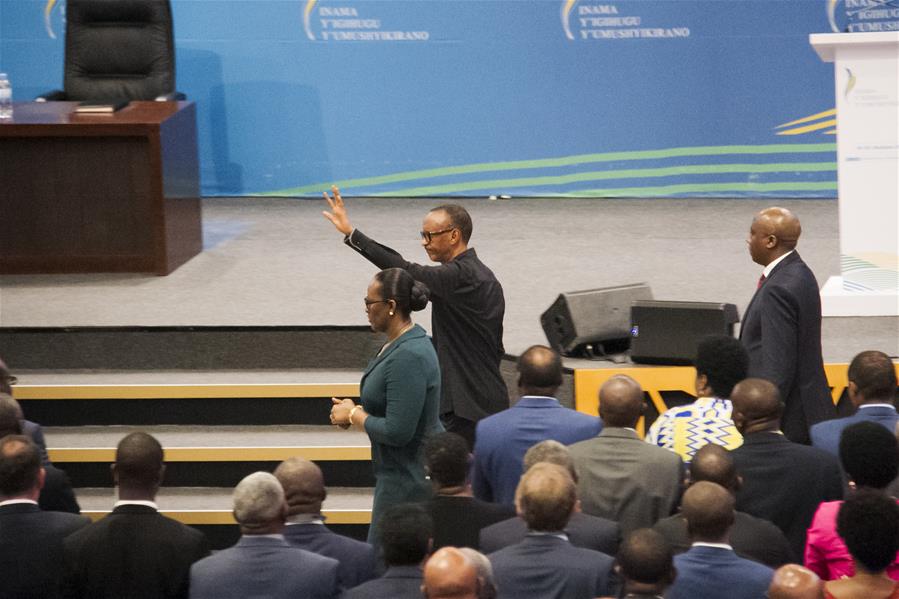
Rwandan President Paul Kagame waves his hand while attending the 17th National Dialogue Council of Rwanda in Kigali, Rwanda, Dec. 19, 2019. The 17th National Dialogue Council of Rwanda, locally called Umushyikirano, closed on Friday in the capital city of Kigali. The two-day event, opened by Rwandan President Paul Kagame with the State of the Nation Address, featured discussions under the themes of driving double-digit growth and engaging families for community resilience. (Photo by Cyril Ndegeya/Xinhua)
by James Gashumba
KIGALI, Dec. 20 (Xinhua) -- The 17th National Dialogue Council of Rwanda, locally called Umushyikirano, closed on Friday in the capital city of Kigali.
"The Umushyikirano gives Rwandans including those from diaspora and invited non-Rwandans an opportunity to tell the government if ongoing or planned programs are meeting the priorities of the people," said Ismael Buchanan, senior lecturer of the department of political science at the University of Rwanda, in an interview with Xinhua.
"Rwandans get a chance to talk to the president, cabinet ministers and heads of government agencies. This is a home-grown solution for Rwandans," said Buchanan.
The two-day event, opened by Rwandan President Paul Kagame with the State of the Nation Address, featured discussions under the themes of driving double-digit growth and engaging families for community resilience.
Among the highlights were ways to push forward economic growth by leveraging available opportunities to improve competitiveness, and advancing social development through strengthening community resilience with the participation and collaboration of all Rwandans.
It also offered platform for Rwandans to collectively reflect on the nation's vision 2020 and the development journey ahead.
Participants pushed forward ideas on available opportunities which could be utilized to improve the country's competitiveness whilst advancing social development.
According to Buchanan, over the past years, Umushyikirano, provided by the Constitution, has made important contributions to national building.
Rwandans use Umushyikirano to assess issues related to the state of the nation, functioning of the decentralized structures, and national unity, he said.
At the close of each Umushyikirano participants draw a list of resolutions to be implemented over the course of the coming year.
Buchanan said Umushyikirano also saw the emergence of transformational ideas like establishing savings and credit cooperative for teachers Umwalimu SACCO and communities mediators Abunzi.
"Most of those results are set of 'home grown solutions' or culturally owned practices translated into sustainable development programs," he added.
He stressed that the dialogue has been central to Rwanda's progress toward achieving its vision.
Frederick Golooba-Mutebi, a researcher on politics and public affairs, said the importance of Umushyikirano rotates around a number of benefits. It brings together Rwandans including officials and ordinary citizens from all walks of life to talk about their country and its aspirations and their own individual and collective aspirations, he told Xinhua.
The scholar explained that coming together creates a certain sense of "being in it together" or collective ownership of aspirations.
"It gives a chance to some people who live outside Rwanda to come and listen to discussions about where the country is at and where it is going. That, in my opinion, gives them a sense of a country on the move," said Golooba-Mutebi.
It also allows citizens to comment on, pose questions and raise concerns about what may or may not be working to their expectations, which creates a sense of holding leaders to account, said Golooba-Mutebi.
Nadine Munezero, a farmer in western Rwanda's Rubavu district, said Umushyikirano gives her an opportunity to be heard by the president and other national leaders. "I also get a chance to expose the dirt which local leaders want to cover up in my area," she said.
Umushyikirano's model could also benefit other African countries once they are introduced into, said Golooba-Mutebi.
"At the very least it would create a sense of togetherness that is sorely missing in countries where politics is adversarial and prone to creating or accentuating divisions," he said.