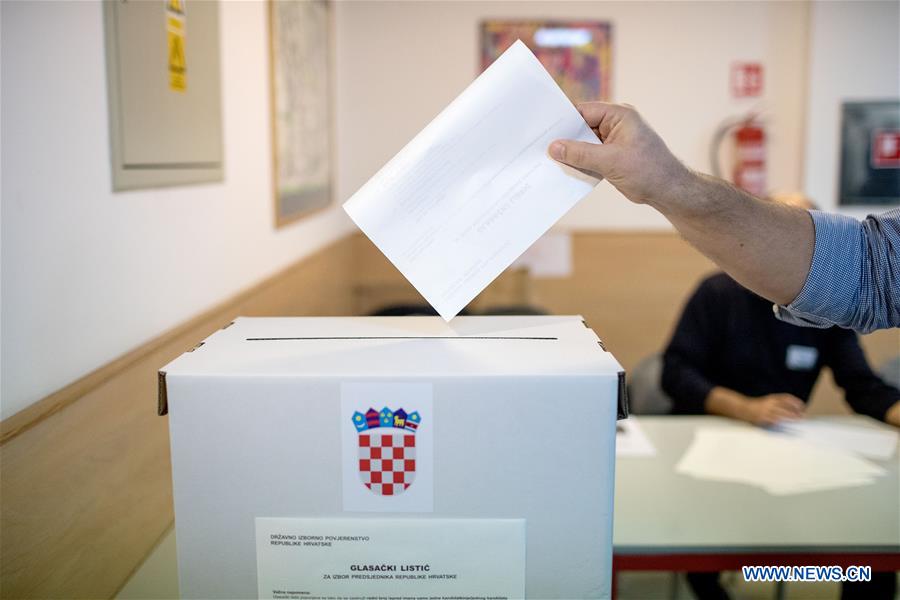
Photo taken on Dec. 22, 2019 shows a ballot box at a polling station during the presidential election in Zagreb, capital of Croatia. Croatian voters began to cast their ballots in a presidential election at 7 a.m. local time (0600 GMT) on Sunday. Over 3.8 million eligible voters will choose their president for the next five years from 11 candidates. (Igor Kralj/Pixsell/Handout via Xinhua)
ZAGREB, Dec. 22 (Xinhua) -- Croatian voters began to cast their ballots in a presidential election at 7 a.m. local time (0600 GMT) on Sunday.
Over 3.8 million eligible voters will choose their president for the next five years from 11 candidates.
A record number of more than 24,000 observers will oversee the work of electoral committees on Sunday, according to the State Electoral Commission.
Croatia's president is elected by a majority vote. If none of the candidates obtains over 50 percent of the vote in the first round of voting, a second round will be held on Jan. 5 for the top two candidates.
Polling stations will close at 7 p.m. (1800 GMT), with the first results expected at 8 p.m. (1900 GMT).
Recent polls have shown that the incumbent president Kolinda Grabar-Kitarovic, former prime minister Zoran Milanovic and popular singer Miroslav Skoro are the top three contenders.
Grabar-Kitarovic is running for a second term as the candidate of the Croatian Democratic Union (HDZ), the ruling conservative political party. She is believed to have a slight lead going into the election, followed closely by Milanovic of the center-left Social Democratic Party, who is backed by the liberal opposition.
The incumbent president said in her campaign that she had pulled Croatia out of the apathy and raised the country's reputation to the highest possible level. Her main rival, Milanovic, ran a campaign under the slogan "Normality," arguing that many things in Croatia right now are not normal.
Skoro, who is running as a right-wing independent candidate, is trailing third. He played a populist card under the slogan "Now or Never," promising to "give the state back to the people."
The election is seen by some as a test for the conservative government just a few days before Croatia takes over the European Union's presidency for the first time.
If Grabar-Kitarovic fails to secure another term, it would be a blow to the ruling HDZ and Prime Minister Andrej Plenkovic, a moderate in the HDZ, ahead of parliamentary elections in 2020.
This is the seventh presidential election in Croatia since the southeastern European country gained independence from former Yugoslavia in 1991.