
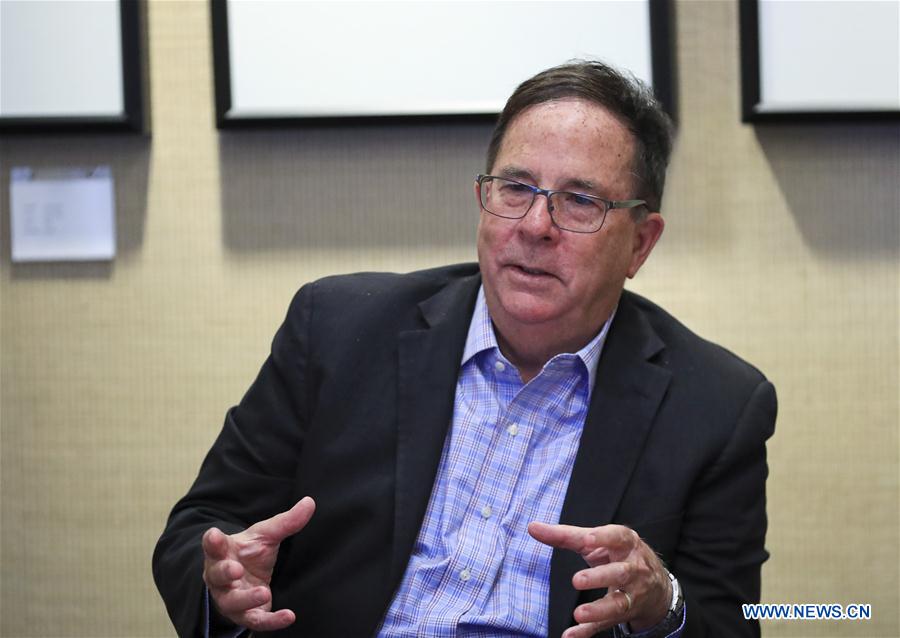
Robert Schooley, professor of medicine at the Division of Infectious Diseases and Global Public Health at the University of California, San Diego (UC San Diego), speaks in an interview with Xinhua in San Diego, the United States, Feb. 28, 2020. (Xinhua/Li Ying)
by Xinhua Writer Tan Jingjing
LOS ANGELES, Feb. 29 (Xinhua) -- China has done an amazing job in containing the novel coronavirus, Chancellor Pradeep Khosla of the University of California, San Diego (UC San Diego) told Xinhua in a recent interview, expressing his support for enhanced academic cooperation with Chinese research institutions in fighting the epidemic.
"In this time of high anxiety, we have witnessed the incredible resilience of the Chinese people," Khosla said Friday. "I commend the Chinese government for taking such strong efforts."
Khosla has recently sent a video message to the Chinese community in UC San Diego to stand by their side amid China's fight against the disease.
"To the people of Hubei and other provinces bravely fighting the virus on behalf of the world community, we offer our support," Khosla said in the message.
Epidemics like this remind us how vital it is to have international cooperation in science and public health, he said.
The Chinese government has really stepped up the game to get this virus under control, said Robert Schooley, professor of medicine at the Division of Infectious Diseases and Global Public Health at UC San Diego.
"What the Chinese government has been doing is extremely successful even if there will continue to be a few additional cases over the next coming months," Schooley told Xinhua.
"What China has averted is an expansion of the virus on the trajectory it started early in January. The slope of this epidemic has been significantly blunted by the interventions that have taken place," he said.
The Chinese scientific community has been "phenomenal" in its fast description of the biology of the virus, the molecular epidemiology of the virus, and the monoclonal antibodies to the virus, said Schooley, a leading expert on infectious diseases.
Clinical Infectious Diseases, one of the most heavily cited journals in the fields of infectious diseases and microbiology, is getting 15 papers per day from China, according to Schooley, also editor-in-chief of the journal.
"That tells you the outpouring of information coming from Chinese scientists and physicians who are working on this disease. They have been informing the whole international community about how best to approach it," Schooley said.
It is very important that there are a lot of activities happening in China to understand the disease, to understand the immune response, to understand the sequencing, and to develop a vaccine, Khosla said.
The medical school at San Diego has lots of connections in many different ways with Chinese universities, according to Schooley. "The Chinese infectious disease communities are very closely tied to the U.S. infectious community at UC San Diego. We have quite a few ties with Chinese scientists and universities that are facing the epidemic from the front lines."
There is a very rapidly evolving network of scientists around the world led by scientists in China, trying to develop ways to combat the disease, he said.
"We are learning from China's approach, and we'll be trying to take some of the best practices from that approach to deal with this virus as we confront it increasingly here," Schooley said.
