
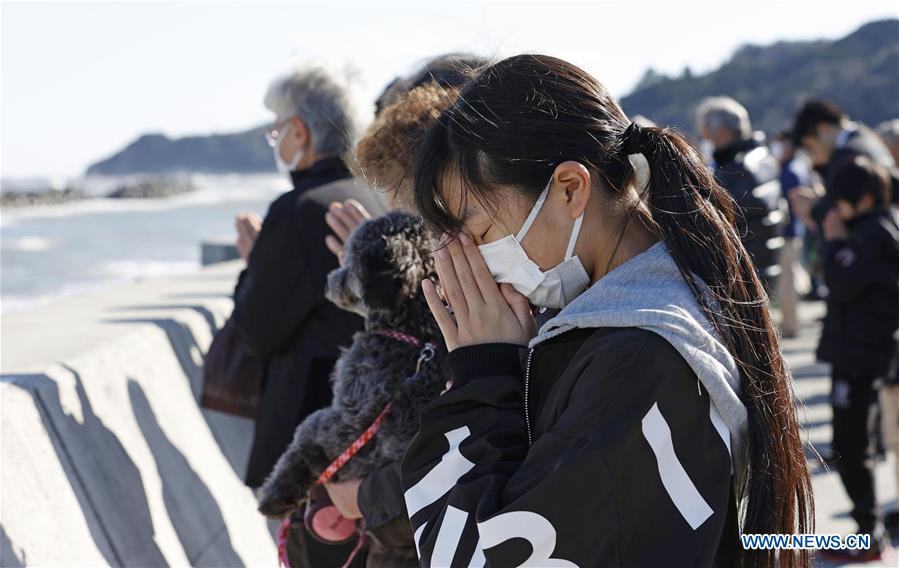
People mourn for the victims of the 2011 earthquake and tsunami in Fukushima, Japan, March 11, 2020. Japan marked the ninth anniversary on Wednesday of the massive earthquake and tsunami in its northeastern region leaving more than 15,000 people dead, with several events being canceled or scaled down over the COVID-19 concerns. (Kyodo News/Handout via Xinhua)
TOKYO, March 11 (Xinhua) -- Japan marked the ninth anniversary on Wednesday of the massive earthquake and tsunami in its northeastern region leaving more than 15,000 people dead, with several events being canceled or scaled down over the COVID-19 concerns.
A government-sponsored memorial ceremony had been held every year in Tokyo since 2012 was canceled for the first time, while Japanese Prime Minister Shinzo Abe and some 20 government officials attended a small ceremony at his office instead.
They offered a silent prayer at 2:46 p.m. local time, the exact time the powerful earthquake occurred on March 11, 2011.
Abe then delivered an address, offering his sincere condolences to those who lost their loved ones in the disasters. He also expressed sympathy to everyone who was affected by the disasters.
"We must never forget the valuable lesson we learned by this immense sacrifice," said Abe, adding that the government will continue to help survivors who are forced to live an uncomfortable life in temporary housing till now.
According to Abe, Japan has been repeatedly hit by disasters that can be regarded as national crises. However, the country has overcome each of them with courage and hope. He hopes to follow in the footsteps of ancestors and move forward together.
At the same time, people in hardest-hit areas including Fukushima, Iwate and Miyagi prefectures paused to observe a moment of silence.
The tsunami following the quake on March 11, 2011, engulfed the six-reactor Fukushima plant and triggered the world's worst nuclear disaster since the 1986 Chernobyl crisis.
Maki Okubo, who was 27 years then, was swept away by the tsunami. Last summer, part of her remains were finally found off the coast of Miyagi prefecture. Her father Mitsuo Okubo told local media, " This year is different. We can feel my daughter close to us."
Fukiko Takahashi, a 77-year-old resident from Miyagi Prefecture, put her hands together as she gazed over the city toward the ocean from Mt. Hiyori. "Many people I knew died. Nine years have passed but it's still painful now," she told Kyodo News.
Nine years after the disasters, some 48,000 people have still not returned to their hometowns, with about 65 percent of them from Fukushima prefecture. Many have chosen not to return, with the population of 90 percent of the 42 disaster-hit municipalities declining compared to what they were previously.
A male resident said, "Only three out of 60 families in my neighborhood have returned and the people are all over 70 years old. I wish everyone would come back."
According to a survey conducted by NHK, when asked about current state of reconstruction in Fukushima, Iwate and Miyagi prefectures, 49 percent of local residents said it was "worse than expected."
Last week the government approved a bill to extend the life of the Reconstruction Agency, established to oversee rebuilding efforts, until 2031 -- a decade longer than originally planned, which suggests that the recovery effort is still far from over.
