
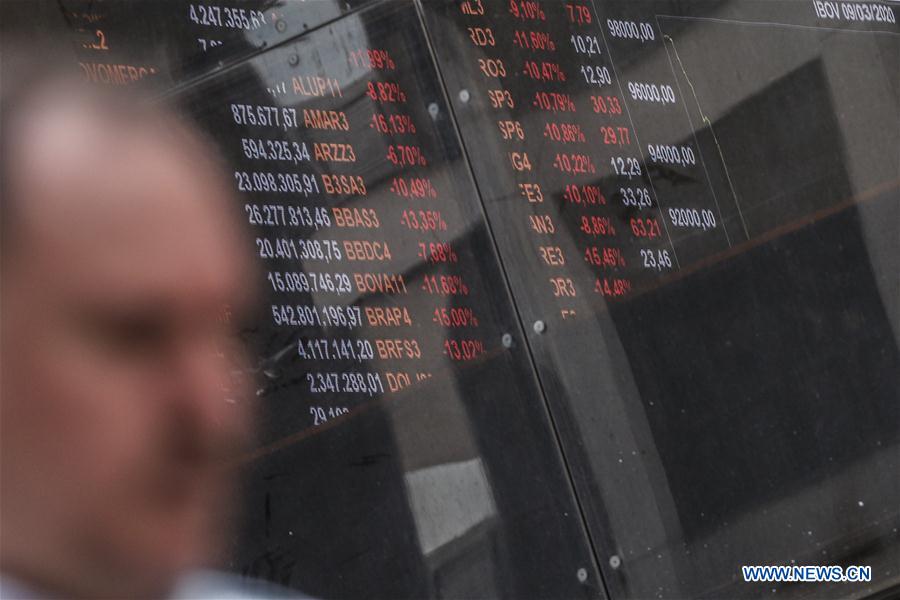
A man passes by the facade of a stock exchange in Sao Paulo, Brazil, March 9, 2020. Plummeting oil prices amid the potential fallout from a coronavirus pandemic impacted stock markets on Monday, including Sao Paulo's, which opened with a 10-percent drop. The steep fall triggered a so-called circuit breaker, a measure that suspended operations for half an hour. (Photo by Rahel Patrasso/Xinhua)
SEOUL, March 10 (Xinhua) -- Expectations are divided among South Korean market experts for the global economy and stocks over the COVID-19 spread across the globe and the oil price crash.
"While global stocks tumbled over the COVID-19 and crude price plunge, it will not lead to a global financial crisis," the head of global stock research at a local brokerage in Seoul, who declined to be identified, told Xinhua Tuesday.
Despite the pandemic fear emerging in the market, the fatality rate remained relatively low compared to the previous infectious diseases, while the confirmed cases in the United States and Europe would go down in the end following a near-term surge as seen in China and South Korea, the research head forecast.
U.S. stocks plunged over 7 percent in the worst day since the 2008 global financial crisis on Monday, with the rout reaching 7 percent minutes after the open and the circuit breakers triggered to halt trading for 15 minutes.
Crude futures tumbled more than 20 percent in the trading overnight, and European stocks plummeted amid rising worry about the spread of the COVID-19 across Europe.
The oil price crash came as Saudi Arabia and Russia embarked on a price war by vowing to ramp up oil productions, hitting the already exacerbated demand caused by the expected global economic slump.
Signs of a slowing trend in the daily infected patients were seen in East Asia, but infections recently grew fast across Europe, prompting Italy to launch a nationwide lockdown.
"The global economy will show a V-shaped recovery after the confirmed COVID-19 cases begin to slow down owing to countermeasures taken by affected countries," the research head said.
He forecast that oil-producing countries are highly likely to consider the oil supply cut in the end as the lower price leads to difficulty for their fiscal status.
South Korea reported 131 more COVID-19 cases on Monday, bringing the total number to 7,513. It was the slowest daily increase in two weeks and far below the daily growth of 500 or more last week.
The South Korean government unveiled 11.7 trillion won (9.8 billion U.S. dollars) of supplementary budget last week to bolster private consumption and help fight against the COVID-19.
The U.S. Federal Reserve had an emergency meeting last week, slashing its target rate by 50 basis points to a range of 1.00-1.25 percent in its first emergency move since the 2008 global financial crisis.
Han Dae-hoon, a stock analyst at SK Securities, said in a report that the future market moves depend on the Fed's actions, noting that if the Fed unveils market stabilizing measures, such as the liquidity supply larger than expected through quantitative easing (QE), global stocks would stabilize more or less.
The analyst forecast that the panic in the global stock market would continue only with the Fed's rate cut. The Fed's regular rate-setting meeting is scheduled for next week.
Expectations for a bear market remained. "A possibility mounted for the global economic recession. A possibility for the global financial crisis cannot be ruled out completely," Seol Tae-hyun, a stock analyst at DB Financial Investment in Seoul, told Xinhua.
"The risk of the COVID-19 is unpredictable because it is an infectious disease ... During the global financial crisis, we were able to predict fiscal and monetary countermeasure from a traditional perspective," Seol said.
The analyst forecast that the global economic indicators would worsen though it is expected to emerge with a time interval across the globe, saying the world economy would show a moderate recovery after uncertainties go away.
Oh Tae-dong, a stock strategist at NH Investment & Securities, said in a report that the South Korean stock market already priced in the oil price plunge and the weakened domestic demand from the COVID-19, but he forecast that local stocks would get back into a real recovery track after the recovery of global stocks.
The benchmark Kospi index rose 0.42 percent to close at 1,962.93 on Tuesday, after dropping over 4 percent in the previous day. The won/dollar exchange rate finished at 1,193.2 won per dollar, down 11.0 percent from a day ago.
