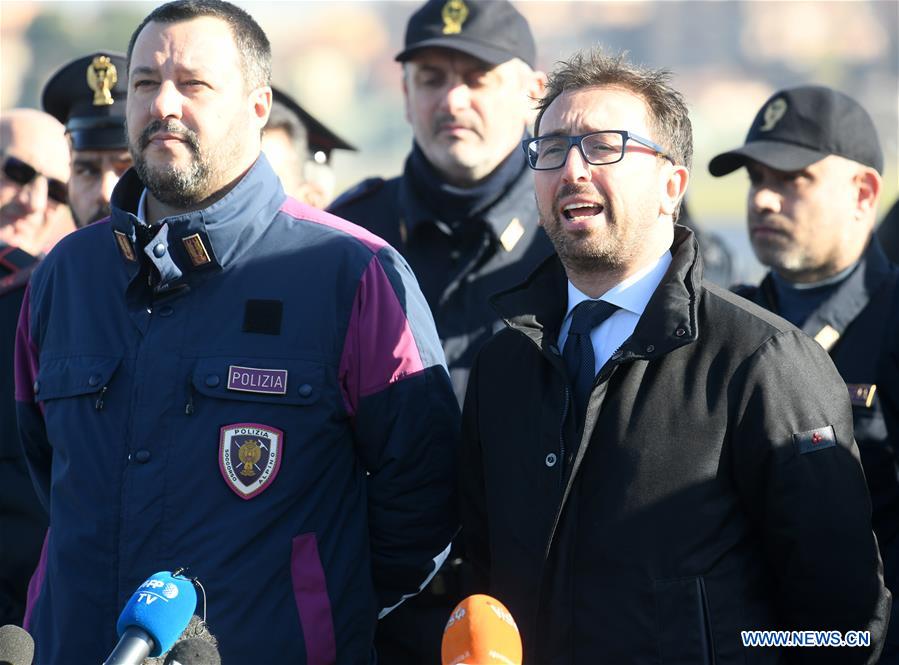
Italian Justice Minister Alfonso Bonafede (front, R) and Interior Minister Matteo Salvini (front, L) give a statement to media after the arrival of former left-wing militant Cesare Battisti at the Ciampino Airport in Rome, Italy, Jan. 14, 2019. Cesare Battisti was extradited to Italy on Monday from Bolivia, where he was captured over the weekend by Italian, Brazilian and Bolivian agents after 38 years on the run. (Xinhua/Alberto Lingria)
ROME, Jan. 14 (Xinhua) -- Former left-wing militant Cesare Battisti was extradited to Italy on Monday from Bolivia, where he was captured over the weekend by Italian, Brazilian and Bolivian agents after 38 years on the run.
Italian Justice Minister Alfonso Bonafede and Interior Minister Matteo Salvini were on hand at Rome's Ciampino Airport, where the militant landed shortly after 11:30 a.m., as shown live on Rainews 24 public broadcaster.
Battisti, 64, a former member of the far-left Armed Proletarians for Communism, had been a fugitive in Mexico, France and Brazil since breaking out of an Italian prison in 1981.
He was captured Saturday in the Bolivian city of Santa Cruz de la Sierra on an international arrest warrant issued by prosecutors in Milan, where he was convicted in absentia to two life sentences for four murders that took place in Italy in the 1970s.
The victims were Maurizio Campagna, an agent of Italy's DIGOS anti-terrorism special operations unit, Lino Sabbadin, a butcher, Pierluigi Torregiani, a jeweler, and Antonio Santoro, a penitentiary police officer.
Battisti has always denied committing the murders, which took place during the so-called "years of lead" in Italy, which lasted throughout the 1970s and were marked by a number of bloody attacks by both extreme left and extreme right-wing militant groups.
In televised comments at Ciampino Airport on Monday, Salvini called Battisti "a murderer, a criminal, a coward who never repented," adding that "this is not a point of arrival but one of departure" because a number of convicted former militants "are still out there enjoying life" instead of in prison in Italy.
"My thoughts go out to the relatives of the victims, whom I hope to meet soon at the interior ministry," said Salvini, thanking Brazilian President Jair Bolsonaro and the Bolivian authorities for aiding in Battisti's capture.
"Today we tell the world that no one can escape Italian justice," said Bonafede. "We are talking about a multiple murderer, who committed extremely serious crimes and whose escape mortified the pain of the victims' families."
At a joint press conference with Salvini and Bonafede later in the day, Prime Minister Giuseppe Conte praised the "great teamwork of intelligence services, police and Interpol" in achieving "a great result." "We owed it to the relatives of the victims, it was necessary to ensure (Battisti's) sentence would be served," said Conte.
Salvini said that "we are working on the cases of dozens of militants who are not serving their sentences in an Italian prison, and we already have positive feedback on some of them."
News of Battisti's capture broke in Italy in the small hours of Sunday, sparking comments from top officials and relatives of the victims.
In a statement Sunday, Italy's President Sergio Mattarella expressed "satisfaction" at Battisti's arrest in Bolivia in hopes that he "will serve his sentence for the serious crimes he committed in Italy, and that the same happens for all fugitives abroad".
Alberto Torregiani, who has been in a wheelchair since the 1979 shooting that killed his father Pierluigi and left him disabled, said in televised comments that "after (almost) 40 years, my father and the other victims can finally rest in peace".
Italy has repeatedly sought the extradition of Battisti, who lived abroad for years under the protection of former leftist Presidents Francois Mitterrand of France and Luiz Inacio Lula da Silva of Brazil.
Brazil's current far-right President, Bolsonaro, vowed during his campaign that if elected, he would extradite Battisti to Italy. Outgoing Brazilian President Michel Temer signed an extradition order in December for the Italian ex-militant, who by then had gone underground.