



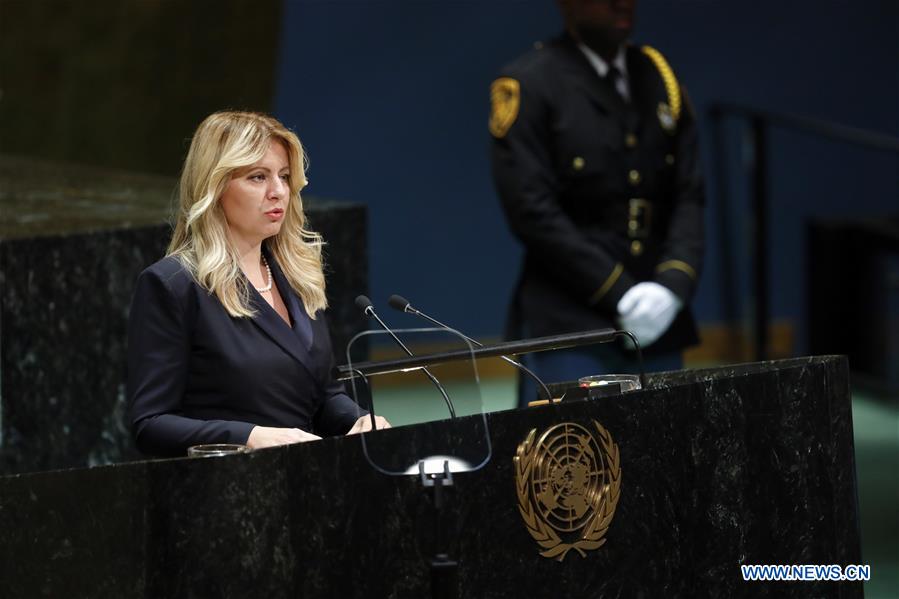
Slovak President Zuzana Caputova addresses the General Debate of the 74th session of the UN General Assembly at the UN headquarters in New York, Sept. 24, 2019. World leaders attending the ongoing General Debate of the 74th session of the United Nations General Assembly (UNGA 74) on Tuesday voiced strong support for multilateralism and called for international cooperation to tackle common threats and challenges together. (Xinhua/Li Muzi)
UNITED NATIONS, Sept. 24 (Xinhua) -- World leaders at the ongoing General Debate of the 74th session of the United Nations General Assembly (UNGA 74) on Tuesday voiced strong support for multilateralism and called for international cooperation to tackle common threats and challenges together.
Croatian President Kolinda Grabar-Kitarovic said that "joining forces" should be the fairly simple way to respond adequately to emerging threats.
"It is upon us to address the greatest challenges of the globalized 21th century: climate change, sustainable development, migration, terrorism, weapons of mass destruction and new technologies," said the Croatian president.
South Korean President Moon Jae-in also called for international cooperation, noting that "the Sustainable Development Goals of the United Nations and the Paris Agreement on climate change are major tasks that we must achieve through multilateral cooperation."
"We come here in recognition of a simple reality -- this General Assembly is vital to meet the dangers and seize the opportunities of our world," said King Abdullah II of Jordan.
Collective action is "the promise" of the United Nations, he said.
"This organization was created by the specific, individual actions of member countries, coming together to shape a better future," the king added.
"And today, we still urgently need each and every member country to act -- to act together with our global neighbors and achieve the better, safer world all of us need," he said.
"The world faces enormous and diverse cross-border challenges between peoples and states and that imposes on us multilateral action, especially when it comes to risks threatening international peace and security, environmental issues, sustainable development, asylum and immigration," said Qatari Emir Sheikh Tamim bin Hamad Al Thani.
"In the situation of international peace and security, nothing can replace the wisdom of leaderships, especially those of the major powers, who are capable of embracing the purposes of the United Nations Charter," he said.
"We have no means at our disposal other than activating the mechanisms adopted by the international community in the field of collective security, deterring international law violators, ensuring the respect for the sovereignty and security of states, prohibiting the occupation and annexation of the lands of others by force or changing their nature, and preventing armed conflicts by means of peaceful resolution of disputes," he added.
"We stand for multilateralism in international relations, as it alone contributes effectively to the world's peace and security," said Angolan President Joao Lourenco.
"For this reason, it is never too much to insist on the need for a deep reform of the United Nations Organization, so that it can better fulfill its great responsibility for conflict management and resolution and war prevention," said the president.
Portuguese President Marcelo Rebelo de Sousa voiced his support for "an effective multilateralism, based on international law and the Charter of the United Nations and its legal extension to new global realities such as the environment and climate change, the oceans, data protection, cybersecurity, combating terrorism and artificial intelligence."
"Nobody is an island and nobody can, alone or with a handful of allies, address the increasingly complex problems affecting everybody," said the president.
"The world and life change so much and we have seen a great deal of geostrategic change in less than 40 years. We and our descendants will witness many more, ever faster changes in the next 40 years," he added.
Dutch King Willem-Alexander said that the Netherlands "is convinced that close collaboration within a broad-based partnership of states offers the best guarantee of freedom, security and prosperity for all."
"The fight against poverty and inequality is best served by joining forces at the international level," he added.
Slovak President Zuzana Caputova said that more and more often "we hear leaders speaking about putting their national interest before the global good. And yet, the best way to be patriotic actually lies not in national egoism, but in cooperation."
"Let us use this opportunity to become the generation, which laid the foundations for cooperation based on the common sense of our shared destiny," she added.
The General Debate of UNGA 74 opened Tuesday at the UN headquarters in New York with the theme of "Galvanizing multilateral efforts for poverty eradication, quality education, climate action and inclusion."
