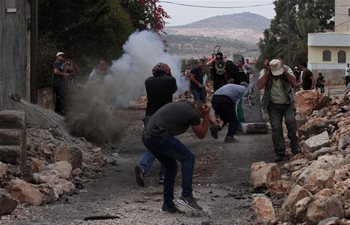
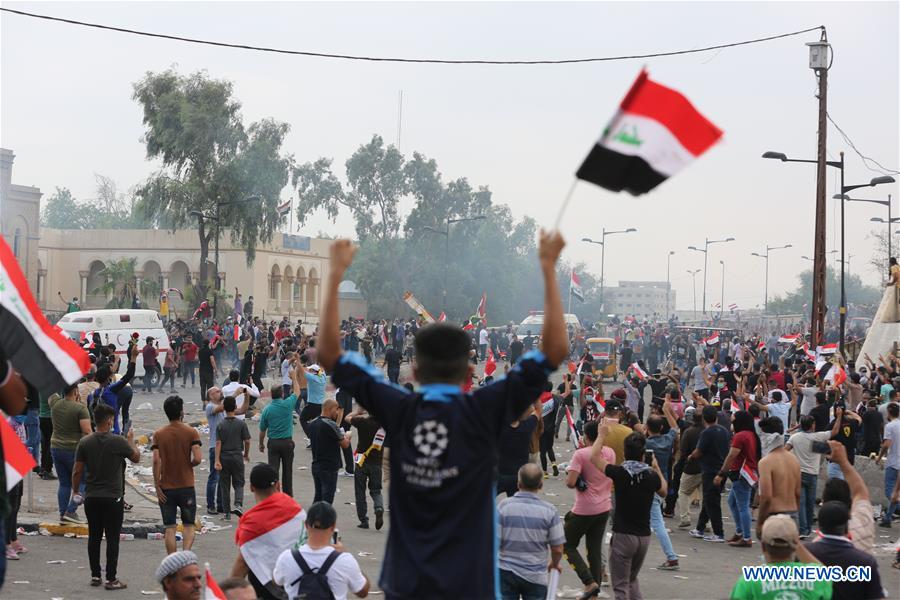
Protesters demonstrate in Baghdad, Iraq, on Oct. 25, 2019. Hundreds of protesters rallied Friday in some Iraqi cities including capital Baghdad, amid the resumed anti-government demonstrations over unemployment, corruption and lack of public services. (Xinhua/Khalil Dawood)
BAGHDAD, Oct. 25 (Xinhua) -- Hundreds of protesters rallied Friday in some Iraqi cities including capital Baghdad, amid the resumed anti-government demonstrations over unemployment, corruption and lack of public services.
In Baghdad, hundreds of demonstrators managed overnight to cross one of the main gates of the heavily fortified Green Zone, which houses the main government offices and some foreign embassies, but were forced to retreat after the riot police used tear gas and water cannons to disperse the crowds.
Since early morning, protesters poured into the Tahrir Square in downtown Baghdad on the eastern side of the Tigris River and frequently tried to cross the nearby al-Jumhouriyah Bridge to reach the Green Zone, but were also prevented by the riot police.
The repeated attempts to cross the bridge pushed the security forces to completely close it with three-meter high concrete blocks.
Friday protests also broke out in other cities in several southern and central provinces, including Dhi Qar, Basra, Maysan, Diwaniya, Muthanna, Karbala, Wasit and Najaf, where protesters called for reform, accountability for corrupt people and job opportunities, according to Iraqi media and activists.
Ali al-Bayati, a member of the Iraqi Independent High Commission for Human Rights, said in a brief statement that the "casualty in the new wave of protests so far rose to two killed and 67 others wounded."
He also said that more than 40 members of security forces were wounded in the clashes, adding there are strict instructions for the security forces to "deal with high professionalism with the demonstrators," and the forces that prevent demonstrators crossing al-Jumhouriyah Bridge were not armed.
Meanwhile, Shiite cleric Ayatollah Ali al-Sistani called on both the protesters and the security forces to be fully committed to the peacefulness of the demonstrations and prevent violence and sabotage.
The demonstrations came after Prime Minister Adel Abdul Mahdi made a televised speech, in which he warned of chaos if the government resigns, and promised a cabinet reshuffle, more job opportunities and the establishment of a court to prosecute corrupt officials should he remain in power.
Earlier this month, massive protests erupted in Baghdad and other central and southern provinces over similar reasons.
The Iraqi government responded with presenting packages of reforms aimed to provide job opportunities, build housing complexes and pay stipends to the poor, as well as scaling up the fight against corruption.
On Oct. 22, a high-level panel tasked with a probe into the killing of some 150 protesters during the wave of anti-government protests announced its final report, and recommended sacking and prosecuting a number of security officers.
The panel confirmed that there were no direct orders from the high-level security authority to open fire at protesters. Some security officers used excessive force with live ammunition due to their "weak command and control during the protests" that led to high casualties.