



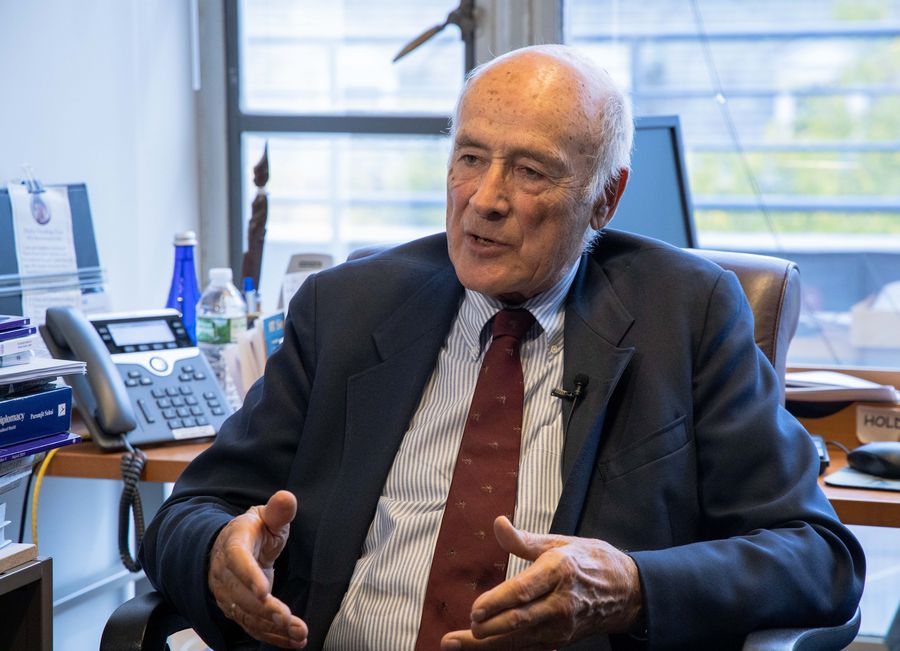
Prof. Joseph Nye speaks in an interview with Xinhua at Harvard University in Massachusetts, the United States, Oct. 8, 2019. (Xinhua/Xie E)
A renowned political scientist suggests that China and the United States, now in a difficult relationship, draw inspiration from the rules of Ping-Pong.
by Miao Xiaojuan
BOSTON, the United States, Oct. 30 (Xinhua) -- Few would disagree that a respected player of Ping-Pong, or table tennis, must have accurate judgment, swift response and an open attitude to shake hands with his or her opponent win-or-lose.
Nearly five decades after Ping-Pong helped break the ice between China and the United States, a renowned political scientist has suggested that the world's two largest economies, now in a difficult relationship, draw inspiration from such rules of the game.
"There could be many games where China wins or the United States wins. But as long as we shake hands at the end and have the enjoyment of another match, then we are both better off," said Joseph Nye, Harvard University's distinguished service professor, emeritus and former dean of Kennedy School of Government.
"We have a lot to gain from making sure our competition doesn't become so severe that we miscalculate into violent conflict, and that we don't forgo the areas where we have a lot to gain from cooperation," Nye told Xinhua in an exclusive interview.
Nye, who pioneered the theory of soft power, is known as one of the most influential scholars in international relations and policymaking.
Citing U.S. Vice President Mike Pence's hawkish speeches against China as an example, Nye said there was a danger of exaggerating the fear of China and declaring a "new Cold War."
"We have to accept that our systems are going to be different and we are not going to agree on many aspects, but we can still live with each other," Nye said, stressing that the two countries do not present an existential threat to each other.
"What we need is a clear appraisal of where we have common interests and where we have differences and figure out how to manage them," he added.
Once a poor country isolated by the West, China is now the world's second largest economy and leading engine of growth, as well as a global leader in innovation and a major player in global governance.
"China has done a very good job of raising hundreds of millions of people out of poverty. Chinese economy will continue to do well and Chinese strength will continue to increase," Nye said.
China has gained a great deal of soft power from its traditional culture and successful economic performance. Initiatives like the Belt and Road, under which China helps other countries to develop important infrastructure, has also increased its soft power, according to Nye.
Calling China's continued rise a natural process that the United States should be able to manage, he said: "The Chinese power will rise and we are going to have to accommodate that."
Contrary to what some American politicians have thought or said, Nye believes that the United States is not being replaced by China and called on the two countries to cooperate.
"The United States is acting foolishly, but not in decline," he said.
He suggested that the two countries cooperate on dealing with climate change, maintaining international financial stability, developing a stable trading system and dealing with global health issues, among others.
In terms of reducing the hard edges of mistrust and fear of the other side, Nye called on the United States and China to further strengthen people-to-people exchanges and improve their soft powers.
"If we can make ourselves attractive to each other in ways that we reduce fears and miscalculations, it's a win-win," he said.
As 2019 marks the 40th anniversary of China-U.S. diplomatic ties, Nye said, if Ping-Pong Diplomacy were to come into play again, the most needed would be the spirit of the game for the next 40 years.
"Friendship first, competition second -- that's what a healthy relationship is all about," he said. (Xinhua correspondents Guo Peiran and Xie E in New York also contributed to the story.)■
