



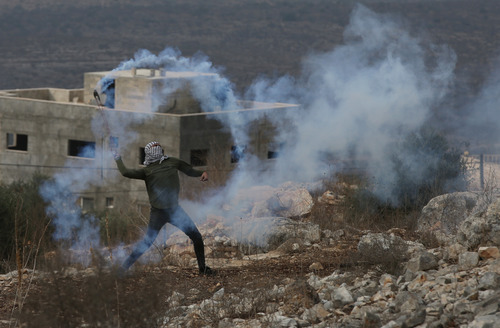
A Palestinian protester uses a slingshot to throw back a tear gas canister fired by Israeli soldiers during clashes, after a protest against the expanding of Jewish settlements in Kufr Qadoom village near the West Bank city of Nablus, Nov. 15, 2019. (Xinhua/Ayman Nobani)
If Israel annexes some of the Palestinian territories in occupied West Bank, it "means completely destroying and forcibly displacing us," feared a Palestinian villager living in Jordan Valley.
RAMALLAH, Nov. 21 (Xinhua) -- Palestinian farmer Yousef Asmar, who lives in a remote village in the West Bank's Jordan Valley, worries about what the future may hold for him and his family, amid threats by Israel to annex the area.
Asmar, 42, lives in Khirbet Makhoul village and earns his living from herding and farming, like the majority of the area's residents.
He said he is gravely concerned with the repeated Israeli threats to impose its sovereignty over the Jordan Valley, which may affect the future of his family.
He told Xinhua that the possibility of Israel declaring its sovereignty over the area "means completely destroying and forcibly displacing us."
He said he is attached to the small lot of land, which is about 0.65 square km, where he plants wheat and barley.
"I have no other job. My capital and my main source of living is my land," he said. "If they force us to leave or prohibit us from planting, we will be displaced."
He went on complaining about the lack of irrigation water due to Israeli restrictions on Palestinians' water consumption, which forces farmers to limit their agricultural activity.
He said he believes this is part of an Israeli scheme to evict Palestinians from the Jordan Valley.
The Palestinian Jordan valley constitutes 28 percent of the West Bank. It is home to nearly 65,000 Palestinians, including the population of Jericho, which amounts to 2 percent of the Palestinian population, according to official data.
For Palestinians, the Jordan Valley, which is located in the east of the West Bank, on the borders with Jordan, is considered a vital and integral part of their future state for its strategic location and fertile lands.
Israeli Prime Minister Benjamin Netanyahu, during his last electoral campaign in September, said that Israel will annex the Jordan Valley and impose its sovereignty over West Bank settlements for security concerns in the long run.
Around half million Israeli settlers live in the West Bank settlements, including East Jerusalem, according to Israeli sources.
UN data shows there are 31 Jewish only settlements built in the Jordan Valley with a population of some 8,000 settlers. Since its occupation of West Bank in 1967, Israel has set up some 90 military posts in the area and forcefully evicted a number of Palestinians.
Palestinians generally fear that Israel will take over more than 60 percent of the West Bank, by confiscating lands that have been put under its control in the 1993 interim Oslo accords.
Under the accords, the West Bank was divided to three areas: Area A under total Palestinian control, Area B under Palestinian control and Israeli security control, which makes up around 22 percent of the West Bank, and Area C under full Israeli control which takes up over 60 percent of the West Bank's 5,655 square km area.
Palestinian land and settlement expert Khalil Tafakji warned that Israel could impose its control over the entire eastern part of the West Bank and cut off its geographical continuity with the rest of the territory.
Tafakji told Xinhua that he believes Israel will seek to surround Palestinian villages and communities in the Jordan Valley and will not allow its expansion.
"The annexation is aimed at exploiting large agricultural areas and allowing Israel to invest in them, building more settlements and legalizing settler outposts, not for security reasons as they claim, because it already has a peace agreement with Jordan," he explained.
Palestinian Authority's settlement watchdog said that 19 communities, home to 3,700 Palestinians, in the Jordan Valley are at risk of forced displacement by Israel.
Palestinians' fear for a possible annexation of large areas of the West Bank increased after U.S. Secretary of State Mike Pompeo recently said the U.S. administration considers "the establishment of Israeli civilian settlements in the West Bank is not, per se, inconsistent with international law."
Many believe that Pompeo's statements will encourage Israel to press ahead with its threats.
Israeli settlement activity, deemed illegal by most world powers and under international law, is considered one of the issues that have hindered the Israeli-Palestinian peace talks. ■
