



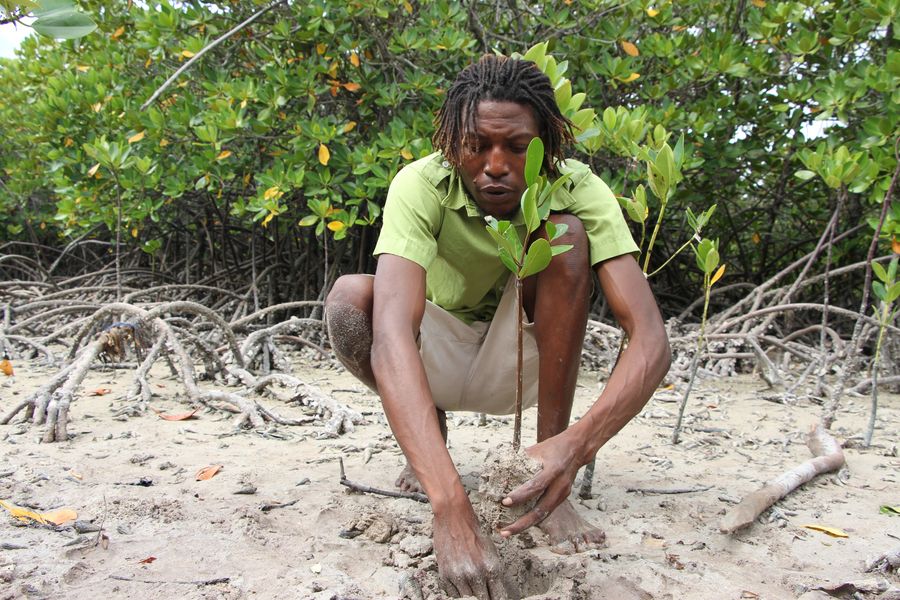
Alex Thoya, deputy chairman of the Mida Creek youth group, re-planted a mangrove tree along the Mida creek in Malindi, Kilifi County, Kenya, on Nov. 6, 2019. (Xinhua/Peter Mutai)
An eco-tourism project in coastal Kenya that invites local youths to plant mangroves and improve the environment proves an innovative way to achieve multiple benefits, including boosting tourism business, creating jobs, and giving back to the community.
NAIROBI, Nov. 22 (Xinhua) -- It is 7 a.m. in the morning and all members of the Mida Creek youth group in Malindi of Kenya's costal Kilifi County are up and attending their first meeting meant to allocate roles for the day.
The 28 youngsters divide roles ranging from canoe riding, restaurant services and boardwalk maintenance.
All members, with exception of those manning the restaurant, embark on the removal of plastics that had been driven by ocean waves and replanting of mangroves along the coastal creek.
"The activities are important to us because it is here that we earn our living and also assist less fortunate members of this community, including paying bursary fees to bright students," Kibwana Ali Bakari, the group's projects coordinator told Xinhua during a recent interview.
Bakari revealed that they formed the group as a way of creating employment and also to help raise awareness on environmental conservation in their locality.
He said that the beach around the creek where they are based grappled with degradation of mangroves and the beach was filthy following increasing garbage that continues to appear.
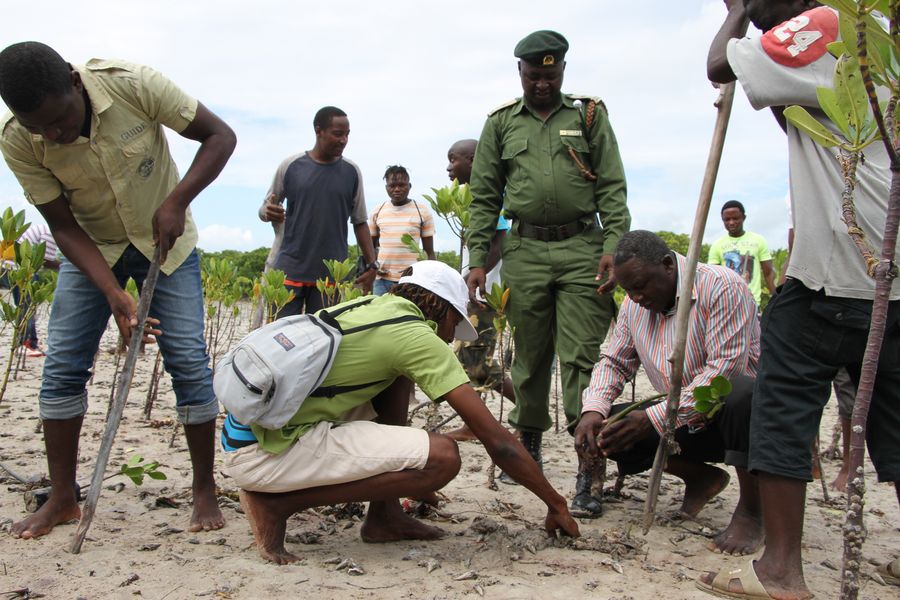
Members of the Mida Creek youth group, the Kenya Forest Service, and Gede Community Forest Association planted mangrove along the Mida creek in Malindi, Kilifi County, Kenya, on Nov. 6, 2019. (Xinhua/Peter Mutai)
"Through our eco-tourism projects, we are proud of earning a living and also having paid secondary school fees for 900 orphaned students and others from poor families," said Bakari.
The money, he said, is generated from the only restaurant at the beach, sale of curios, boardwalk over the mangrove trees, leasing out boats to tourists and leasing of sandals to tourists talking a walk on the boardwalk.
He said that under their bursary scheme Arabuko-Sokoke Schools and Ecotourism Scheme, they assist people living near the forest.
"We engage them in the conservation of the forest and ensure that they benefit through our eco-tourism projects," said Bakari.
Eric Fondo, assistant ecosystem conservationist at Kenya Forest Service (KFS), said that the creek is an area of biosphere besides the Arabuko-Sokoke forest.
Fondo said that the youth group members and other community members have realized the importance of the forest as the water flows underground to the creek daily.
"Without the forest, the mangrove along the creek can all be wiped out," said Fondo, adding communities are now enjoying the benefits of responsible conservation.
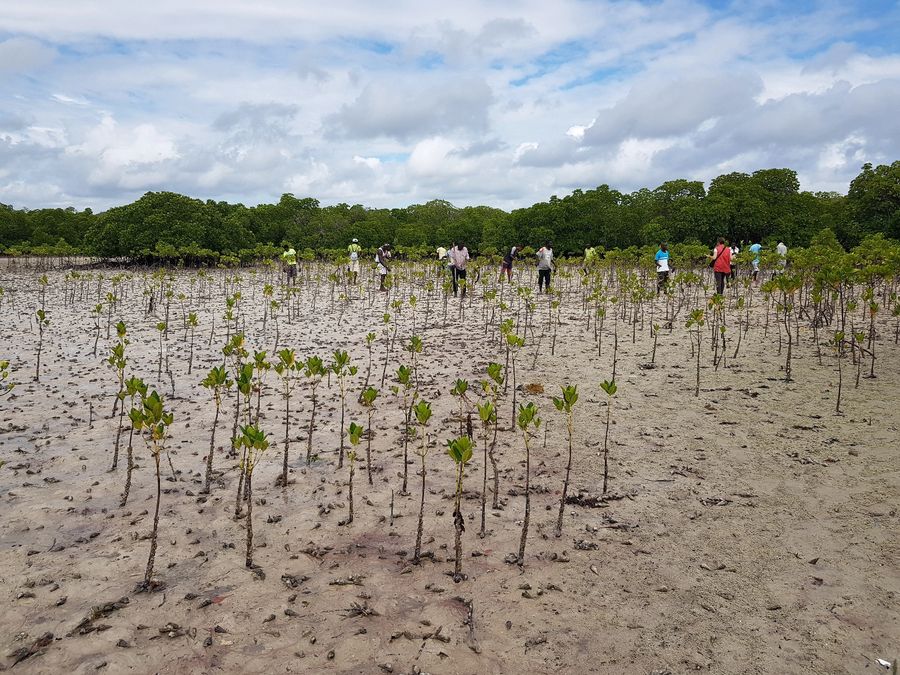
Members of the Mida Creek youth group were all out re-planting mangroves along the Mida Creek where they operate businesses to earn a living in Malindi, Kilifi County, Kenya, on Nov. 6, 2019. (Xinhua/Peter Mutai)
Griet Ingrid Dierckxsens, Africa regional knowledge management and communication specialist at the UN Environment said that in saving the forest and the adjacent mangroves, members of the youth group are helping store carbon that is fundamental for climate change adaptation.
Dierckxsens said that by adopting alternative livelihoods, the youth group has made a tremendous contribution in saving the forest.
Charo Ngumbao, chairman of Gede Community Forest Association that looks over Arabuko-Sokoke forest, noted that the community had to sit down with scientists from KFS and National Museum of Kenya to agree on how best to manage the forest and benefit at the same time.
"The youth group is an example of what good conservation practices can deliver," said Ngumbao.
Since the youth ventured into conservation of mangrove forest, the surrounding communities have stopped cutting indigenous trees.
The youth group in collaboration with villagers has helped plant about 10,000 seedlings in June and plans to plant 2,000 during the current short rains season. ■
