



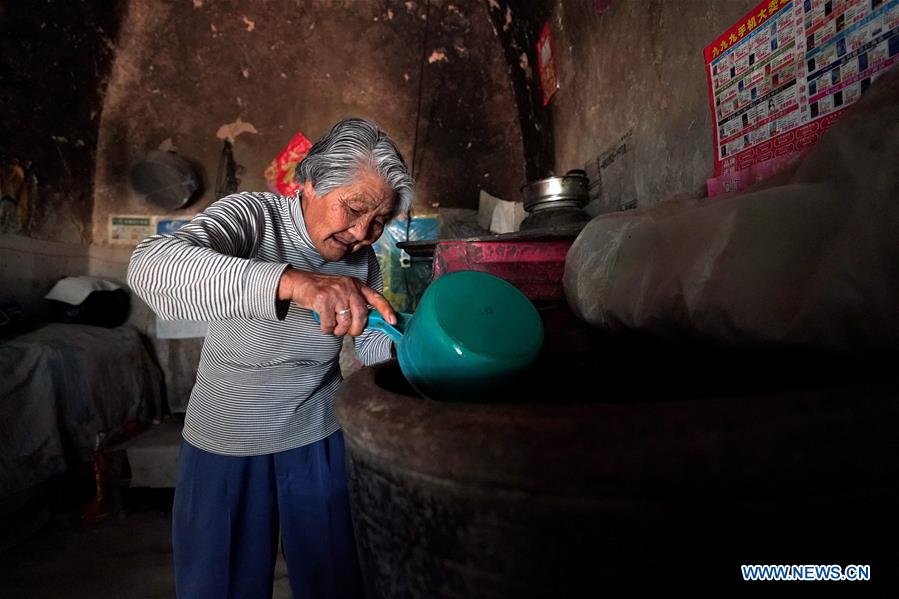
A villager checks her water stock at home in Nanling Village of Yicheng County, north China's Shanxi Province, July 3, 2019. As the switch was pulled, water spurted out from 403 meters down under. Nanling Village's very first deep-water well went into service on an early winter morning. In the past, the village, spreading across the ravines of the Zhongtiao Mountains in northern China, had relied solely on mud pits to store its valuable drinking water for centuries. Haunted by the fear of drought, generations had dreamt of direct access to drinking water but only ended up digging pits on dry grounds, craving for rain and snow water. There was even a saying about the scarcity of drinking water: "In Nanling, water is as dear as cooking oil." With the new well, the village's 786 residents no longer have to live at the mercy of Nature, as their ancestors had done. The preciousness of water in Nanling is highlighted by the fragility of local water security. There was a time when large storage jars were a necessity for every household in the village. Whenever it rained or snowed, the villagers would collect water dripping from the eaves with every container they could manage, and then transfer the garnered water to the jars or pits. On occasions of drought, unfortunately, the only way to get water was by travelling a long distance to the mountain streams. Back in the 1960s and 1970s, experts had asserted that there hardly existed enough underground water in Nanling, given the village's geology. Despite that, the struggle for water went on. In 2017, dire water shortage here prompted a discussion on drilling a deep-water well. The whole village responded with active support and donations, hoping the well could solve their water problems once and for all. By the end of 2018, the village had raised 350,000 yuan (about 50,000 U.S. dollars) to fund the long-awaited well. After paperworks were ready, the drilling began in May 2019. However, the drilling did not go smooth. At 100 meters under the ground, water only sprung for a few minutes. At 300, water disappeared within a dozen minutes. The drilling team was faced with a dilemma: to dig, or not to dig? The project ran into a cul-de-sac. Eventually the drilling team decided not to give up. By mid-October, when they bored 403 meters downwards, miracle occurred: underground water ran out at ten cubic meters per hour and for 170 consecutive hours. Villagers were moved to tears of joy at the sight of flowing water. Soon the water quality report followed: crystal clear and of good quality. At a completion ceremony for the well-drilling, villagers brought water containers with them and stood in lines before the water pipe. Some couldn't help drinking directly from the pipe. The era of "water slaves" ended. In the near future, an extended network of pipe water is expected to benefit every household in the village. (Xinhua/Zhan Yan)
