



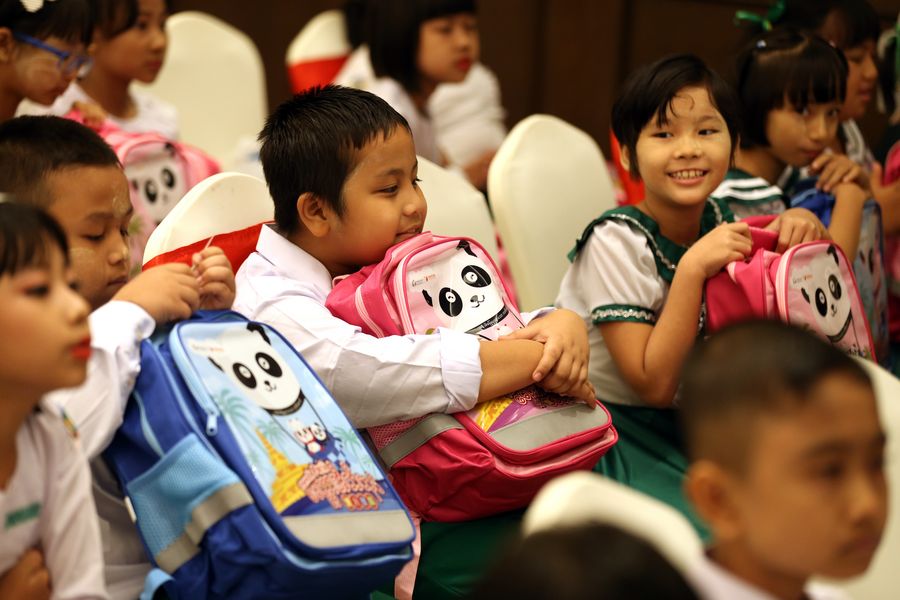
Students hold school bags with panda images during the ceremony for the 2019 Panda Pack donation and the 4th anniversary of China Foundation for Poverty Alleviation (CFPA) Myanmar Office in Yangon, Myanmar, Aug. 17, 2019. (Xinhua/U Aung)
"The Chinese program staff are very hardworking and have a strong spirit of team work. They help to raise the living standard in the village and empower the people to pursue a better life," said U Khant Zaw, director general of Department of Rural Development of Myanmar's Ministry of Agriculture, Livestock and Irrigation.
by Xinhua writers Wang Chenxi, Che Hongliang, Zhang Dongqiang
NAY PYI TAW, Jan. 18 (Xinhua) -- Kin Thi Tar Tun once had to pump water out from the ground for drinking.
In her memories, residents in rural areas of Myanmar's capital city of Nay Pyi Taw used to live in wooden or bamboo made cottages without running water.
The 47-year-old villager said the underground water was not suitable for drinking, resulting in many health problems.
But those days have gone in Aye Chan Thar village in rural Nay Pyi Taw, thanks to a China-Myanmar pilot program, which helped the region acquire drinkable water from a reservoir.
"Now we have safe drinking water, no worry about it any more," said Kin Thi Tar Tun.
In November 2017, China and Myanmar signed a pilot program agreement, which aims to reduce poverty in Myanmar by referring to China's experience. The bilateral program includes upgrading rural infrastructure, enhancing public service quality and fostering farmers' self-sustainability.
Aye Chan Thar village became one of the first two local towns to run such pilot program. In January 2018, experts and technicians from the International Poverty Reduction and Development Center of China's southern Yunnan province came to the village to improve its water supply, traffic condition, education facility and health infrastructure.
At the end of 2018, China's experts helped the village build water facilities to obtain water from a reservoir three kilometers away.
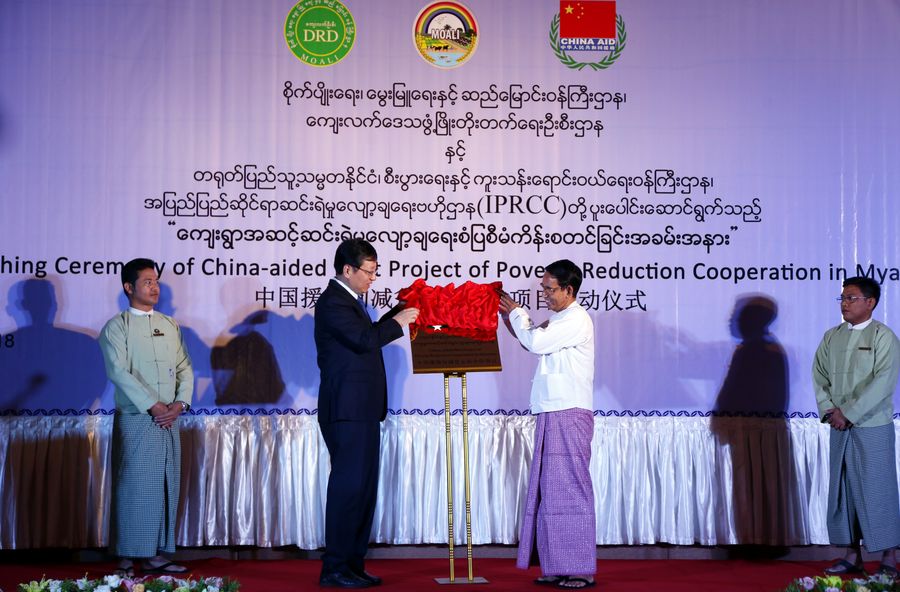
Myanmar Minister of Agriculture, Livestock and Irrigation Aung Thu(2nd R) and Chinese Ambassador Hong Liang(2nd L) unveil during a launching ceremony of a China-aided project in Nay Pyi Taw, Myanmar, Feb. 1, 2018. A China-aided pilot project of poverty reduction was launched with a view to improving the infrastructure of villages and raising the level of public services and self-development capacity in Myanmar.(Xinhua/U Aung)
Besides, the muddy road in front of Kin Thi Tar Tun's house was rebuilt with cement. A new clinic now stands opposite her house.
The village's middle school used to be dilapidated, without sufficient classrooms and teachers' dormitories. The China-Myanmar program refurbished the school by cementing floors and ceilings, and adding teachers' dormitories and a library.
The poverty reduction efforts have taken local villagers' needs into consideration, said Yin Zhenxiang, a program community coordinator from China, who has been in the village since 2018.
"We have considered the situation in the village and try to encourage the villagers to start their own business," Yin said.
Aung Soe Win, another resident from the village, once made his life as a migrant worker. Now helped by agricultural experts, he has become an experienced vegetable farmer.
"Folks here know my vegetables are good, and many come to buy from me," Aung Soe Win said.
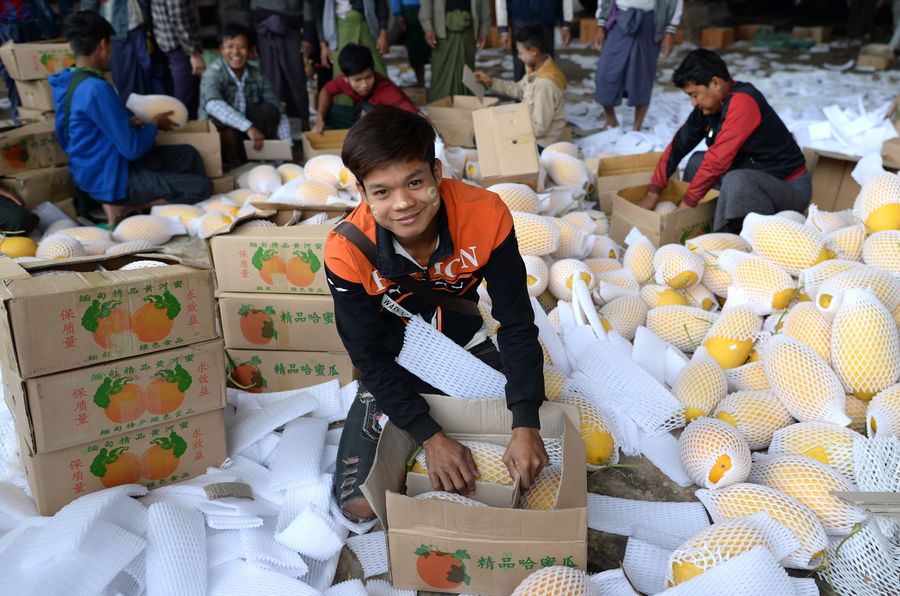
A worker from Myanmar transports melons at a market near Wanding port in Ruili City, southwest China's Yunnan Province, March 8, 2019.In 2017, the two countries signed a memorandum of understanding on the set-up of the economic cooperation zone along the China-Myanmar border. More mutual exchanges in wider sectors of education, culture, arts and sports also strengthen the ties between China and Myanmar. (Xinhua/Qin Qing)
In November 2019, over 90 representatives from the Association of Southeast Asian Nations and the Food and Agriculture Organization of the United Nations visited Aye Chan Thar village.
U Khant Zaw, director general of Department of Rural Development of Myanmar's Ministry of Agriculture, Livestock and Irrigation, said the two villages now have better roads, drinking water and electricity supply.
"The Chinese program staff are very hardworking and have a strong spirit of team work. They help to raise the living standard in the village and empower the people to pursue a better life," he added.
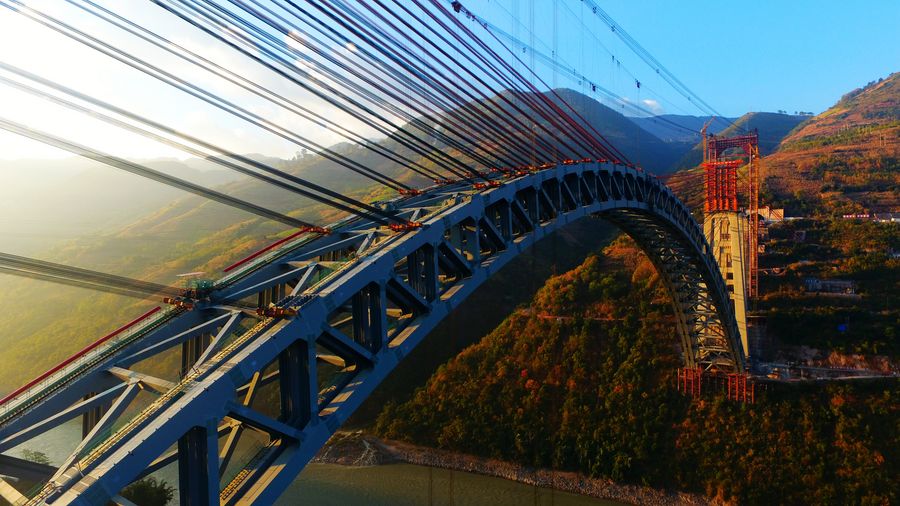
Photo taken on Dec. 10, 2018 shows the railway arch bridge across the Nujiang River in southwest China's Yunnan Province. The bridge is a key project of the 220-kilometer-long Dali-Ruili railway which is a key section of the China-Myanmar international railway corridor linking Kunming, the provincial capital of Yunnan, with Yangon of Myanmar. (Xinhua)
Under the program, some villagers visited China's capital city of Beijing and the southwestern province of Guizhou to learn how to grow crops and vegetables.
Kin Thi Tar Tun once visited Guizhou and saw China's farmers growing crops in small farmland in mountainous areas.
She brought back some corn seeds and sowed them in the way she learnt in China. Now the corn has yielded ears in her land. ■
