



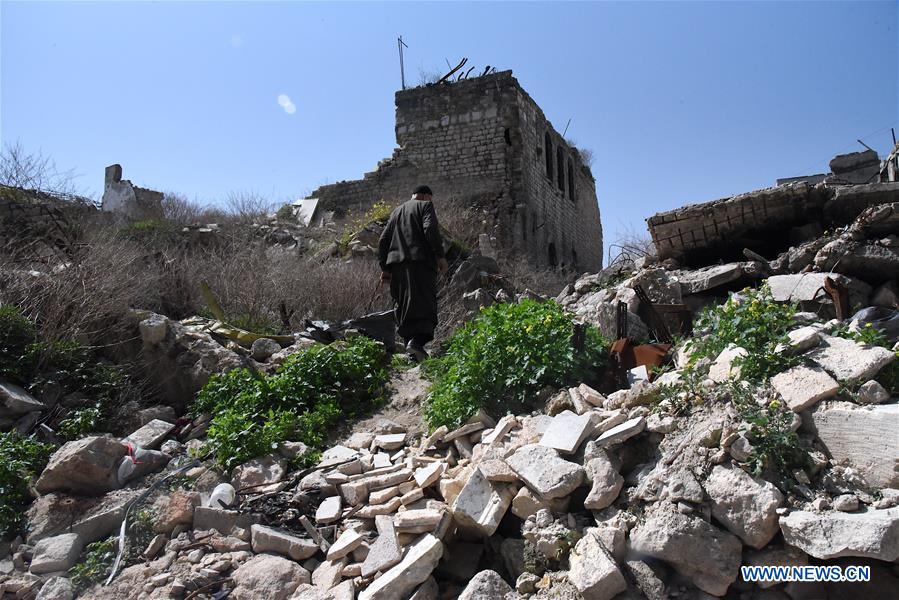
Abu Subhi, a 62-year-old man, climbs piles of debris to get to his shattered home in Aleppo city, northern Syria, on March 11, 2020. The Syrian war is entering its 10th year, and the living people are trying to pull themselves together with the burdens of war still hanging over their shoulders. (Photo by Hummam Sheikh Ali/Xinhua)
by Hummam Sheikh Ali
ALEPPO, Syria, March 13 (Xinhua) -- The Syrian war is entering its 10th year, and the living people are trying to pull themselves together with the burdens of war still hanging over their shoulders.
Aleppo is one of the Syrian cities that have witnessed all kinds of woes during the war.
Almost everyone has suffered a certain loss, whether losing a family member, losing homes or reeling under tough economic hardships.
LOSING HOME
For Abu Subhi, a 62-year-old man, the hardest hit he took during the war was getting displaced several times after his home in old Aleppo was reduced to ruins during the battles there.
The man returned four years ago, when the war ended in eastern Aleppo, to find his home completely destroyed except for one room.
"A palace" that is what he called it, once a big house that grouped the entire family on happy occasions.
Now, the old man climbed piles of debris and rubble to get to the ruins of his shattered home, a view that resembles the remains of Titanic under the ocean.
On what used to be a window, Abu Subhi sat and looked into the destruction around him, remembering the old sweet memories he had in every corner.
"We lived in bliss and that bliss was a great one but when the war came, we lost everything. I lost lots of money and got displaced several times," the man told Xinhua.
On the biggest loss during the war, he said it's his "palace" because his best memories and moments were in that house.
"This home is the most precious to me and it's still my only hope even though it's destroyed. I come here and cry because I had lived the most beautiful days of my life here," he said.
After his loss, the man is still in despair, as his children and grandchildren left the country during the war and now he lives with his wife in another area in Aleppo.
He said it has been a long time since he laughed from his heart. "It's only the lips that smile today, but my heart is crying," he told Xinhua.
"Around 50 people used to gather in this home; my children and grandchildren. Today all I have is a memory," he said.
Abu Subhi now works in his shop, selling tablecloths to make a living.
The job provides a venue for him to socialize with his neighbors and try to take his mind off the calamities he had suffered during the war.
ECONOMIC HARDSHIP
Um al-Noor, a woman in her 50s, is another example from Aleppo. The woman had enjoyed a very comfy life ahead of the war, as she used to work as a DJ in women-only parties, a part-time job just to keep her amused.
Today, the woman is working on a taxicab, which is a job usually for men in Syria. The woman's health is not that good and she lost her son in the beginning of the war while he was in the military service.
Working 12 hours per day, al-Noor said it still cannot afford much of her needs.
Al-Noor is one of the thousands of women who found themselves facing the tough war and life conditions alone.
"The war was so unfair and it got us here. All Syrians know that the women in Aleppo were pampered ahead of the war, but during the war, we have worked in everything for our livelihood," she told Xinhua.
DOUBLE LOSSES
Lilas Nabhan, a 10-year-old girl, has suffered twice at the same time: losing her father and her leg by a blind mortar shell.
It happened in 2016, when the rebels were still in Aleppo's eastern part. Nabhan had just finished a visit to her grandmother's house on the occasion of the Muslim feast, when she wanted to buy some candies.
Asking her father to buy her some candies, the rest of the family continued to walk down the street, while she and her father fell behind to enter a shop.
Suddenly, a mortar shell exploded, and the girl blacked out.
Later, she learned that her father died and she lost her right leg while the rest of the family members escaped unscathed physically but endured a heavy emotional trauma with their double losses.
After the incident, the girl was feeling so sad but her family stood by her side, so did her schoolmates, which enabled her to overcome her despair.
"My injury didn't affect my future or my dreams because I love life and I am always optimistic. I say that this is the will of God and I cannot do anything about it and it's not affecting me. I want to become an actor or a lawyer," the girl said.
Her mother, Fatima Suruji, said the unfortunate event leading to her husband's death and her daughter's injury will never be forgotten, particularly that it happened on the first day of Eid, a feast when people celebrate.
"There is no more joy for us on this occasion and this memory will be in my head forever, as Lilas's situation has affected me most. I stood by her side and I took her to several activities when I felt she was angry or sad. I later bought her crutches to help her walk around ... and she was helping herself," Suruji told Xinhua.
HOPE FOR BETTER TOMORROW
Abdul-Karim Sangari is an old barber who owns a barbershop in the Hamidiyeh area in Homs city in central Syria. His house was destroyed in the Khalidiyeh neighborhood and he had to change several homes during the war.
However, the man didn't leave Syria and is now encouraging all those who left to return and to rebuild their lives even if it was from scratch.
"I stayed here in the country I didn't leave. We only left for the safe areas but we never left Syria. We returned when Homs became safe because there is nothing more beautiful than one's own country and home. I call on the people who left to return to their homes and country because one's country is very precious," said the old man.
As the country's war is entering its 10th year, the International Committee of the Red Cross said in a report on Friday that around 11 million Syrians rely on relief aid while tens of thousands have gone missing.
It said one in two Syrians is displaced. Also, two million children have dropped out of school or didn't get the chance to attend a school in the first place.
