



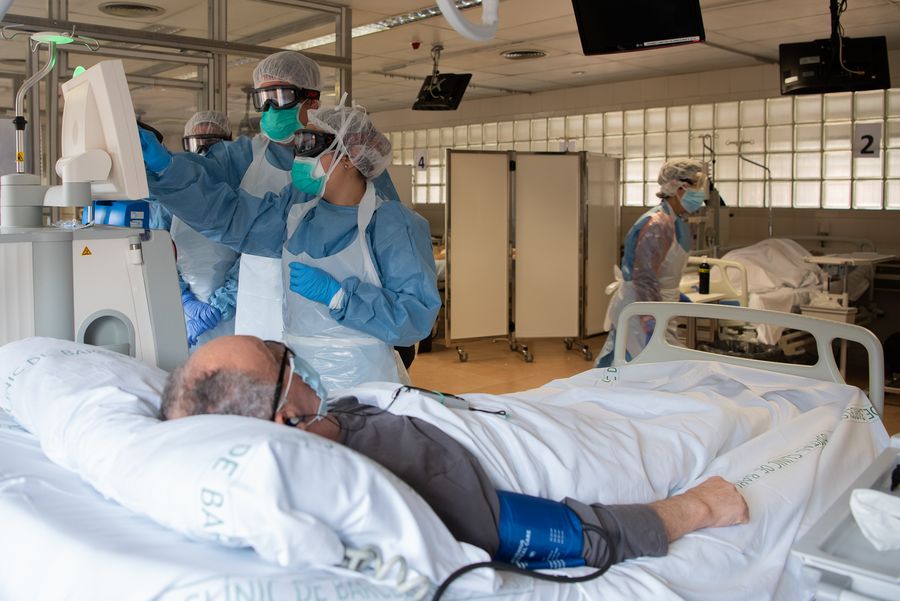
Medical workers attend the COVID-19 patients at a hospital in Barcelona, Spain, April 7, 2020. (Photo by Francisco Avia/Xinhua)
- A new strategy will be published by the WHO to summarize what the world has already learned about the new virus, including six criteria for countries to consider lifting restrictions.
- In Spain, workers from some non-essential sectors of the economy, mainly industry and construction, returned to work on Monday.
- In the U.S., White House mulls guidelines on reopening economy
- In Iran, the ban on inter-province travels placed to curb the spread of the novel coronavirus will be lifted on April 20.
BEIJING, April 14 (Xinhua) -- The World Health Organization (WHO) has warned that lifting restrictions too soon could lead to a deadly resurgence of COVID-19 as some countries are easing their social and economic restrictions amid the outbreak.
On Monday, WHO Director-General Tedros Adhanom Ghebreyesus told a virtual press conference from Geneva that a new strategy will be published to summarize what the world has already learned about the new virus.
"The decisions must be based first and foremost on protecting human health, and guided by what we know about the virus and how it behaves," he said.

A resident wearing a mask walks on the street in Paris, France, April 13, 2020. (Photo by Aurelien Morissard/Xinhua)
The new strategy will include six criteria for countries which consider lifting restrictions:
First, transmission is controlled;
Second, health system capacities are in place to detect, test, isolate and treat every case and trace every contact;
Third, outbreak risks are minimized in special settings like health facilities and nursing homes;
Fourth, preventive measures are in place in workplaces, schools and other places where it's essential for people to go;
Fifth, importation risks can be managed;
And sixth, communities are fully educated, engaged and empowered to adjust to the "new norm."
"Every country should be implementing a comprehensive set of measures to slow down transmission and save lives, with the aim of reaching a steady state of low-level or no transmission," Tedros added.

Police officers stop a bus to check in Rome, Italy, on April 13, 2020. (Photo by Augusto Casasoli/Xinhua)
On Friday, Tedros told a regular press briefing that a welcome slowing has been seen in some of the hardest-hit countries in Europe, like Spain, Italy, Germany and France.
As "some countries are already planning the transition out of stay-at-home restrictions," the WHO chief warned that "lifting restrictions too quickly could lead to a deadly resurgence."
"The way down can be as dangerous as the way up if not managed properly," he said, underlining that the WHO is working with affected countries on strategies for gradually and safely easing restrictions.
On Monday, workers from some non-essential sectors of the economy, mainly industry and construction, return to work in Spain, although experts warned of a possible new rise in coronavirus cases.
RESTRICTIONS EASED
Spain's temporary ban on all non-essential work was imposed for two weeks by Prime Minister Pedro Sanchez on March 30, two weeks after imposing a State of Alarm and the corresponding lockdown on most of the population on March 14, in an attempt to halt the spread of the coronavirus.
The spread of the infection has slowed in Spain over the last month from around 20 percent on a daily basis to approximately 3 percent now. But the country had 169,496 confirmed cases and registered 17,489 deaths as of Monday. There are fears that allowing some people back to work will lead to a new rise in caseload.

People walk past a closed park in Rome, Italy, April 11, 2020. (Xinhua/Cheng Tingting)
In reality, reopening the economy will only affect a small percentage of the workforce, given that all shops (except those selling necessary items) remain closed, along with bars, restaurants, hotels, schools and cultural venues.
Meanwhile, many people have been adapted to home working over the past month and the fact that thousands of companies have opted to use a temporary regulation of work to lay off workers for the duration of the crisis will severely limit the number of workers returning to their posts on Monday.
In such Spanish regions as Catalonia, around 300,000 people will go back to work, mainly in the industrial and construction sectors.
The central government has issued guidelines advising workers to maintain distances of at least two meters between each other. Police were on duty in Madrid and other towns and cities on Monday morning to hand out face masks to those traveling on public transport.
Spanish Interior Minister Fernando Grande-Marlaska said the day was "developing within the normality of the exceptional situation which we are currently in."
"If the safety of workers is affected, then their activity cannot restart," he said.
However, not everyone agrees with the decision to reopen the economy. Daniel Prieto-Alhambra, a professor of epidemiology at Oxford University told Spanish national radio network RNE that the measure poses a "risk of new infections."

A pedestrian wearing a face mask walks past a closed shop in San Mateo City, California, the United States, April 2, 2020. (Xinhua/Wu Xiaoling)
U.S. President Donald Trump said Monday his administration is close to completing a plan to open the economy, noting that he would have "total" authority to do that.
"We will soon finalize new and important guidelines to give governors the information they need to start safely opening their states," Trump told reporters at a White House briefing.
"We want to have our country open, we want to return to normal life. Our country will reopen successfully," he said.
When asked whether he would have the power to open or close state economies, Trump said "the authority of the president of the United States having to do with the subject we are talking about is total."
New York, New Jersey and four other northeastern states are setting up a working group to coordinate plans to restart the economy, while California, Washington and Oregon on the West Coast have said they would work on their guidelines together.
The three U.S. West Coast states of California, Oregon and Washington, announced an agreement Monday on a shared vision for reopening their economies and controlling COVID-19 into the future.
"The West Coast is guided by science. We issued stay at home orders early to keep the public healthy. We'll open our economies with that same guiding principle," California Governor Gavin Newsom said on Twitter Monday.

Photo taken on March 27, 2020 shows the White House in Washington D.C., the United States. (Xinhua/Liu Jie)
The White House is facing mounting pressure from business executives and advocacy groups to reopen the U.S. economy, as measures to slow the spread of the virus have led to growing economic fallout, with a staggering 16.8 million Americans filing initial jobless claims in a three-week period ending April 4.
According to Peterson Institute for International Economics (PIIE)'s semiannual Global Economics Prospects outlook released Friday, the U.S. output is expected to shrink by 8.0 percent in 2020, and unemployment rate will probably peak around 20 percent in the early summer.
"There're economic risks in both directions," Treasury Secretary Steven Mnuchin said at the White House briefing.
When asked whether he would consult with health experts before opening up the economy, the U.S. president gave an affirmative answer.
As of Monday night, over 580,000 confirmed cases have been reported across the United States, with death toll surpassing 23,000, according to the Center for Systems Science and Engineering at Johns Hopkins University.
Deborah Birx, coronavirus response coordinator for the Task Force, told reporters at the briefing that "those curves are already starting to plateau."

People wearing face masks cross a street in Tehran, Iran, on April 10, 2020. (Photo by Ahmad Halabisaz/Xinhua)
In Iran, President Hassan Rouhani said that the ban on inter-province travels placed to curb the spread of the novel coronavirus will be lifted on April 20, as Iran's daily infections decline, Financial Tribune daily reported on Monday.
During a meeting of the National Headquarters for Managing and Fighting the coronavirus, Rouhani said that restrictions on road trips across Iran's 31 provinces will be removed and low-risk businesses in the capital Tehran will resume activities later in April.
Following a decision by the Iranian authorities, all the low-risk business activities have reopened across the country except in Tehran since April 11.
The scheme allows some workplaces to reopen if they commit to complying with strict protocols of "a smart social distancing" introduced by the Health Ministry.
"The government is planning to make a decision on high-risk businesses" which requires mass gatherings, including gymnasiums, cinemas, beauty salons and stadiums as well, Rouhani added.
"High-risk businesses will resume work after careful analysis and planning," Rouhani was quoted as saying by Financial Tribune.
On Monday, Iraj Harirchi, Iranian Deputy Minister of Health and Medical Education, urged people to still remain at home and avoid any unnecessary trips, visits and shopping, despite the ease on social activities.
"Eighty percent of infected people have either little or no symptoms. These individuals can transmit the virus in society," Harirchi was quoted as saying by the state TV.
"Our efforts are aimed at identifying them in the early stages ... and to isolate those who have been in contact with such people," the official added. ■
