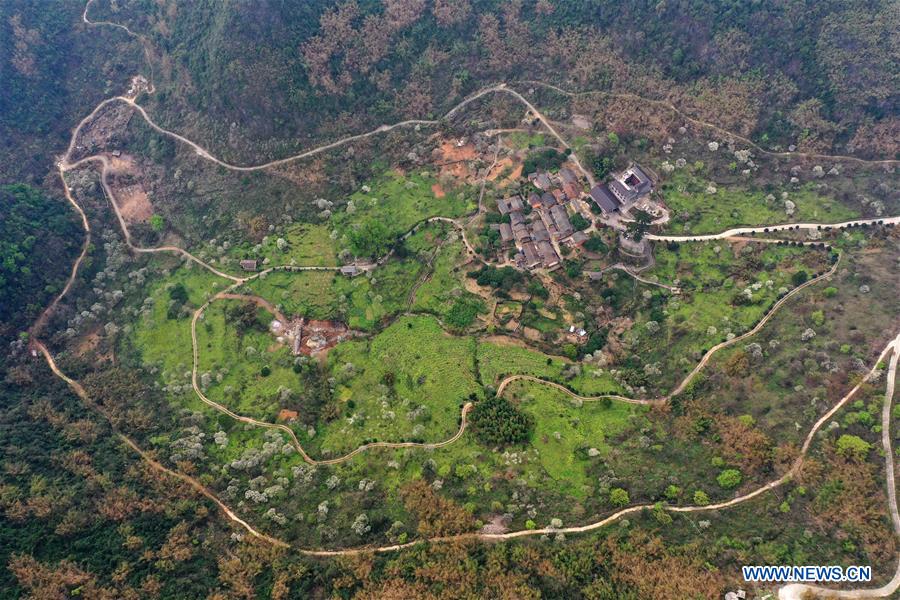
Aerial photo taken on Feb. 29, 2020 shows the spring scenery at Tongbantun Village of Dongqi Township in Rongan County, south China's Guangxi Zhuang Autonomous Region. Long Gexiong, 52, left his hometown at 24 and went hunting for jobs in Liuzhou City, south China's Guangxi Zhuang Autonomous Region. After two decades working outside, he returned at long last to his home village in the deep mountains. Long dropped out of school in 1986 due to poverty and eked out a living by planting plum trees. However, barren hills and water shortage resulted in poor harvests for consecutive years. As many locals migrated to more prosperous regions to improve their standard of living in the 1990s, Long, heavily affected by low crop output, also followed the trend and started a journey working outside his hometown, a remote village called Tongbantun in Rongan County of Liuzhou City. Working as a welder and home decorator in Liuzhou, Long earned a good income, but he kept a close eye on his hometown and always thought of returning. True to his word, he traveled back to his hometown in 2012. To his surprise, Long found the village on the verge of dying out. Bumpy roads, ramshackle houses, fields left unattended, the village was home to only six empty-nest seniors aged between 60 and 90, as young people either found jobs elsewhere to make a living, or moved outside the mountains with their parents. "If we didn't come back, the village would disappear when the seniors pass away. I cannot sit idly watching my hometown vanish," Long said, "Tongbantun is our root, without root we will be cast adrift." After the Spring Festival in 2012, Long and his cousins invested 580,000 yuan (about 81,945 U.S. dollars) to set up a cooperative in Tongbantun to plant plum trees and grapes and develop rural sightseeing tour, embarking on the path of saving the village. Good things never come easy. The arduous work of planting trees and building roads made Long lose more than 15 kilograms weight in just a few months. However, the plum trees and other plants barely bore fruits because of bad weather like hail and flood, causing substantial financial burdens to Long and his fellows. "We just survived on the meager income from the cooperative at that time," said Long. His family fell into poverty due to crop failure, illness and child education. Despite difficulties, Long encouraged others to hang on. Some villagers who worked outside were impressed by Long's resolve to revive Tongbantun and came to help by joining the cooperative and jointly running tourism orchard. They also rebuilt their old and humble houses into homestays to accommodate visitors who come here to enjoy plum tree blossoms. In addition, the local government earmarked more than five million yuan (about 706,424 U.S. dollars) to pave roads, provide drinking water supply, install drip irrigation system and improve tourism facilities in the village. Increasing fruit output and improved infrastructure lured many companies to invest, especially in blueberries, plum trees and grapes plantations. Long was elected as the head of Tongbantun in 2015. He led locals in shaking off poverty by prioritizing impoverished residents in farm produce sale, work assignment and cooperative share holding. "All these years of efforts paid off," said Long. So far, the total area of the tourism orchard has reached around 750 mu (about 50 hectares) in the village. The agritainment brought locals about 500,000 yuan (about 70,642 U.S. dollars) last year. Long's family and the village dropped the "poverty-stricken" label in 2018. He was recognized by the local authorities for his outstanding contributions to poverty alleviation. Tongbantun became a model in Guangxi in casting off poverty through tourism development. "We are glad to see our hometown take on a new look", Long said, hoping more villagers will return home to unlock the hidden value and enjoy the life in the village. (Xinhua/Huang Xiaobang)