



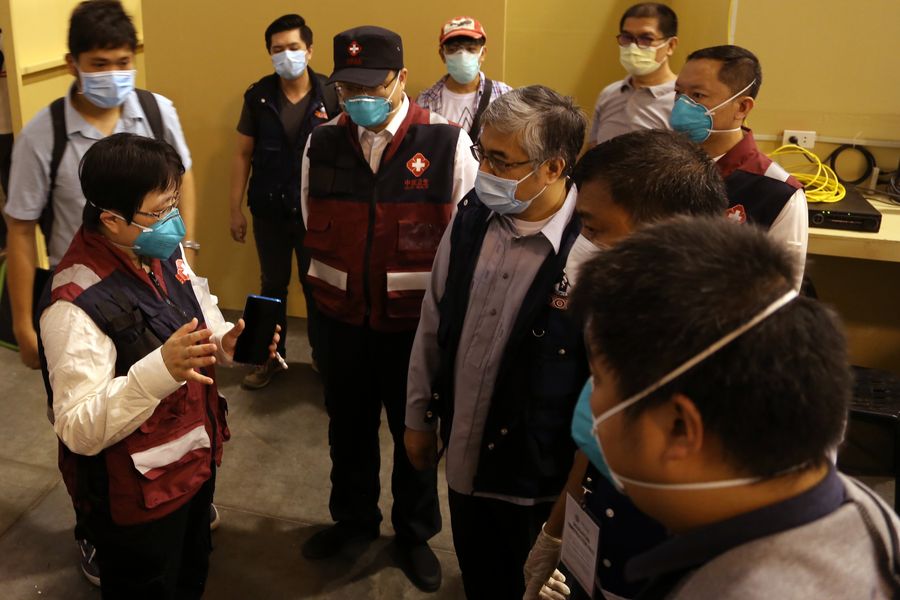
The Chinese medical expert team visits a converted COVID-19 quarantine facility at the Philippine International Conference Center (PICC) on April 14, 2020 in Manila. (Xinhua/Yuan Mengchen)
"We believe the government will better control the spread of the disease after the increase of capacity of testing and the number of mobile hospitals," Weng Shageng, the head of the Chinese experts team said, adding the Philippines will win the battle against COVID-19 eventually.
MANILA, April 17 (Xinhua) -- A delegation of 12 Chinese experts helping the Philippines combat the coronavirus disease (COVID-19) said on Friday that the measures taken by the Philippine government are effective in stopping the spread of the pandemic, adding this southeast Asian country will win the battle against COVID-19.
"We believe that the response measures taken by the Philippine government are positive, proactive and effective," Weng Shageng, the head of the team, told a virtual media briefing.
As far as the team is concerned, he said the Philippines is capable of controlling COVID-19 after it continues to focus on strengthening testing capacity to identify those infected and isolate them to prevent further transmissions.
The Philippines now has reported 5,878 COVID-19 cases, including 387 deaths and 487 recoveries.
The team lauded the Philippines for focusing on the importance of prevention and control of COVID-19 by imposing home quarantine of suspected cases and implementing an early lockdown that retracted the movement of the people.
Moreover, the team said the government fast-tracks the building of quarantine facilities and mobile hospitals to isolate COVID-19 patents.
"We believe the government will better control the spread of the disease after the increase of capacity of testing and the number of mobile hospitals," Weng said, adding the Philippines will win the battle against COVID-19 eventually.
He also lauded the professionalism of the medical staff that they met during their rounds of several hospitals and quarantine facilities in Metro Manila and during their online consultations with healthcare workers in the provinces.
"The medical staff are very dedicated to the face of the outbreak. We are deeply moved by their perseverance and active work of the medical staff despite the shortage of manpower, personal protective equipment (PPEs) and the hospital conditions," Weng added.
The team advised the Philippines to further strengthen its testing and detection capacity to be able to isolate those who are sick, to address the shortage of medical staff and ensure the protection of healthcare workers.
The team also stressed the need to optimize the allocation of medical resources so that hospitals can focus on severe and critical COVID-19 patients.
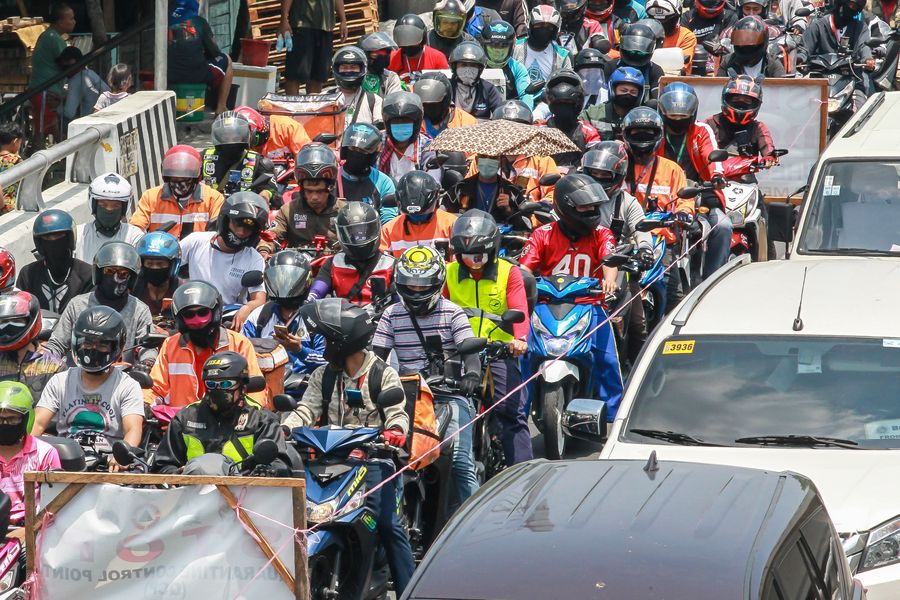
Motorists line up at a COVID-19 community quarantine checkpoint in Las Pinas City, the Philippines, April 16, 2020. (Xinhua/Rouelle Umali)
The contingent, which arrived in Manila on April 5, has visited several hospitals, testing laboratories, and quarantine facilities set up by the government to care for COVID-19 patients and people suspected to be infected by the virus.
The Chinese experts also met with local medical staff to discuss and share their experiences and best practices in handling COVID-19.
Their Philippine counterpart welcomed the team's ideas on how to improve and level-up the Philippines' COVID-19 response, including the different levels of surveillance, risk-assessment, isolation strategies, detection through accurate testing, clinical case management, and non-pharmaceutical public health measures.
However, Weng said it would be up to the Philippine side to adopt and apply these best practices.
Chinese Ambassador to the Philippines Huang Xilian said China will continue to help the Philippines combat the disease.
China has chartered flights to bring its donations of medical supplies, including non-invasive ventilators, as well as thousands of medical protective suits, N95 respirators, surgical masks, and medical face shields, to the Philippines.
The team will leave the Philippines and go back to China on April 19. ■
