



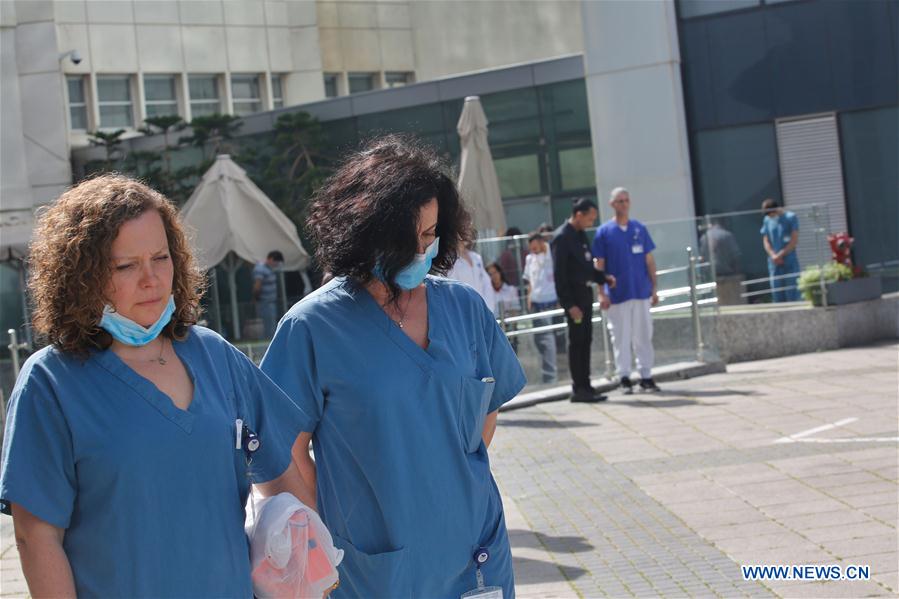
Israeli medical workers stand two minutes of silence to remember the six million who were killed in the Holocaust, in Sourasky Medical Center Hospital in the central Israeli city of Tel Aviv on April 21, 2020. A two-minute-long siren wailed throughout Israel at 10 a.m. on Tuesday to remember Holocaust victims. (Photo by Gil Cohen Magen/Xinhua)
by Keren Setton
JERUSALEM, April 21 (Xinhua) -- As Israel is fighting the COVID-19, the annual Holocaust memorial day takes on a different face this year.
Israel's Holocaust day is usually filled with ceremonies. The main one is held at Yad Vashem, the world Holocaust remembrance center, in Jerusalem.
A two-minute siren cuts through the entire country in the morning and everything comes to a standstill in commemoration for the six million Jews who perished under Nazi Germany during World War II.
According to data released by the Israeli Finance Ministry ahead of the memorial day this week, there are almost 190,000 Holocaust survivors in Israel, in the average age of 84.
Since large gatherings are prohibited due to health ministry directives, the annual ceremonies, also held at schools and workplaces country-wide, have been cancelled. People were called to stand on their porches during the siren.
Amcha, an organization that provides mental support for survivors and their families, asked people to stand on their balconies holding a sign that reads: "Remembering from up close, embracing from a far," in tune with the social distancing norms that are now prevalent.
In recent years, schools have distributed memorial candles that stay lit for the length of the memorial day which begins on sundown the night before.
This time with schools still closed, children collected the candles and were asked to light them at home. Each candle bears the name of one victim. The candles have a barcode that can be scanned on a smartphone, which then exposes personal information about the victim.
Usually on the eve of the remembrance day, six people light torches at the center in memory of the victims. Holocaust survivors are selected in order to reflect an annual theme.
This year, the ceremony will be recorded in advance, each torch lighter did so alone. The edited broadcast was televised as usual. This year the theme is "Rescue by Jews during the Holocaust: Solidarity in a Disintegrating World."
"We want people to be able to participate personally," said Simmy Allen, head of the International Media Section at Yad Vashem, "This year when we are all stuck at home, we need to transfer it to the virtual platforms. Everything will be online and accessible."
One of the moving ceremonies on the day is the reading of the names of victims. Names are read all over the country, with the main ceremony held at the Yad Vashem Hall of Names. This year it will be different.
Having been closed to visitors since the middle of March, due to health ministry directives, the museum launched a campaign leading up to the memorial day calling for people to record the name reading and upload the videos to the various social media platforms.
"Join us and mark Holocaust Remembrance Day this year from your homes," said Yad Vashem Chairman Avner Shalev in a statement released by the center, "Help us to restore the memory of those murdered during the Holocaust, as you do each and every year. Although the circumstances this year are unique, the message is still the same: We will never forget them."
The traditional wreath laying ceremony will also be held without an audience. Testimonials from survivors will be streamed online. The center is also offering internet lectures.
"We are sending the information out," Allen told Xinhua, "Every year people come to Yad Vashem. We have always had online activity, but this year we have increased this significantly in order to reach everyone. People are thirsty for this content."
For the past decade, a social initiative called Zikaron BaSalon (memories in the living room) has becoming increasingly popular in Israel and in other countries around the world.
People host a Holocaust survivor in their living room and other guests are welcome to the open house in order to hear a testimony first-hand. It has made the Holocaust accessible for younger generations who are more distant from the event. This year this is not possible.
According to Dana Sender-Mulla, co-founder and board member of the organization, 300 such testimonies will be given throughout the day via the Zoom video-conference application.
This is a significant reduction to previous years in which face-to-face gatherings were allowed. The COVID-19 crisis has sped up what would have naturally occurred in the coming years as the survivor population dwindles.
"We have always been thinking how we can teach people how to remember the Holocaust without the survivors in order to prepare ourselves for the day when they will no longer be here," she told Xinhua, "The current, historic situation, forces us to mark the memorial day without them."
Israel's first victim of the virus was himself a Holocaust survivor. His death highlighted the fact that the elderly in the country and in fact worldwide, are most vulnerable to COVID-19. The majority of the 173 deaths in Israel have been people over the age of 70.
"We want to keep them safe because we care about them deeply," said Sender-Mulla. "In recent weeks we have mobilized hundreds of volunteers who keep in daily contact with them and we make sure they know they are important to us and that we want to hear them and their stories." Enditem
