



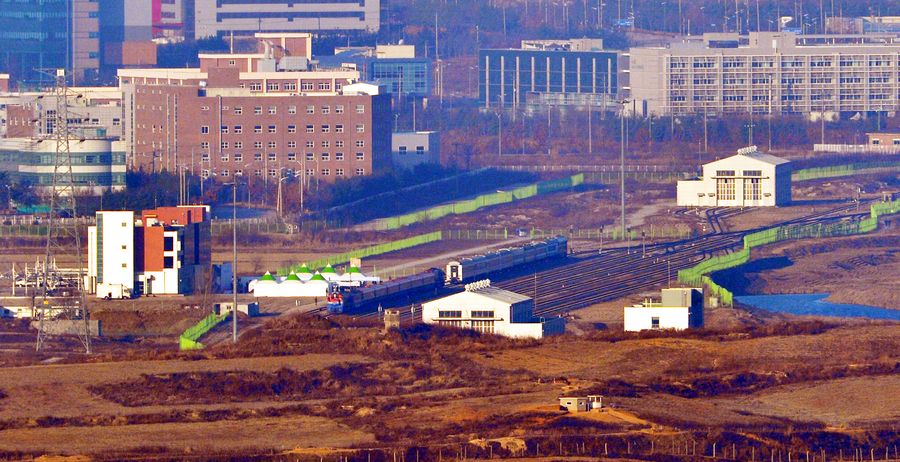
File Photo: Attendees from the South Korean side arrive by train in Kaesong, a border town of the Democratic People's Republic of Korea (DPRK), to take part in the groundbreaking ceremony for rail and road connection across border between South Korea and DPRK on Dec. 26, 2018. (Xinhua)
It will be pursued speedily without a preliminary feasibility study as it was designated as an inter-Korean cooperative project.
SEOUL, April 24 (Xinhua) -- South Korea has decided to launch the construction of the southern section of the inter-Korean railway along the east coast of the Korean Peninsula.
The inter-Korean exchange and cooperation consultative committee was chaired by Unification Minister Kim Yeon-chul, deciding to start the reconnection of a 110.9-km railway from the eastern coastal city of Gangneung to the border town of Jejin, local media reported Thursday.
It will be pursued speedily without a preliminary feasibility study as it was designated as an inter-Korean cooperative project.
The Gangneung-Jejin railroad is the South Korean section of the Donghae Bukbu Line, which was built during the 1910-1945 Japanese colonization of the peninsula but was severed during the 1950-1953 Korean War.
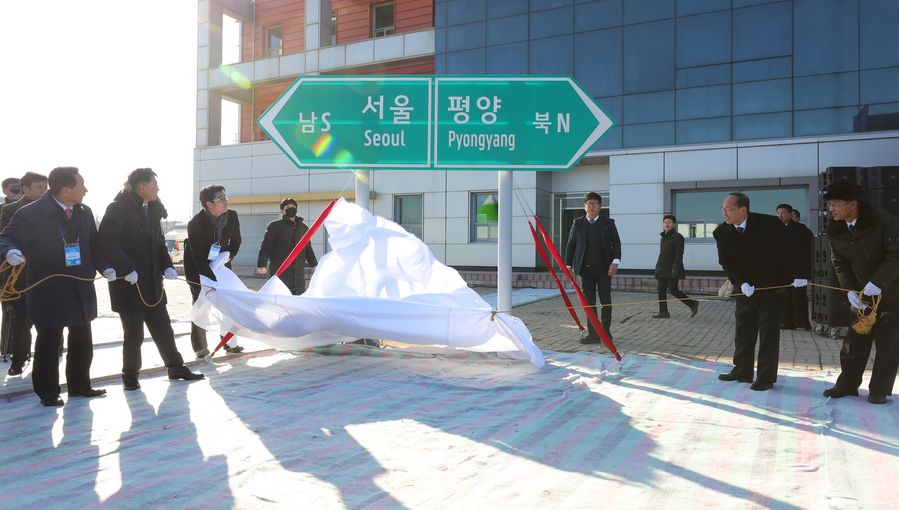
File Photo: Guests take part in the groundbreaking ceremony for rail and road connection across border between South Korea and the Democratic People's Republic of Korea (DPRK) at Panmun Station in the DPRK's border town of Kaesong on Dec. 26, 2018. (Xinhua)
The Donghae Bukbu Line construction project was pursued since 2000, and South Korean President Moon Jae-in and Kim Jong Un, top leader of the Democratic People's Republic of Korea (DPRK), agreed in their first summit on April 27, 2018, to reconnect inter-Korean railways and roads along the eastern and western peninsula.
South Korea and the DPRK held a groundbreaking ceremony for the inter-Korean railway reconnection project in December 2018, but construction works had been delayed amid the international sanctions toward Pyongyang.
The Moon government hoped to re-link the railways across the inter-Korean border, eventually connected to Europe through the Trans-China Railway (TCR) and the Trans-Siberian Railway (TSR). ■
