



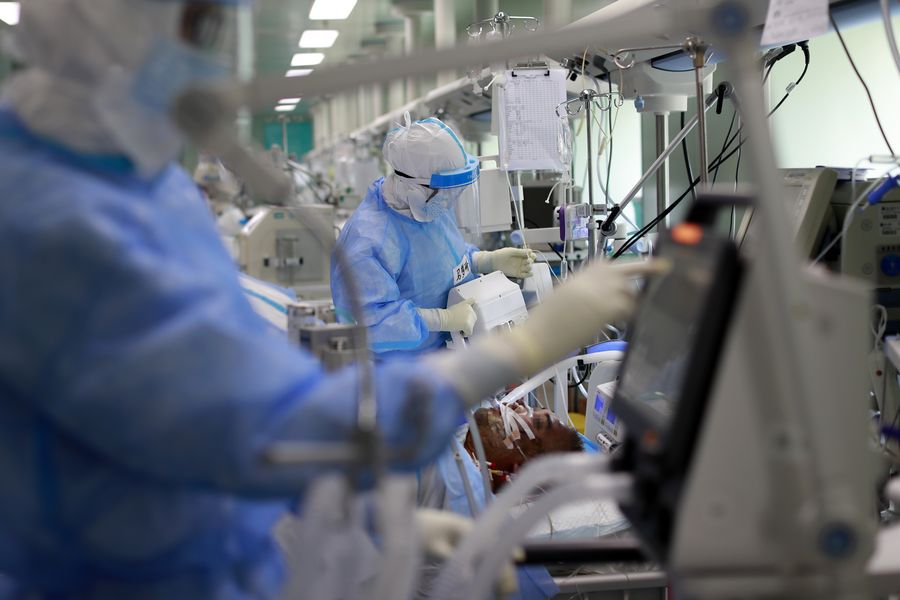
Medical workers take care of a COVID-19 patient whose nucleic acid test result has turned negative in a ward at the west campus of the Union Hospital affiliated to Tongji Medical College of Huazhong University of Science and Technology in Wuhan, central China's Hubei Province, April 24, 2020. (Xinhua/Shen Bohan)
The median duration of the virus in stool is 22 days, longer than 18 days in respiratory tissue and 16 days in serum.
HANGZHOU, April 26 (Xinhua) -- New research on COVID-19 patients in China shows that the virus persists longer in patients' stool than in the respiratory tissue.
Researchers from Zhejiang University estimated viral loads in 3,497 respiratory, stool, serum and urine samples collected from 96 COVID-19 patients from Jan. 19 to March 20.
A viral load refers to a measurement of the amount of the virus present in an infected patient. In the case of COVID-19, the higher the viral load, the more virus a patient can shed into the surrounding environment.
Among the patients, 22 were mild COVID-19 patients and 74 were severe cases. Being infected by the virus was confirmed in all patients by testing sputum and saliva samples.
According to the results published in the British Medical Journal, the virus was detected in the stool of 55 patients, in the serum of 39 patients and only in the urine of one patient.
The median duration of the virus in stool is 22 days, longer than 18 days in respiratory tissue and 16 days in serum.
The viral loads differed significantly by sample type, with respiratory samples showing the highest, followed by stool samples, and serum samples showing the lowest.
The researchers also found that the median duration of the virus in the respiratory samples of patients with severe COVID-19 is 21 days, significantly longer than 14 days among patients of mild cases.
But no significant difference in viral loads was found in stool and serum of samples from mild and severe patients.
In mild patients, the viral loads peaked in respiratory samples in the second week from disease onset, while the viral loads continued to be high during the third week in severe patients.
Meanwhile, the virus duration was longer in patients older than 60 years and in male patients.
The researchers pointed out the limitations of their study, such as the relatively small number of participants and the result might be affected by the quality of collected samples.
They concluded that their study highlights the need to strengthen the management of stool samples containing COVID-19, and strict management are also needed during each stage of severe cases of the disease. ■
