



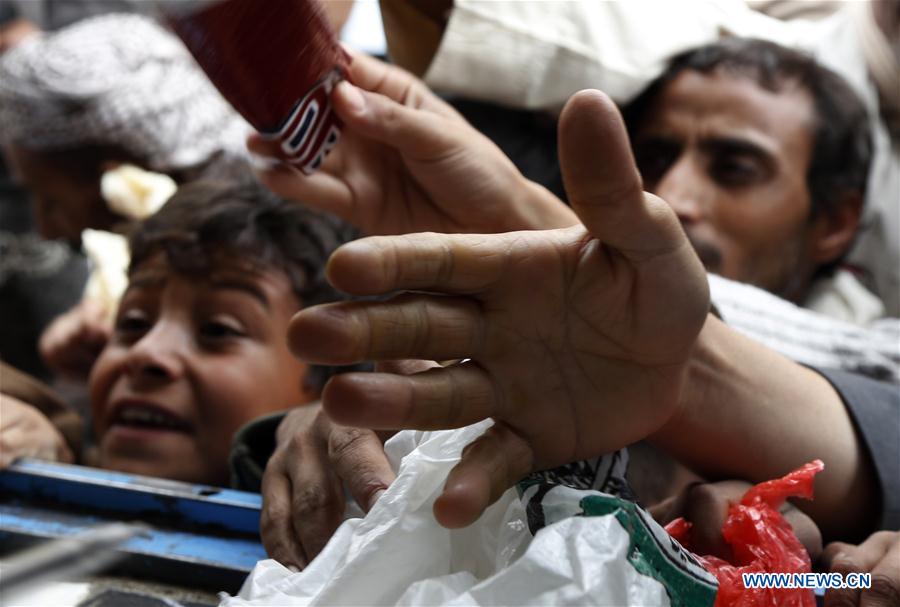
People wait to receive bread provided by a charity bakery in Sanaa, Yemen, April 27, 2020. (Photo by Mohammed Mohammed/Xinhua)
SANAA, April 29 (Xinhua) -- Everyday, hundreds of Yemeni families stand in long queues in front of charity bakeries in the capital Sanaa amid fears of the COVID-19 spread as the continuing civil war in the country has pushed over 20 million Yemenis to the brink of starvation.
"Since I left my job following the stop of salary payment, I come to here everyday to get 10 loaves of bread ... and sometimes I get nothing," Ahmed Hizam, resident of Sanaa, told Xinhua at the door of a charity bakery in Noqom neighbourhood.
The 62-year-old father of eight is one of millions of Yemenis living on charity since the civil war erupted five years ago.
Amer Al-Qahm, owner of the charity bakery, hopes to continue the aid to the needy families.
"We distribute 12,000 loaves of bread everyday for about 700 families ... and we will continue," he said.
Although Yemen has so far recorded only one laboratory confirmed case of COVID-19 on April 10 in Hadramaut province, the shattered health system puts millions vulnerable to the pandemic.
"Since the first confirmed COVID-19 case, we have warned that the virus is now in Yemen and may quickly spread," UN Humanitarian Coordinator for Yemen Lise Grande said.
"There's no time to lose ... the factors are all here with low levels of general immunity, high levels of acute vulnerability and a fragile, overwhelmed health system," she said in a statement this week.
The Yemeni war erupted in late 2014 when the Iran-backed Houthi rebels stormed Sanaa and forced the internationally-recognized government of President Abd-Rabbu Mansour Hadi to flee.
The five-year war has shattered the country's economy, caused the collapse of local currency and triggered the stop of paying salaries to millions of the civil servants in the northern cities under the control of the Houthi group.
UN aid agencies have estimated that nearly 80 percent of the Yemeni population requires some form of humanitarian assistance and protection, while 10 million people are just a step away from famine.
The war in Yemen has damaged more than half of its health system, where the fragile health institutions have been struggling to contain increasing infections of deadly epidemics, including cholera, malaria and dengue fever.
The cholera in Yemen has infected over than 1 million and killed more than 2,000 others since 2017, in what UN aid agencies describe as the world's worst humanitarian crisis in the modern history.
In March, UN Secretary-General Antonio Guterres called on the Yemeni warring parties to "immediately cease hostilities, and do everything possible to counter a potential outbreak of COVID-19."
However, the fighting has been escalating on multiple frontlines.
The civil war has killed tens of thousands of people, mostly civilians, displaced 3 million and pushed the country to the brink of famine.
The UN Security Council has called on the Yemeni government and the Houthi group to immediately abide by the call of Guterres for engaging in a nationwide cease-fire, resuming peace talks and preparing for combating possible spread of COVID-19.
UN Special Envoy to Yemen Martin Griffiths has urged the Yemeni warring parties to quickly response to the call of peace, take the chance to halt the war and sit on the table of negotiations to avoid Yemen's possible new humanitarian crisis.
Like many residents of Sanaa whose life has been affected by the ongoing civil war, Khaled Mohamed demand all Yemeni warring parties to head for peace.
"We hope that all sides to immediately stop this brutal war ... that has destroyed our homeland and killed our children." Enditem
