



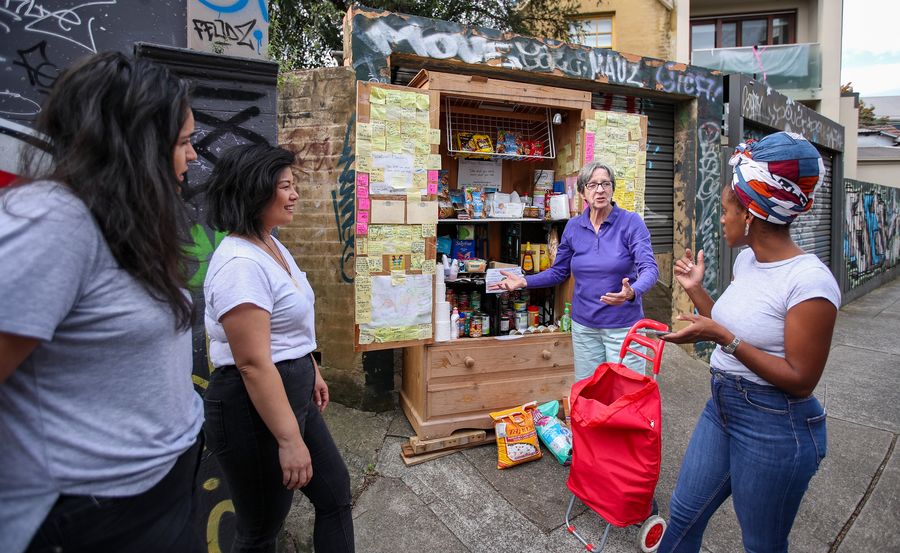
Joyce Akinpe (1st R), Michelle Gomez (1st L) and Maureen Lee (2nd L) talk with a resident (2nd R) in the community of Newtown in Sydney, Australia, April 29, 2020. (Xinhua/Bai Xuefei)
"Take what you need and leave what you can," three Australian girls set up a "Newtown Blessing Box", a closet-like street pantry, to help share groceries and food for their local community during the COVID-19 pandemic.
SYDNEY, May 5 (Xinhua) -- Joyce Akinpe moved to Australia seven years ago to start a new life, finding an exciting job as an event coordinator in the country's biggest city Sydney.
However, when the local economy started to feel the impact of COVID-19, Akinpe found her world collapsed in front of her eyes in a way she never thought possible. As restrictions were imposed to stop the virus' spread, she suddenly lost her job in an industry she loved.
"I'm an event coordinator so our industry is completely gone. I'm concerned for the future because I don't even know if we're going to be able to have events anymore if we don't have a vaccine," Akinpe said.
"I just wake up everyday thinking that it's a nightmare and I want to wake up from it."
Seeing that there were in fact many others like herself in trouble from the outbreak, Akinpe and her two roommates, Michelle Gomez and Maureen Lee, brainstormed ideas for how to help their local community of Newtown. They came up with a street pantry.
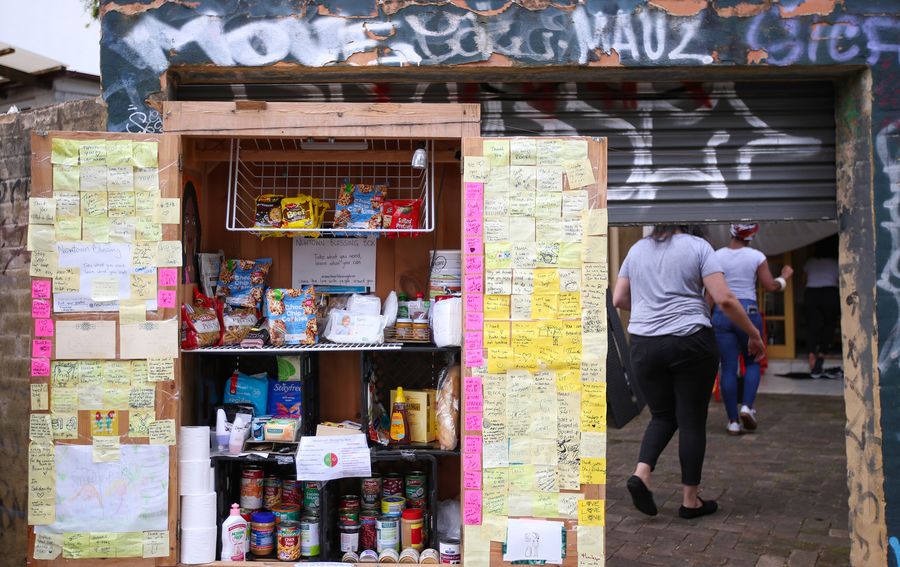
Photo taken on April 29, 2020 shows the Newtown Blessing Box in the community of Newtown in Sydney, Australia. (Xinhua/Bai Xuefei)
Gomez told Xinhua that the original idea was very simple, "take what you need and leave what you can."
With the help of Gomez's father they built the Newtown Blessing Box. A closet-like pantry, roughly as tall as a person, with shelves and hanging baskets and two doors made from old furniture they found.
It sits just at the back of the trio's home where they can look after it, and after they put some information leaflets into the mailboxes of their neighbors, it didn't take long before the Blessing Box was quickly filled with the generous donations from the community.
There were in fact so many donations that from time to time they had to be left outside the box as it was too full.
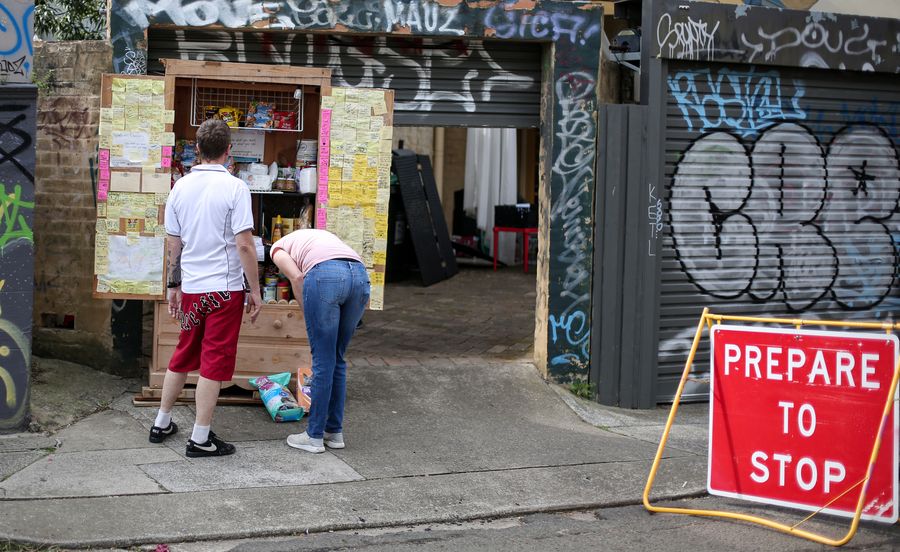
Residents check the Newtown Blessing Box in the community of Newtown in Sydney, Australia, April 29, 2020. (Xinhua/Bai Xuefei)
The trio told Xinhua it was the community's strong support that kept the project alive.
"We now have hundreds of people visiting our box every day. It might only take two hours for the box to be full and next hour it might become empty again. We are now helping others to initiate similar projects in their own suburbs too," Gomez said.
Lee said the items in the box were mostly convenience foods, as well as necessities such as pasta, pasta sauce and toilet paper.
"We received 60 free taco vouchers today from a nearby Mexican restaurant. Given how tough the restaurant business is these days, it's very generous of them to do so," Lee said.
During the interview, the girls were surprised to see that someone had just dropped 24 rolls of toilet paper at the blessing box. During the irrational rush to buy necessities such as toilet paper in the early days of the pandemic, many Sydney supermarkets ran out of stock.
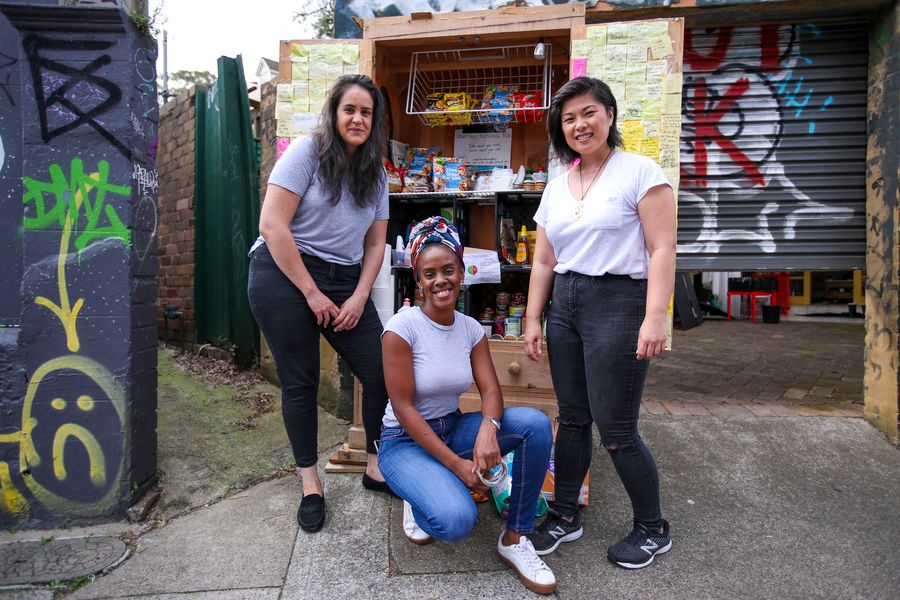
Joyce Akinpe (C), Michelle Gomez (L) and Maureen Lee (R) pose for a photo in front of the Newtown Blessing Box in the community of Newtown in Sydney, Australia, April 29, 2020. (Xinhua/Bai Xuefei)
Lee said they had received many toilet paper donations, and people who come to get the paper don't take it all at once.
"They think there are other people who need it more. Few people take everything at once and many others left notes thanking others for their help," Lee said.
Gomez added that it's been a busy time, as there was a constant flow of donations and they need to sanitize all donated items and make sure all food packages are not broken. But she said that bringing people together in a time when they need it most has been worth it.
"Sometimes even people don't need anything, they just come and wave and smile (at us) and we say 'hello' from 10 meters away." ■
