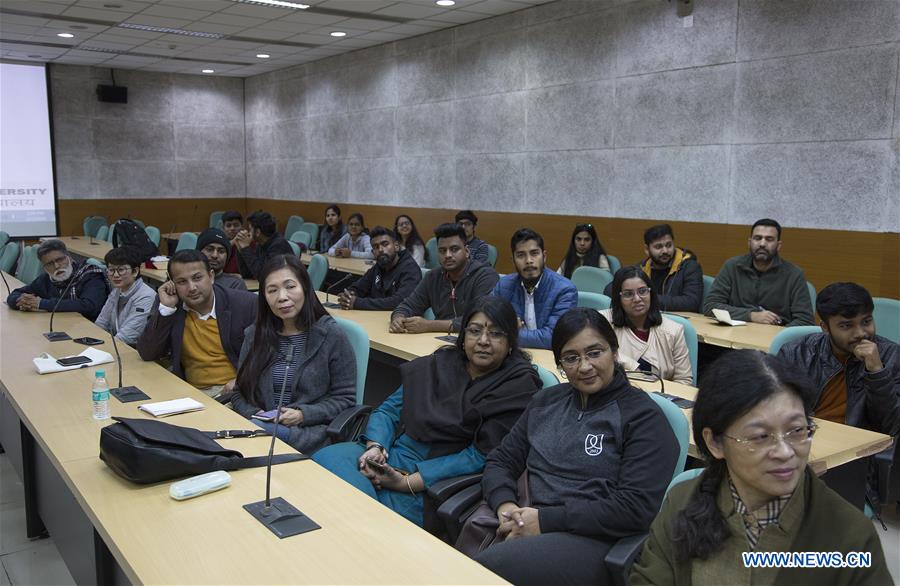
Delegates from China and India attend a seminar to discuss progress in the ongoing ambitious China-India translation project of classical and contemporary works at Jawaharlal Nehru University in New Delhi, India, Jan. 3, 2020. The year 2020 is the 70th anniversary of the establishment of the diplomatic relations between Beijing and New Delhi. Both countries have earmarked 70 different programs to celebrate the bond between them. (Xinhua/Javed Dar)
NEW DELHI, Jan. 3 (Xinhua) -- A seminar was held here on Friday to discuss progress in the ongoing ambitious China-India translation project of classics and contemporary works.
The year 2020 marks the 70th anniversary of the establishment of diplomatic relations between New Delhi and Beijing. Both countries have earmarked 70 different programs to celebrate the bond between them.
As part of such commemoration, delegations from both China and India participated in the seminar at prestigious Jawaharlal Nehru University (JNU) to highlight the improvement from respective sides towards achieving the goal and underline the importance of the project in bringing two cultures closer.
As per the project, undertaken following a memorandum of understanding (MoU) signed in 2013 between Chinese and Indian authorities, each country will translate 25 literary works of the other's ancient classics and contemporary literature.
"From China side, we have completed 13 volumes and Indian side has completed four volumes," said Jiang Jingkui, professor of Indian Studies at the Peking University.
Jiang is the team leader of the translation project and he made the introduction during the seminar in Hindi.
"China has been translating the India literary works since a very long time and compared to it Indian side hasn't been working at that pace," said sinologist B R Deepak, a professor at the JNU.
"It can be understood from the example -- if China has translated a whole house of books, we have translated a box full of books," he said.
Experts and scholars at the seminar unanimously agreed that translating each other's literary works brings academics, students together and thereby help in building people-to-people contacts.
"Only literature can bring us closer and help us understand each other better," said professor Surinder Kumar. "What we are doing today will open new vistas for our future generation."
Cultural and educational counsellor at the Chinese embassy in New Delhi Zhang Jianxin expressed his happiness over the project and the way it was moving forward.
"My dream was to become a translator. I love reading books and the fragrance of ink in the books soothes me," Zhang said. "It is my interest in the project that brought me here and I look forward to being part of more such projects."
Over dozen leading scholars from India have completed the Hindi translation of Chinese literary works, which include novels written in the 20th century and Confucian classics.
Experts said the translation project would contribute immensely to promoting the sharing of culture between India and China.