



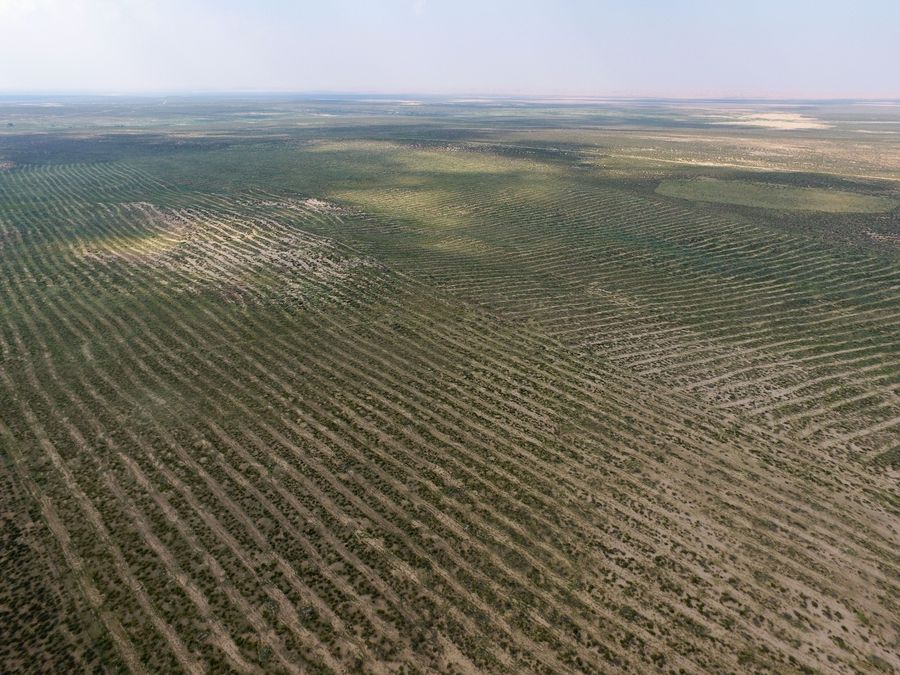
Photo taken on July 31, 2018 shows licorice planted at the Kubuqi Desert in Hangjin Banner, north China's Inner Mongolia Autonomous Region. (Xinhua/Liu Lei)
Licorice, which was designed to combat desertification, has not only helped buffer sand dunes from spreading in China's eighth-largest desert, but has also provided a new source of income to local residents.
HOHHOT, Nov. 24 (Xinhua) -- A plant designed to combat desertification has not only helped buffer sand dunes from spreading in the Ulan Buh Desert, the eighth-largest in China, but has also provided a new source of income to local residents.
Wei Jun, chair of the Inner Mongolia Wangyedi Cistanche Biological Co., Ltd., said the company started to reap a harvest of 66 hectares of licorice, after four years of growing on the edge of the desert.
Licorice, commonly known as sweet grass, is a commonly used herb in Chinese medicine prescriptions.
Wei said with the role of biological nitrogen fixation and sand control, the plant has grown well with plenty of sunshine and the big temperature difference between day and night in the desert region.
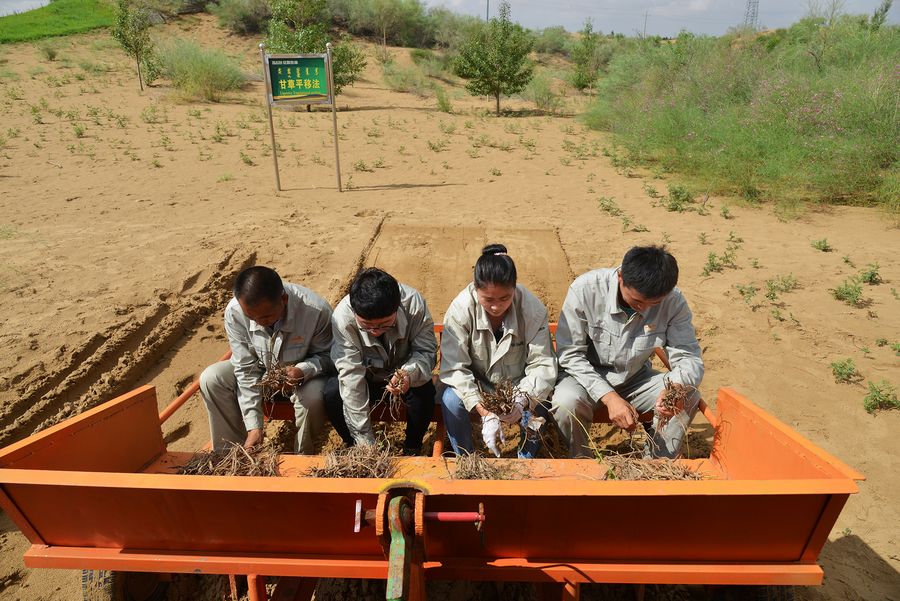
Photo taken on July 24, 2018 shows technicians use licorice to combat desertification at the Kubuqi Desert in Hangjin Banner, north China's Inner Mongolia Autonomous Region. (Xinhua/Lu Ye)
The licorice grown in the desert region contains higher medicinal levels of glycyrrhizin and glycyrrhizic acid than varieties planted in plain areas. With the market price for licorice set at 6 yuan (0.85 U.S. dollars) per kg, the company can earn 135,000 yuan per hectare.
Wei said the plant can be collected by mechanical harvesters, while workers manually sort the picked crop.
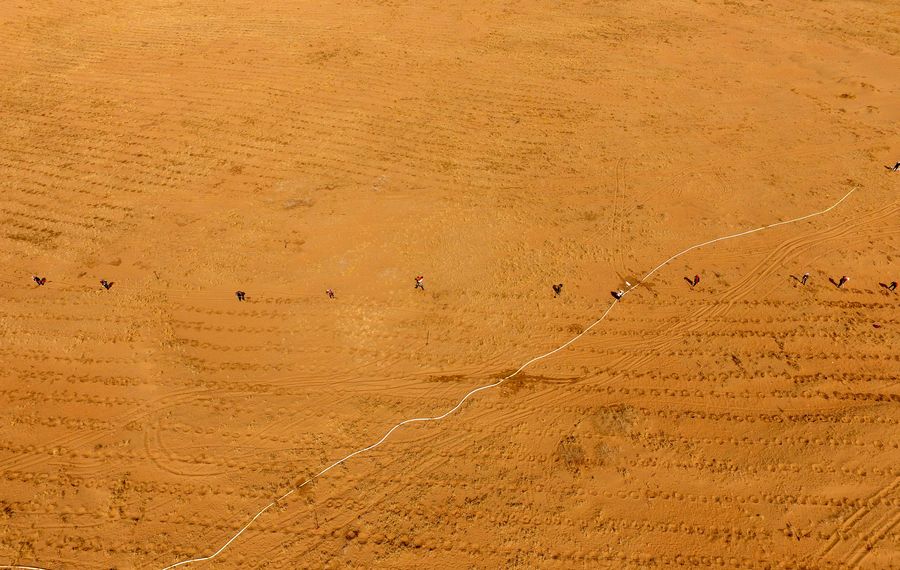
Workers plant sacsaoul trees at Ulan Buh Desert in Dengkou County of Bayannur City, north China's Inner Mongolia Autonomous Region, March 25, 2018. (Xinhua/Liu Lei)
The Ulan Buh Desert covers a total area of 1 million hectares, with nearly one-third of its area in Dengkou County, Inner Mongolia. After 70 years of ecological management, 186,667 hectares have been planted with vegetation, which forms an ecological barrier.
The Dengkou County authority has eyed medicinal herbs like licorice for economic benefits, with a plan of planting 3,333 hectares of licorice in the greening area. ■
