



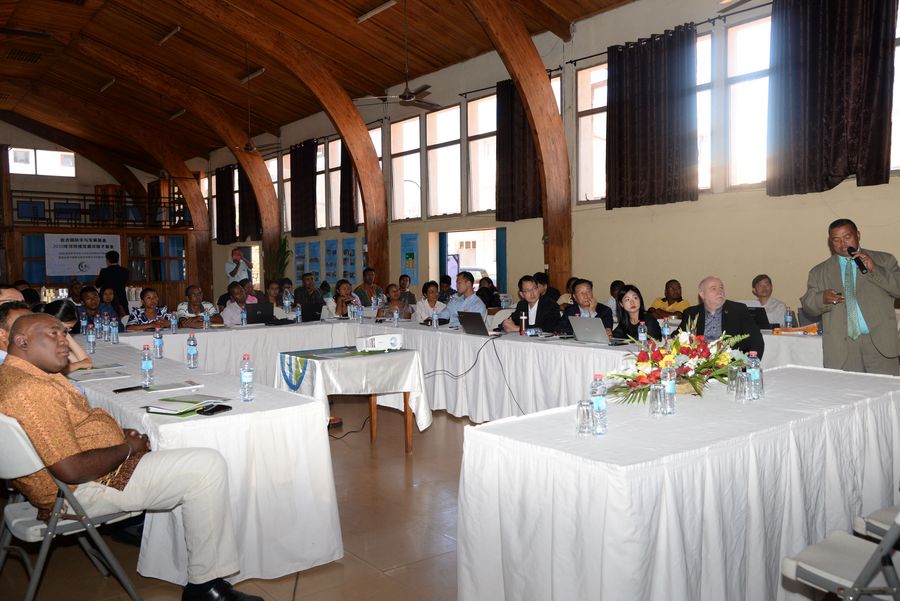
The capacity building workshop on Juncao technology was held in Antananarivo, capital of Madagascar, on Jan. 11, 2019. (Sitraka Rajaonarison/Xinhua)
Chinese-invented Juncao technology can help Madagascar speed up sustainable development given its potential to transform farmers' livelihoods by increasing their income, a Malagasy official says.
ANTANANARIVO, Jan. 12 (Xinhua) -- Chinese Juncao technology speeds up Madagascar's progress in 2030 agenda for sustainable development, a Malagasy senior official has said.
The general secretary of Madagascar's Ministry of Agriculture, Livestock and Fishery, Tilahy Desire, made the remarks during a capacity building workshop on Juncao technology held on Saturday in Antananarivo, capital of Madagascar, for policy makers and farmers in the country.
Juncao, which literally means "mushroom" and "grass," refers to a Chinese-invented technology using grass to grow mushrooms. Its use can help increase local income through low-cost mushroom cultivation and contain desertification by providing a new source of cattle feed.
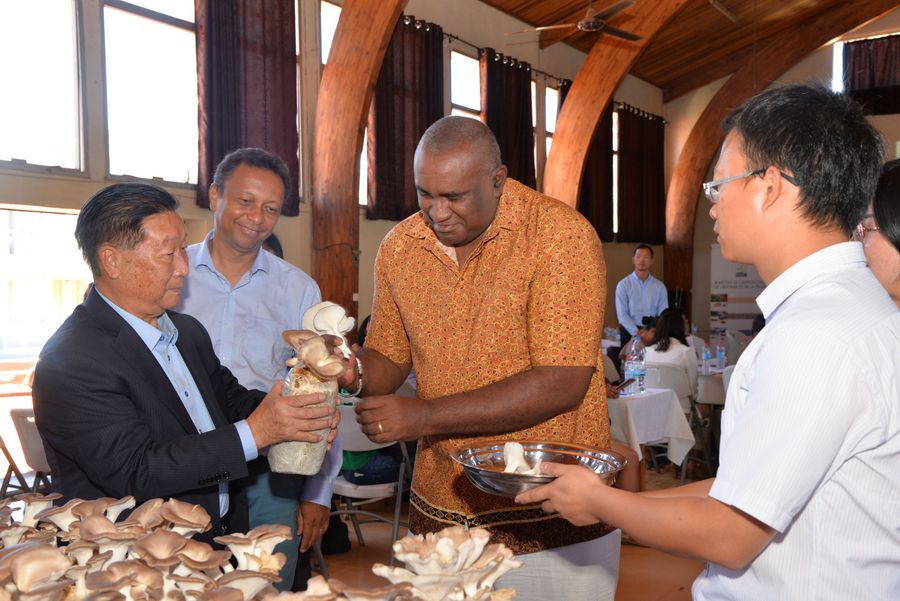
Lin Zhanxi (1st L), a Chinese professor who invented Juncao technology, showed the plantation of mushroom by Juncao during a capacity building workshop on Juncao technology held on Jan. 11, 2019, in Antananarivo, Madagascar. (Sitraka Rajaonarison/Xinhua)
"It is with the importance of partners in mind that my department has decided to advance the introduction of Juncao technology in several countries, including Madagascar," the United Nations Department of Economic and Social Affairs finance officer Armin Plum said at the workshop.
"Madagascar has enormous climatic potential for planting Juncao grass," Lin Zhanxi, a Chinese professor who invented the technology, told the participants at the workshop.
Lin said he hoped Juncao technology will develop in wide scale in Madagascar, where Juncao is still known only through the sale of Juncao cuttings and the giant pennisetum silage bale, which is used to feed livestock during the dry seasons since its implementation in the country in 2017. ■
