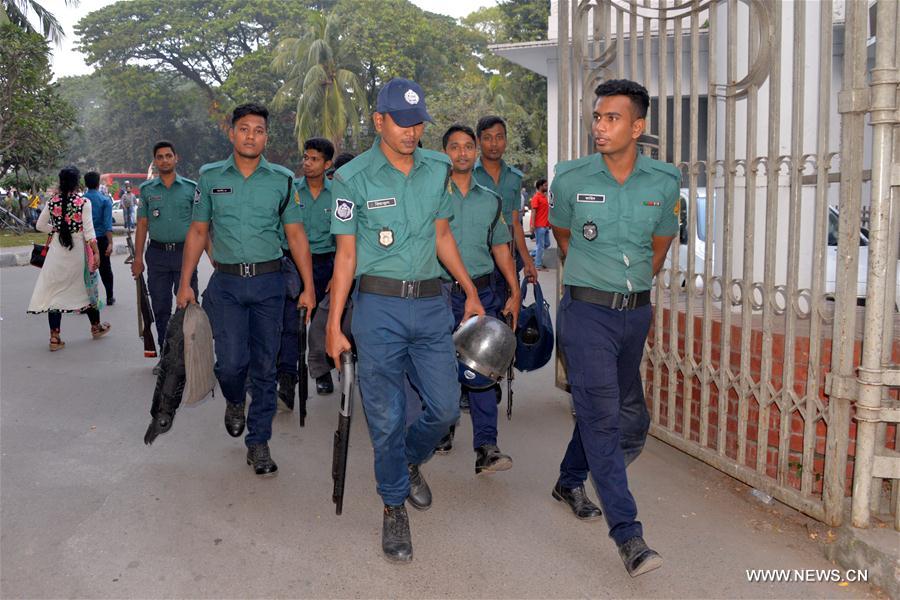
Bangladeshi security members stand guard around Bangladeshi Supreme Court in Dhaka, capital of Bangladesh, ahead of mutiny trial verdict on Nov. 27, 2017. A High Court Division Bench in Bangladesh has upheld penalty for hundreds in a mutiny case and in its observation recommended a fresh probe into the failure of the intelligence for the carnage which left 74 people dead including 57 officers deputed from the Army. (Xinhua/Salim Reza)
by Naim-Ul-Karim
DHAKA, Nov. 27 (Xinhua) -- A High Court Division Bench in Bangladesh has upheld penalty for hundreds in a mutiny case and in its observation recommended a fresh probe into the failure of the intelligence for the carnage which left 74 people dead including 57 officers deputed from the Army.
The court's observation came on the second day of delivering the 10,000-page verdict over the killings during the two-day mutiny inside the headquarters of the paramilitary Border Guard Bangladesh (BGB), previously known as Bangladesh Rifles (BDR), eight years ago.
Amid tight security, the High Court division bench of Justice Nazrul Islam, Justice Shawkat Hossain and Justice Md Abu Zafor Siddique on Monday delivered the mass verdict in the 2009 BDR mutiny murder case, which is considered the largest of its type in world history.
The division upheld death sentence for 139 convicts and life terms for 185 others of the BGB.
The High Court division also awarded jail terms ranging from three to 10 years to 196 border guards.
Another 49 were acquitted of all charges.
All the accused have the right to appeal with the apex court against their convictions.
The High Court bench led by Justice Shawkat Hossain started announcing the verdict, with observations of over 1,000 pages, on Sunday morning.
Attorney General Mahbubey Alam told journalists shortly after the verdict that the court in its observation recommended launching a probe into the intelligence failures about the 2009 mutiny at the paramilitary force's headquarters.
"The court asked to form a committee to investigate why the then BDR's security ( intelligence) unit failed to inform the government timely about the mutiny," said Alam.
He mentioned that the court stressed the need for maintaining good relationships among all BGB members and advised for holding regular basis discussion meeting.
Alam said the court observation instructed for dealing with grievances of members if any with priority and clearing arrears of soldiers if any without delay.
The court observed that the mutiny was aimed at creating an instability in the country and deterring democratic process, he said, adding the court in its observation also mentioned that from the entire case circumstances it seems that there was an internal or external plot to uproot, dethrone and depose Prime Minister Sheikh Hasina's newly formed government following the general election in 2008.
BDR soldiers staged revolt against their army officers reportedly over salary and other benefits.
An official probe into the mutiny blamed that the incident is the outburst of many years of pent up grievances of the BDR soldiers over ignored pleas for pay hikes.
The Bangladeshi government had earlier decided to try the accused for such offenses as killings, attempted murder, looting and arson committed during the mutiny under the penal code.
Other offenses include breach of discipline and defying superiors' orders at the BGB headquarters in Dhaka and other stations of the force across the country under BDR laws through formation of the special courts.
The special courts of the BGB had earlier awarded jail terms ranging from four months to seven years to nearly 6,000 border guards of the force's 57 units.
The trial of Bangladesh's border guards facing charges of serious mutiny crimes at the paramilitary force's headquarters began in 2011 in a court in Dhaka.
A Dhaka court on Nov. 5, 2013 awarded death to 152 BGB personnel, while 161 people including two leaders of ruling Bangladesh Awami League party and opposition Bangladesh Nationalist Party were then sentenced to life imprisonment.
On the first day of the two-day bloody mutiny, on Feb. 25-26, 2009, the head of BDR Major General Shakil Ahmed was shot dead by mutineers.
The BDR revolt, which took place less than two months after Prime Minister Sheikh Hasina took office for the second time, threatened the stability of her government and raised fears of military intervention.
Hasina chose a negotiated settlement instead of calling in the army to quell the revolt.
During the mutiny, over 7,000 BDR personnel were reportedly present at the headquarters of the paramilitary force which, with around 67,000 members, is guarding the country's long border line of 4,427 km with India and Myanmar.