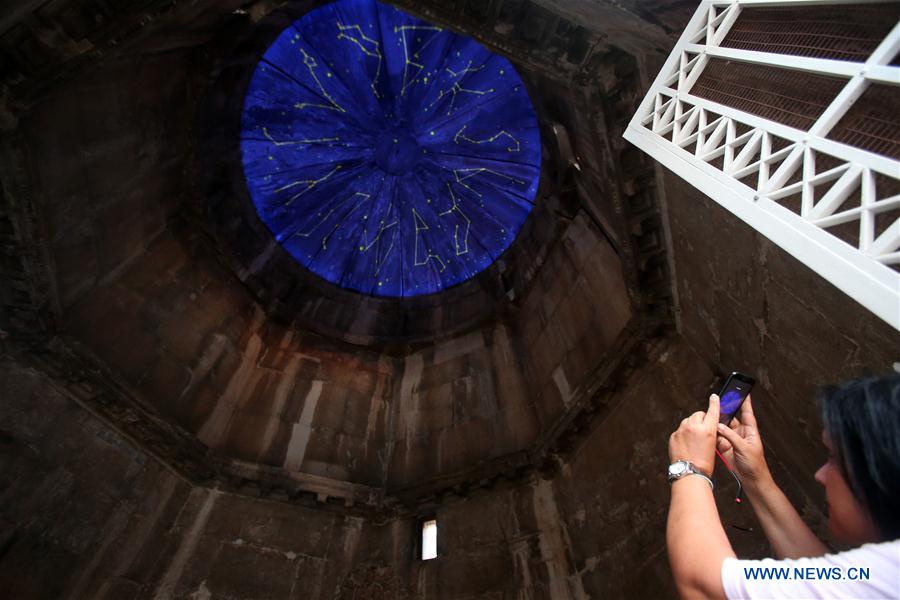
A visitor takes photos at Tower of the Winds or Aerides (means winds in Greek), a 2,000-year-old meteorological station located at the foot of the Acropolis hill, in Athens, Greece, on Aug. 10, 2018. Athenians and visitors flocked to Aerides on Friday, as the Greek Culture ministry organized a series of events in archaeological sites nationwide under the theme "Night" to mark the August new moon. (Xinhua/Marios Lolos)
by Maria Spiliopoulou, Valentini Anagnostopoulou
ATHENS, Aug. 11 (Xinhua) -- Athenians and visitors flocked to a 2,000-year-old meteorological station located at the foot of the Acropolis hill on Friday, as the Greek Culture ministry organized a series of events in archaeological sites nationwide under the theme "Night" to mark the August new moon.
The Tower of the Winds or Aerides (means winds in Greek) built by architect and astronomer Andronicus of Cyrrhus in the 1st century B.C. is considered as one of the first weather stations in antiquity, according to archaeologists.
The 12-meter-high marble clock tower (Horologion in Greek) was unearthed during excavations in the 19th century and had undergone an extensive restoration project since 2014.
Locals and tourists now have the chance to take a closer look at the frieze depicting the eight wind deities, the sundials and hear from experts about the water clock mechanism which was believed that was working in its interior in antiquity to show passersby the position of the planets even during the night.
The water mechanism which offered valuable information to the merchants on their way to the nearby market place has not survived, but the monument's marble roof remains intact and is one of the very few which have made it through the centuries, Nikos Tsoniotis, an archaeologist at the Athens Ephorate of Antiquities, told Xinhua.
During a guided tour at Aerides on Friday, Tsoniotis told visitors how chemical analysis of traces of blue color found on the roof showed that most probably it was decorated with a night sky with stars.
On Friday evening through an artistic projection of a view of the sky Greek director Thanos Constantinou attempted to help visitors see what ancient merchants could see 2,000 years ago at Aerides.
In cooperation with the archaeologists, Constantinou presented an installation which is part of a research he is making as a postgraduate student at the University of Peloponnese on the Tower or Winds' astronomical use, he told Xinhua.
"It was a very interesting event and after the information I received here, when I go home I will definitely study more about this monument. It was my first visit here and I am impressed. Such events are very useful," Elli Pavli told Xinhua.
It was the second year in a row that Greece's Culture ministry opened archaeological sites and museums across the country after sunset to allow people to welcome the August new moon, according to a press release.
From July 28 until Aug. 11, a total of 40 art shows and tours were scheduled on the ancient myths about the night, the scientific achievements of ancient Greeks in astronomy and customs linked to the "Night" theme.