CAPE TOWN, May 2 (Xinhua) -- The ruling by the Court of Arbitration for Sport (CAS) on new testosterone rules for female athletes would strip female athletes of their human dignity, a South African cabinet minister said on Thursday.
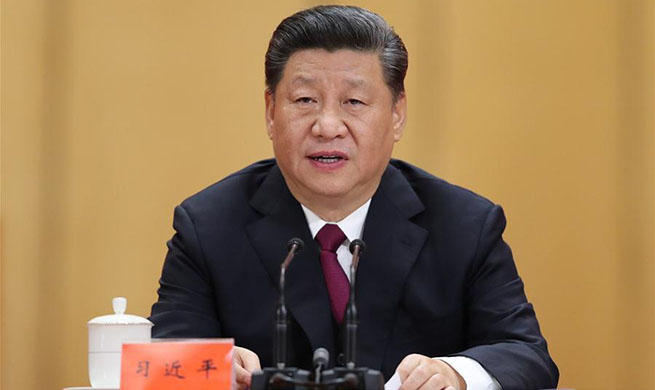
This ruling "must be denounced in the strongest possible terms," said Bathabile Dlamini, Minister in the Presidency Responsible for Women.
On Wednesday, the CAS turned down the appeal by South African female athlete Caster Semenya and Athletics South Africa (ASA) against the new hyperandrogenism rules that bar female athletes with high testosterone levesl from participating in the women's athletics categories.
In a landmark ruling, the CAS found that the new rules, set by the International Association of Athletics Federations (IAAF), were discriminatory for athletes with differences of sexual development (DSD), "but on the basis of the evidence submitted by the parties, such discrimination is a necessary, reasonable and proportionate means of achieving the IAAF's aim of protecting the integrity of female athletics in the restricted events."
"We are shocked, disappointed, angry, and hurt by the CAS ruling to approve the IAAF's new rules that would require mainly African women to inject their bodies with harmful substances to conform to the global north's definition of the female form," said Dlamini.
Last year, the IAAF announced the hyperandrogenism rules which would determine eligibility classification of female athletes with hyperandrogenism to participate in the women's athletics categories and the conditions under which they would be allowed to compete.
Semenya, who is the reigning world champion in the 400m and 800m track, and the ASA made a legal challenge to the CAS against the rules.
The IAAF insists that Semenya should be classified as a "biological male" and forced to take testosterone suppressants if she is to compete in women's competition.
The IAAF's new regulations to arbitrarily manage eligibility in restricted events is a legal route to normalizing colonial definitions of the female body, and setting limits on the performance of female athletes, thereby entrenching societal stereotypes on female sexuality in sport, Dlamini said.
"Ms Semenya, and other female athletes with a similar physique, are being targeted due to their performance in particular athletic codes," she said.
This ruling is more than the eligibility of Semenya to compete in restricted codes, as defined by the IAAF, Dlamini said.
"It is about human dignity and ownership over the African female body, which has been a contested site for generations," she said.