



CHONGQING, June 7 (Xinhua) -- As the Dragon Boat Festival draws near, Chen Ping is busy helping farmers in Haitang Village reap a good harvest of Ay Tsao, a traditional Chinese mugwort herb.
"We are preparing for a government-organized event featuring Ay Tsao, which has become a major industry here," Chen said.
The mugwort herb industry has translated into big bucks for villagers in Haitang, which used to be an "empty village" as a large number of people had gone to big cities for better-paying jobs in southwest China's Chongqing Municipality.
Currently, one hectare of the herbs can bring at least 30,000 yuan (4,340 U.S. dollars) in revenue, with a profit of about 15,000 yuan.
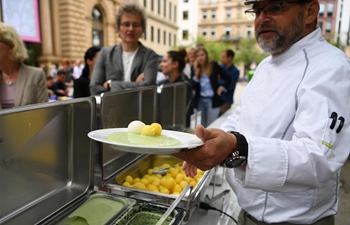
Ay Tsao is a plant with a strong fragrance. It is believed to have the effect of "warding off evil spirits." On the traditional Dragon Boat Festival, which falls on Friday this year, Chinese people usually hang Ay Tsao on their doors to exorcise demons and dried Ay Tsao is boiled as bathwater, as it can help stop itching and disperse excessive dampness from the human body. Ay Tsao is also used for moxibustion, a traditional heat therapy. In addition, the herb is used as a major ingredient for a local snack called "Ciba" in China.
The herbs may have grown out of nowhere in the "empty village," but the idea of powering the local economy with Ay Tsao did not just come out of thin air.
Chen, 38, a resident of Shaoyun Township, which administers Haitang Village, was disappointed to see his hometown so "empty" each time he went back home.
"The village barely had any people, and a lot of land was wasted," Chen said.
Chen, an interior design major, had been a designer for 17 years. Previously, he did not have much knowledge about agriculture.
In 2016, as the government issued a guideline to improve public health levels, Chen saw an opportunity: growing the mugworts. He searched for materials on the Internet and conducted several field trips in the provinces of Henan and Hubei.
"I realized that the Ay Tsao industry is worth tens of billions of yuan, and the herb is a major part of the traditional Chinese medicine (TCM) industry," Chen said. "Demand was much higher than supply."
One year later, Chen piloted some areas of the mugworts in another village and reaped a good harvest that brought more profits than traditional crops.
Chen decided to lead locals in Haitang to grow the herbs in big scale, but the idea was met with strong resistance.
"They said I was too young to understand rural conditions, and they simply did not believe my words," Chen recalled.
Chen later paid visits to local township officials, persuading them that growing Ay Tsao was a easy and suitable job for the women and senior citizens left behind in the "empty villages, and required little fertilizer and pesticide.
"I told them that I could offer technology and free training to villagers," Chen said.
The officials saw potential in the industry and agreed to pilot plantation over an area of about 87 hectares in six villages in the township, including Haitang.
Last year, the experiment proved to be a success.
Villager Peng Baishu said he earned about 10,000 yuan simply from growing the herbs.
"I used the money to renovate my houses, launched a family-inn, and began to sell local specialties such as eggs and smoked bacon," Peng said.
The herbs were turned into a variety of TCM products, and Chen's company recorded a revenue of more than 3 million yuan last year.
Currently, the herb plantation has expanded to many other townships in Chongqing.
"The little Ay Tsao truly transformed fortunes here in the village," said local official Liu Youchun.