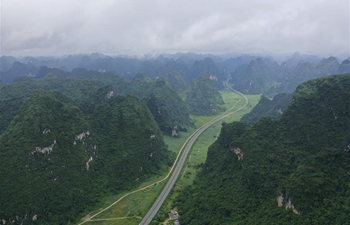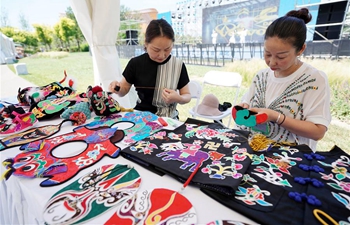

Aerial photo taken on June 14, 2019 shows the view of Shazhou Village in Rucheng County, central China's Hunan Province. Tens of thousands of people from across the country came to a small village in central China's Hunan Province last week looking for a quilt, to be exact, a halved one that is now no longer able to be found. The halved quilt was cut by three young female Red Army soldiers as a gift to Xu Jiexiu, a countrywoman who lived in Shazhou village with her husband and her one-year-old son in 1934. Fifty years later, a Chinese journalist retraced the 12,500-km Long March on foot and wrote the story of Xu and the halved quilt. Since then, it has become probably the most famous quilt in China, with books written about it and an exhibition hall telling its story built in Shazhou. A movie about it also began shooting last week. Every day, 81-year-old Zhu Zhongxiong, Xu's youngest son, would come back to his ancestral house in the village and unlock the doubt of visitors who wondered where the half quilt was. On a rainy winter night of 1934, Xu opened the door and let three young female Red Army soldiers in. She shared her 1.2-meter-wide bamboo bed with them. The three female soldiers took out the only cotton quilt they had and covered Xu, her child and themselves up. Before leaving, the three soldiers cut the quilt in half and left her half, telling her they would come back to visit after their victory with a brand new quilt. However, not long after, the KMT soldiers came back and searched the village after the Red Army left, and found the cut quilt in Xu's house and burned it. Xu never saw them again until she passed away in 1991. Xu always told her children and grandchildren that the Communist Party was a group of people who would cut the only quilt they had in half and give it to those in need. (Xinhua/Chen Zeguo)