



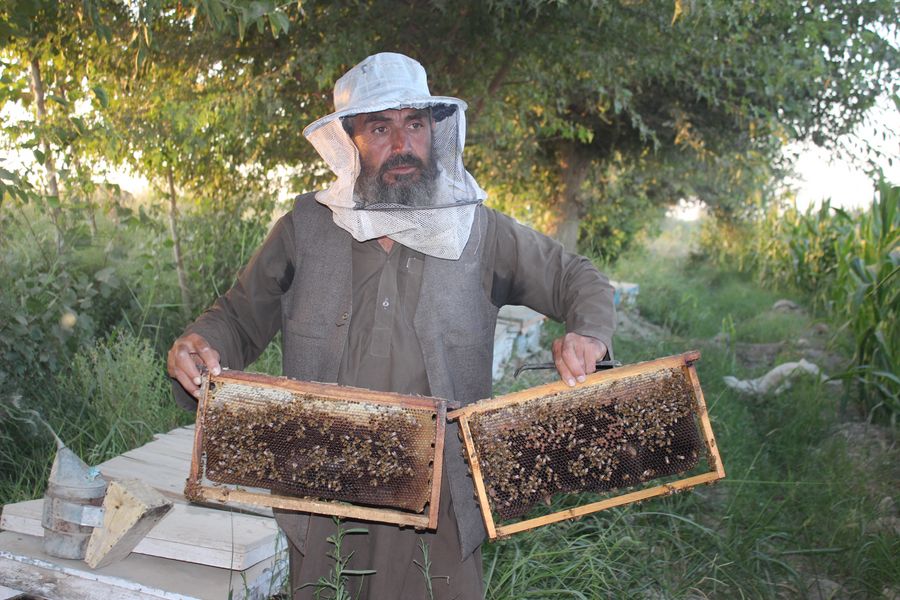
A worker works at a bee farm in Helmand province, Afghanistan, Aug. 19, 2019. (Xinhua/Abdul Aziz Safdari)
"The affordable beehives can be placed anywhere, troubling no one and yielding high returns, and most importantly, could be a good alternative to growing poppies for opium," said a farmer in southern Afghanistan's Helmand province.
by Chen Xin, Safdari
LASHKAR GAH, Afghanistan, Aug. 22 (Xinhua) -- "We want to change the image of Helmand from a poppy-growing province to a honey-producing province, and to make Helmand a sweet home for bees," Afghan farmer Abdul Khaliq told Xinhua recently.
Apiculture has become a common practice in some Afghan provinces, including southern Helmand province, where honey producers said over 16 metric tons of honey has been produced this year to date.
Khaliq, a busy apiculturist working on his own land, said beekeeping was a low-cost venture and very fruitful.
"The affordable beehives can be placed anywhere, troubling no one and yielding high returns, and most importantly, could be a good alternative to growing poppies for opium," he said.
"Helmand has been notorious for years for militancy and growing poppy plants for opium. Farmers must find ways to change the image of Helmand, including building bees farms, producing honey for themselves and for other people in their province as well," he added.
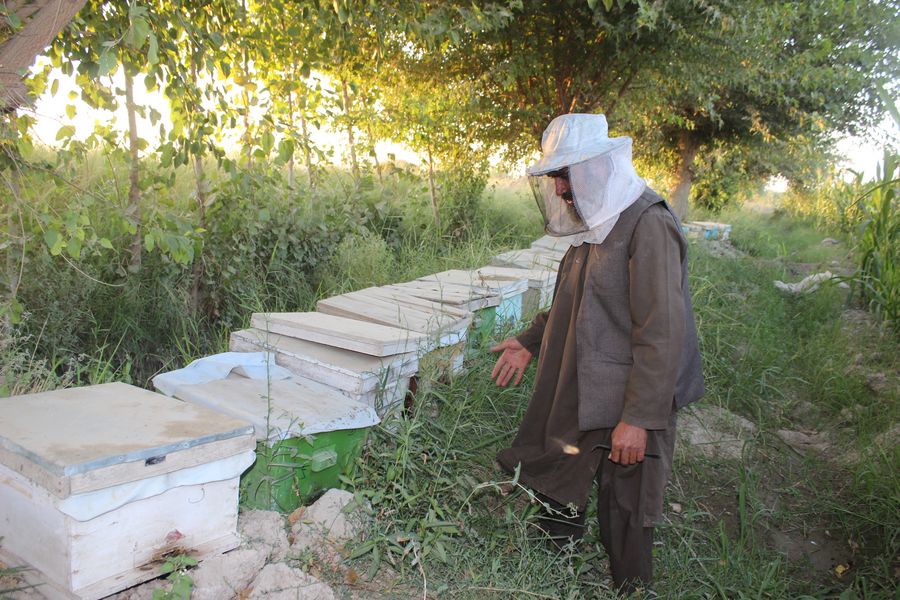
A worker works at a bee farm in Helmand province, Afghanistan, Aug. 19, 2019. (Xinhua/Abdul Aziz Safdari)
Since honey only has a limited market in Afghanistan, the produce is mostly exported to Pakistan and India. Meanwhile, farmers also sell honey at their farm gates to other households in the community or to the contractors coming from the provincial capital Lashkar Gah city and other provinces.
Hundreds of bee-keeping farms are now operating in the Helmand province, once a hotbed for Taliban hardliners and still a hub for poppy-based opium production in Afghanistan's southern zone.
"Around 400 bee-keeping farms have been created in the Helmand provincial capital city, Lashkar Gah, and nearby districts where over 16 tons of honey have been produced this year, a 10 percent increase compared to last year," Rafiullah Qalam, the planning and program officer of the Helmand agriculture department, told Xinhua.
Qalam added that Helmand honey was currently sold only in local markets and exported to neighboring countries, but efforts are being made to export it to international markets as well.
The Comprehensive Agriculture and Rural Development-Facility (CARD-F), one of the key agricultural and rural development programs, has created up to 150 farms, while the provincial agriculture department has built up to 200 beekeeping farms, with over 50 other farms being built since the beginning of this year, in the province, Qalam said.
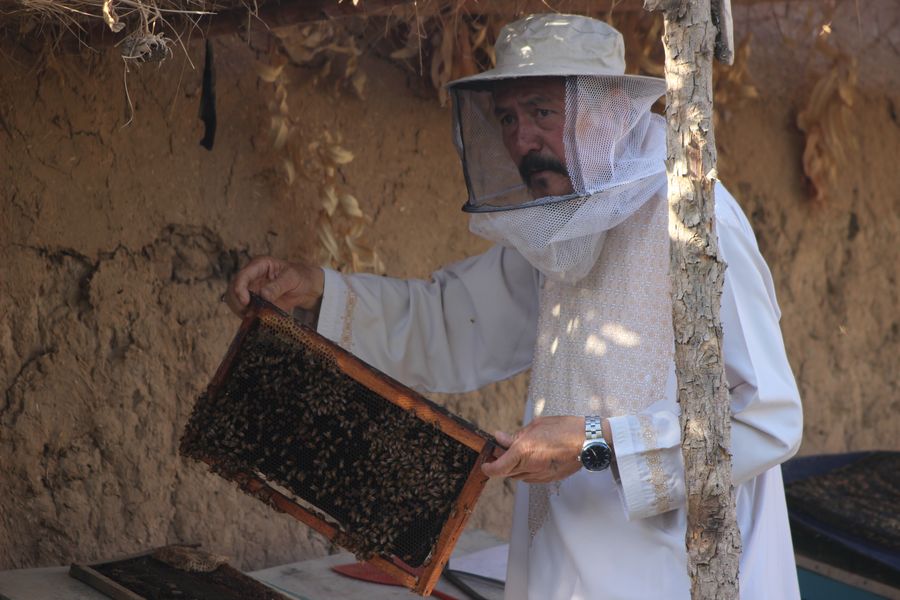
A worker collects honey at a bee farm in Helmand province, Afghanistan, Aug. 19, 2019. (Xinhua/Abdul Aziz Safdari)
Beekeepers in the province look delighted when they collect a high amount of honey. They say it's a good alternative to growing poppies, which has turned the province into the militants' activity center.
"We collect honey three or four times a year, but the market for the product is lacking and that is the reason we have to store it for one more year," Khaliq said.
Currently, one kilogram of good quality honey is sold for 500 afghani (around 6 U.S. dollars) in Helmand province.
Nematullah Hussaini, the head of the Helmand Beekeeping Union complained about a lack of wholesale and official honey markets in Lashkar Gah, where customers think they are buying fake honey.
"A wholesale center should be created locally and other provinces and the honey-sellers themselves should be given official work license," he said.
"Many farmers are currently busy with beekeeping and it is a good alternative to growing poppies," said Hussaini.
The Afghan Ministry of Agriculture, Irrigation and Livestock (MALI) recently reported that the country had the capacity of producing up to 11,000 tons of honey annually.
More than 214,000 bee boxes have currently been put out for collecting honey in 32 provinces of the country, according to the ministry.
