



Falling short of a joint communique, the G7 summit concluded with a one-page declaration to underline their "great unity" and the "positive spirit of the debates."
by Xinhua writers Tian Dongdong, Liu Fang, Ren Ke
BIARRITZ, France, Aug. 27 (Xinhua) -- When leaders at the summit of the Group of Seven (G7) traveled home on Monday after their three-day gathering in the French seaside resort of Biarritz, local wine producers' fears did not fade away.
They are "really worried" about possible U.S. tariffs on French wines, saying that they are relatively too small to pay for the burden.
Such worries mirror the collective concerns about "America First" policy inside G7. During the summit, leaders tried hard to narrow their differences on such issues as trade and the Iran nuclear deal, but in the end a lack of a joint communique made trans-Atlantic rift hard to hide.
"The atmosphere has clearly improved among G7 leaders compared to previous summits ... However, tensions and disagreements remain fundamentally present," Remi Bourgeot, a French economist, told Xinhua.
A journalist is silhouetted on a TV screen at the G7 summit press center in Biarritz, France, Aug. 25, 2019. (Xinhua/Gao Jing)
NO JOINT COMMUNIQUE
Falling short of a joint communique, the G7 summit concluded with a one-page declaration to underline their "great unity" and the "positive spirit of the debates."
"Such a short text implies that G7 members remain deeply divided," said Hua Xin, executive director of Center for European Studies at Shanghai International Studies University. "We can guess the hot discussion these leaders had to formulate these paragraphs."
Prior to the summit, French President Emmanuel Macron feared that a final joint communique with all G7 members would not be made.
"Coming into the summit, Macron was aware of the many unpredictable variables ... so it is most likely that simply in terms of addressing the media they have been saying it has been successful, despite overall not being as successful as they make it out to be," Ian Stanbury, compliance director of the G7 Research Group, told Xinhua on Monday.
"For the divisions amongst members, it would appear as though everything has been done in order to avoid those divisions during talks and especially during media briefings, in order to give the appearance of greater unity within the G7," Stanbury said.
"Examples of this are (U.S. President Donald) Trump not attending the climate meeting, and not commenting substantially when questioned about the invitation of Iran's foreign minister, as well as leaders putting aside their opinions regarding each other for the sake of reaching agreements," he added.
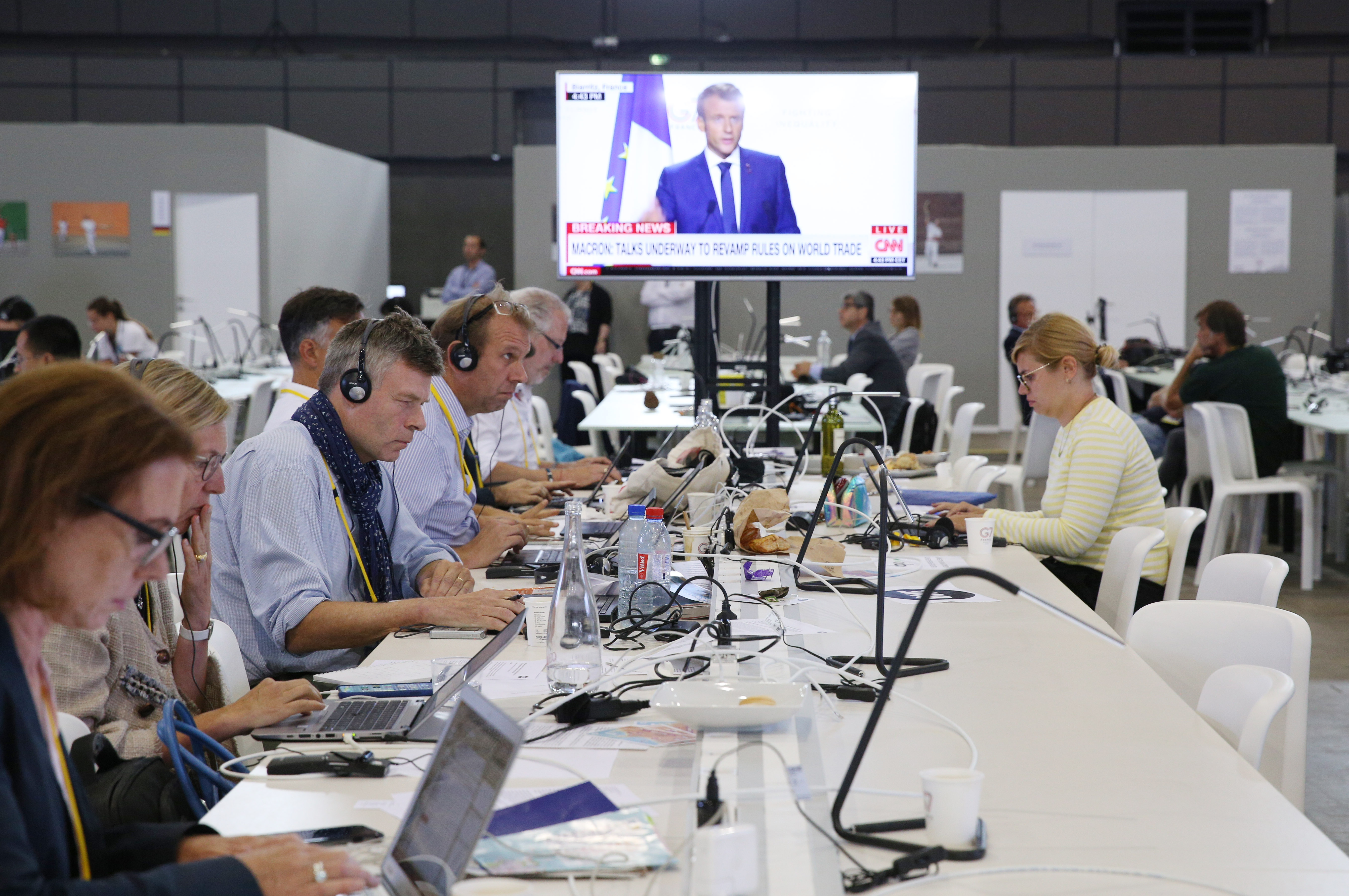
Journalists work at the G7 summit press center in Biarritz, France, Aug. 26, 2019. (Xinhua/Gao Jing)
TRADE WAR FEAR
Before the summit, a U.S.-French detente on digital tax and a Japan-U.S. trade deal were highly expected. However, for Trump and other G7 leaders, divisions on trade are hard to hide.
Digital tax has become a thorny issue between Washington and Paris recently. Back in May, France's upper house of the parliament gave greenlight to impose tax on internet giants. Trump threatened to add tariffs on French wines for retaliation.
On the joint concluding press conference Monday, Macron told reporters that he and Trump reached "an agreement to get out of trouble between us."
"We have found an agreement that is good on both sides, it can resolve very negative situations and modernize the international system," Macron said.
But minutes later, asked whether he could give up the threat to put sanctions against French wine, Trump sheered away by saying that "I can confirm (U.S.) First Lady Melania loves your wine."

A staff member pours wine for guests at the booth of Bordeaux wine at the G7 summit press center in Biarritz, France on Aug. 26, 2019. (Xinhua/Gao Jing)
A similar scenario appeared again shortly. When a Japanese reporter asked Trump whether he could rule out the possibility of U.S. tariffs on Japan's auto industry, he didn't give the confirmation either.
Upon his arrival at Biarritz, British Prime Minister Boris Johnson told reporters that he was "very concerned" about the trade conflict between the United States and China.
"This is not the way to proceed. Apart from anything else, those who support the tariffs are at risk of incurring the blame for the downturn in the global economy," he said.
One day later, he publicly told Trump that Britain is "in favor of trade peace on the whole" instead of a trade war.
"It (trade war) is certainly not a good thing for the world's economy, for the United States to suddenly now be engaging in quite aggressive protectionism," Tristen Naylor, a fellow in international relations at the London School of Economics and Political Science, told Xinhua.
"This is antithetical not just to what American economic policy has been historically, but indeed antithetical to one of the core purposes of the G7, a bloc that was set up in part to fight trade protectionism," Naylor said.
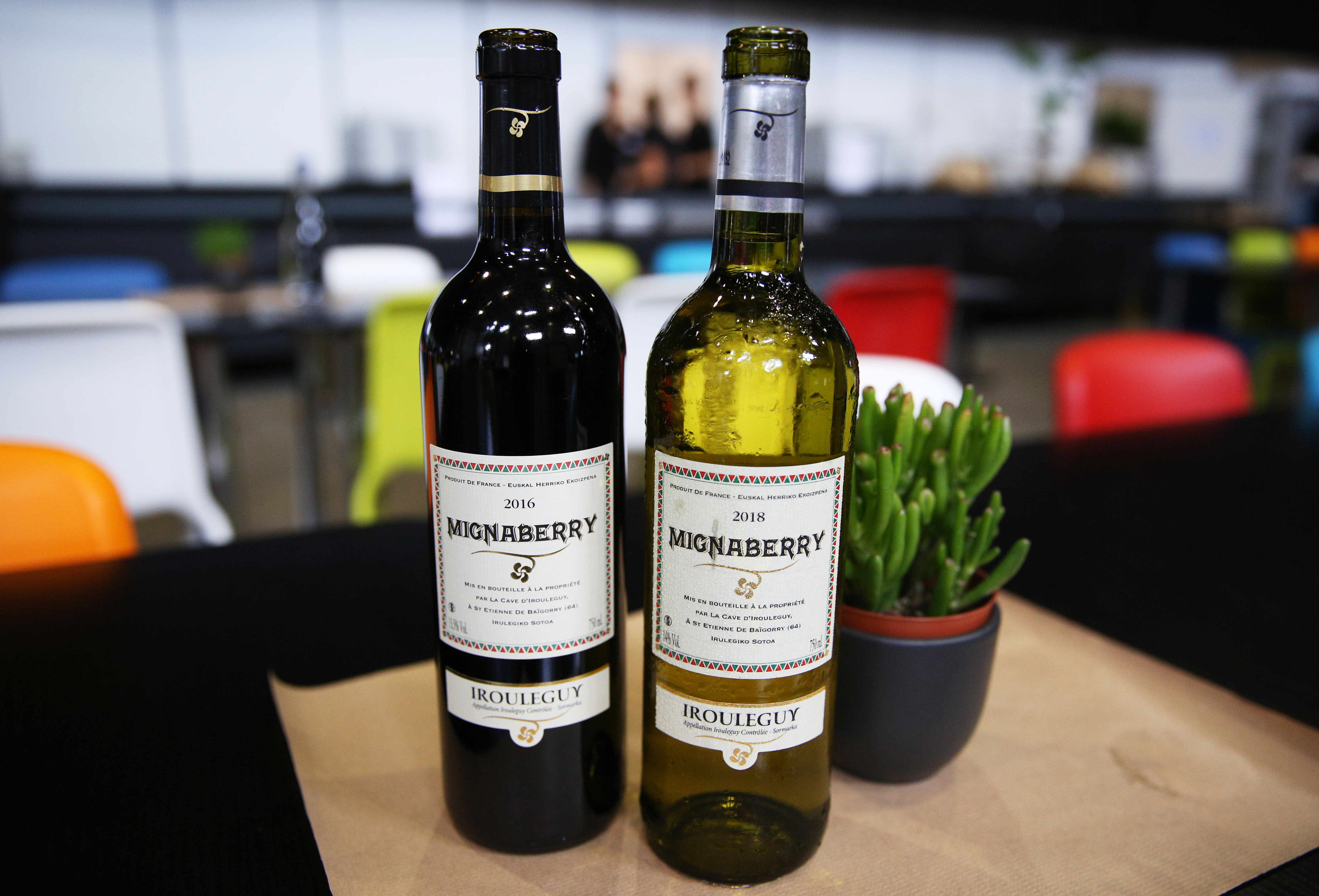
Photo taken on Aug. 26, 2019 shows two bottles of French wine at the G7 summit press center in Biarritz, France. (Xinhua/Gao Jing)
RIFT ON IRAN
On the Iran nuclear issue, disagreements among the G7 leaders had been crystal clear.
During a press conference after meeting with German Chancellor Angela Merkel on Monday, Trump said the G7 leaders had discussed Iran a lot and had agreed that the Islamic republic should not have nuclear weapon.
He said the G7 leaders showed great unity, and in terms of Iran, they had come to a conclusion more or less. However, Merkel told reporters that "it is still moving ... There is a long way to go."
During the joint concluding press conference with Macron, Trump said he was open to meet Iranian President Hassan Rouhani if the circumstances were right. However, he tagged Iran as "No.1 of nation of terror," denouncing the 2015 JCPOA agreement, or known as Iranian nuclear deal signed in 2015, as a "bad deal."
For his part, Macron told reporters that France remains as one of the signatories of the JCPOA, wants to see it alive and is setting up the Trump-Rouhani meeting as a role of the signatory.
"The U.S. administration's approach on Iran hasn't produced the expected results, as they didn't take into account the structure of Iran's political power and the country's unwillingness to back down on its regional influence," Bourgeot said.

Journalists work at the G7 summit press center in Biarritz, France, Aug. 26, 2019. (Xinhua/Gao Jing)
Meanwhile, the declaration of the summit said that "we fully share two goals: to ensure that Iran can never have nuclear weapon, and promote peace and stability in the region."
Hua said the text of the declaration does not necessarily mean that the United States and Europe have reached a consensus. "Iran issue will probably further develop and may trigger new conflicts across the Atlantic."
"I cannot see any concession that the Trump administration has made on the Iran issue, or its approval of Europe's stance. Rift between them remains wide," Hua added.
(Xinhua reporters Ying Qiang, Chen Chen, Xu Yongchun, Gao Jing, Han Qian and Yu Yue in Paris also contributed to the story.)
(Video reporters: Han Qian, Yu Yue, Liu Fang, Tian Dongdong, Ren Ke; Video editor: Yin Le)
