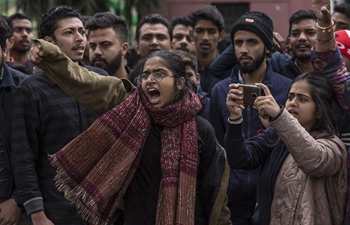
NEW DELHI, Dec. 17 (Xinhua) -- India's top court on Tuesday rejected to initiate a judicial probe into the police action inside two universities, Delhi's Jamia Millia Islamia (JMI) and Uttar Pradesh's Aligarh Muslim University (AMU), during protests against the controversial new Citizenship Amendment Act, officials said.
The court asked the petitioners to approach high courts in respective states, which can appoint committees for fact-finding.
"Regarding the nature of the dispute and the incidents that have occurred, we find it appropriate to appoint single committee in each state to collect the material for fact-finding and we, therefore, consider this appropriate to direct the petitioners to approach the high courts of jurisdiction of incidents said to have occurred," the Supreme Court said.
"We are confident that the Chief Justices of various high courts will call upon for inquiry if needed while appointing a committee including a former judge of the apex court or high court after hearing the union of India and respective states."
The petition was filed by lawyers Indira Jaising and Colin Gonsalves requesting the top court to look into the violence against students and send retired judges to the two universities to investigate what went down.
Chief Justice of India S A Bobde said on Monday that the "rioting" must stop and there should be peace.
On Sunday, protests over citizenship law took violent turn and policemen entered the campuses of AMU and JMI, firing tear smoke shells.
The policemen have been accused of entering the campuses without permission and using excessive force while dealing with the students at the two universities.
Last week, Indian parliament passed the controversial new citizenship law. The law aims at granting citizenship to illegal immigrants belonging to six religions -- Hinduism, Sikhism, Buddhism, Jainism, Parsi and Christianity -- from Bangladesh, Afghanistan and Pakistan. However, it has kept out Muslim immigrants from applying for citizenship.
Opposition parties and civil society members in India criticize the bill as contrary to secular principles enshrined in India's constitution as it excludes Muslims.
With this new law, the government would grant Indian citizenship to those non-Muslim immigrants who had entered the country illegally until December 31, 2014. People in the northeastern states fear granting of citizenship to immigrants would endanger their status.
The law triggered massive protests in northeast and West Bengal.
Students at various universities across country have also staged massive protests against the new law.