by Keren Setton
JERUSALEM, Dec. 19 (Xinhua) -- A Palestinian boycott on Israeli cattle recently ended after lasting three months, showing the failure of an unsuccessful attempt to pressure Israel to change its trade relations with the Palestinian Authority (PA).
The move, taken by Palestinian Prime Minister Mohammed Ishtaye, was more a political statement than an economical move.
"It was easier for Ishtaye to act in the economic sphere in matters that have a political character," said Bader Rock, a legal and economic policy adviser at the Tony Blair Institute for Global Change. "Essentially he said he wants to disconnect the Palestinian economy from Israel. This is not just an economic statement."
Starting in September 2019, the PA barred the import of calves from Israel. Palestinians buy 120,000 cattle heads annually from Israel. Meat is not a cheap commodity even without trade restrictions. As meat prices started further rising, the PA lifted the ban and allowed cattle from Israel back in.
The choice of using cattle as a battle ground for goading Israel was a mistake. For Palestinians to be self-reliant on cattle is an up-hill battle. In order to grow cattle, extensive land and access to an abundance of water are needed. Neither conditions exist in the PA, largely due to Israeli policies which control both access to land and water.
"There was no economic rationale behind the move," said Boaz Karni, from the Economic Cooperation Foundation, an Israeli think-tank. "The motivation is political and not un-justified. According to agreements, there is supposed to be free movement of goods between the sides, within certain limitations. On the ground, Israel allows for free export to the Palestinians, but not the contrary."
"Israel is not upholding the agreements, using various excuses," Karni told Xinhua.
Economic cooperation between the warring sides exists and is anchored by international agreements signed in the 1990's. The trade has had its ups-and-downs, vulnerable to the tensions between the sides.
The Palestinian economy is dependent on the Israeli economy, a stark reminder that separation between the two is an extremely complex mission.
Israel is the PA's largest trade partner. According to the Palestinian Central Bureau of Statistics, 90 percent of Palestinian imports go to Israel.
"Disengaging from the Israeli economy is a mistake," Rock told Xinhua. "Israel is a huge and rich market. The close proximity should be taken advantage of in order to increase export to Israel. The Palestinians should make sure they have other export markets and channels but one cannot do this by taunting the Israeli side which is stronger."
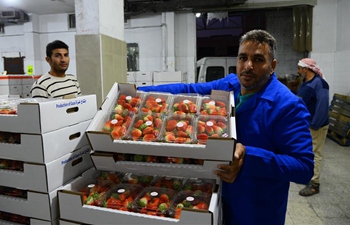
Palestinian agricultural produce is exported to Israel on a daily basis, but with great limitation. Israel also controls the movement of goods between the PA in the West Bank and the Hamas-controlled Gaza Strip.
There is an understanding in Israel that the prosperity of the Palestinian economy has a direct effect on Israel's security, but often this is not translated into policy.
"The quality of life of Palestinians needs to be improved in order for there to be an interest to keep them quiet and for the trade to continue. If trade is not facilitated by Israel, it is Israel's security interests that are hurt," Karni told Xinhua.
Approximately 70,000 Palestinian workers from the West Bank enter Israel on a daily basis, the majority of them working in construction. The money they make is a major engine for the Palestinian economy. It is estimated to inject the economy with millions of dollars annually and is part of the historical economic agreements the parties signed in Paris in 1994.
"To nullify the agreements with Israel would be a mistake," said Rock. "The reason the PA has not collapsed until now...is because of these workers that allow them to increase consumption."
"Upholding the agreements is a Palestinian interest," said Karni, "Israel is rich and it is beneficial to trade with them."
Employment is a major issue for Palestinians and a major stumbling block to their economic advancement. While in the West Bank, the unemployment rate is at an average of 15 percent. In the Gaza Strip almost half of the working age population are unemployed.
According to Rock, the PA should look inwards rather than making moves against Israel. "They (Palestinians) should focus on supporting the Palestinian manufacturer, and make better products, competitive ones, that can compete with Israeli products," he told Xinhua.
At the heart of the matter is the decades long struggle between Israelis and Palestinians. It is difficult to bring down any barrier without finding a solution to the political quandary.
"One cannot solve even the simplest of problems of the Palestinian economy, without solving the political issues. Security and economy are intertwined like a fiber that cannot be taken apart," said Rock.