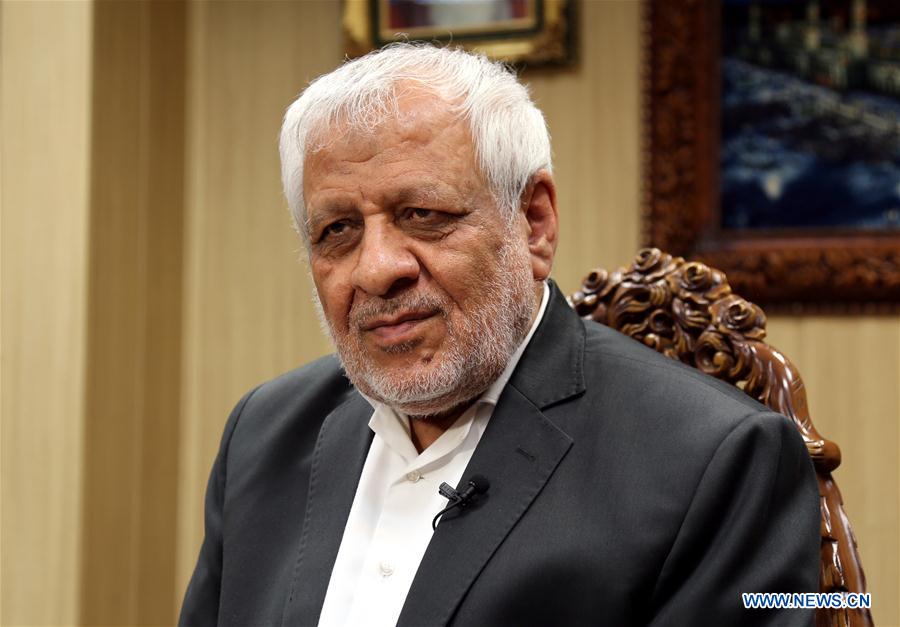
Asadollah Badamchian, secretary-general of Iran's Islamic Coalition Party (ICP), receives an interview with Xinhua in Tehran, Iran, June 15, 2019. Hegemony, which is playing a leading role in U.S. foreign policy, has brought serious challenges to world peace and stability, said Asadollah Badamchian. (Xinhua/Ma Xiao)
TEHRAN, June 17 (Xinhua) -- Hegemony, which is playing a leading role in U.S. foreign policy, has brought serious challenges to world peace and stability, said Asadollah Badamchian, secretary-general of Iran's Islamic Coalition Party (ICP).
Washington has adopted hegemony as its major policy to rule the world, which poses a main challenge to global peace and stability, Badamchian told Xinhua in a recent interview.
The current U.S. administration, with such hegemonic policy, is exacerbating conflicts around the world, said the official of the ICP, a conservative political party founded in 1963.
The United States has launched trade wars against many countries in the world, which reflects its "colonialism and the essence of imperialism," Badamchian said.
Besides, Washington's unilateral withdrawal from the Iran nuclear deal last year was also the result of a long-term hegemony of the U.S. government, he said.
The landmark Iranian nuclear deal, formally known as the Joint Comprehensive Plan of Action, is an agreement on the Iranian nuclear program reached on July 14, 2015, between Iran and the five permanent members of the United Nations Security Council -- Britain, China, France, Russia and the United States -- plus the European Union and Germany.
The White House announced in May last year its withdrawal from the nuclear deal, and soon imposed "the highest level" of economic sanctions on Iran.
The nuclear deal signed four years ago was designed to help achieve a favorable outcome for all parties. However, even back then, the United States had hoped that Iran would behave in a passive manner, Badamchian said.
Once Washington found that Iran stuck to the deal and did not give in, it unilaterally defaulted, he said.
The previous U.S. administration has failed to fulfill the nuclear deal and the current one's unilateral withdrawal from it is worse, he added.
The U.S. government does not care or take sanctions even if it finds that its allies have violated the principle of nuclear non-proliferation, Badamchian said.
However, the United States has not given up and will never give up sanctions on Iran even after Iran has signed and adhered to the nuclear deal, he said.
Considering this hegemonic act and the double standards of the U.S. government, "Iran will follow its own judgement and decisions that suit our national interests," he added.