SIRONKO, Uganda, Sept. 4 (Xinhua) -- Nature and man are in a love-hate relationship in the rugged Mount Elgon ranges in eastern Uganda.
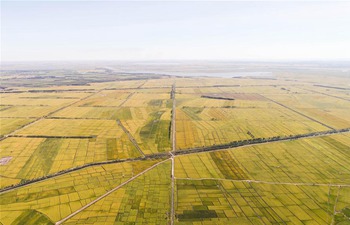
The vegetation covering the ranges dotted with big boulders and a series of water falls is what describes this area as the most fertile land in Uganda. The volcanic soils make a fertile ground for Arabica coffee, the east African country's major foreign exchange earner.
The ranges are the food basket of most of eastern Uganda and neighboring western Kenya. Produce is sometimes taken to as far as South Sudan.
In the last one month, nature here has not been friendly to man. It has spelt death.
As dark clouds gather over Namagoye village in Sironko district, residents use hands, hoes and shovels to remove debris where they believe their loved ones were buried in a landslide that occurred in the area about a week ago.
A week ago, the residents say it was a normal Sunday after the afternoon rain shower. A loud terrifying sound was heard, sending the villagers to scamper for life.
It was a landslide that sent hanging boulders tumbling down, destroying whatever stood in the way.
When all was calm, and a headcount done, 10 residents were missing and the only suspect was the landslide. Witness accounts and the retrieval of one body from the scene made the residents believe that the rest were buried by the landslide.
Deo Nabugodi lost two of his children who had gone to fetch water. As they walked to the water source, he followed them at a distance.
"When I heard the explosion, I ran for dear life but after a distance I remembered I had left the children behind," Nabugodi told Xinhua at the scene.
"I found one of their friends who told me that he had left them at the water point. A search only led me to an empty jerrycan crushed by a boulder," he said, noting that this led him to conclude that his children were dead.
The landslide occurred several days after another in the neighboring Bududa district displaced over 200 people, and left crops and houses destroyed. No human life was lost in that disaster.
Back in March 2010, the worst landslide so far recorded in the ranges left about 300 people dead in Bududa.
It is these dark moments that force the residents in these mount ranges to curse nature.
Environmental experts warn that the ranges have a 15km long crack. They argue that the worst is yet to happen if people are not resettled on safer ground.
But when all is calm and well, the villagers here argue that this is the best place to stay, after all it is their ancestral land. They say whatever is planted in the soils here never fails to grow and it grows in abundance.
"This is where we were born. The government tried to relocate some people but they still came back to their land because it is fertile. They have their crops here," Eunice Nandudu, a local leader told Xinhua.
Mary Kitutu, the State Minister for the Environment, acknowledged that the land is best suited for agriculture, which is the main stay for the locals. She however noted that the locals have to be moved to a safer place since the ranges have turned into a death trap.
She said the government has already got a relocation plan and urged the local leaders not to stop people from moving to a safer place.
At the foothill of the ranges, food markets are flourishing as trucks line up to pick agricultural produce from the mountains. Traders take the produce to markets in northwestern Uganda, South Sudan, and western Kenya.